Showing posts with label Canada. Show all posts

Canada Releases Tamiflu From National Emergency Stockpile

image

Healthmap Flu Near You – Jan 8th, 2013


# 6836


It’s no secret that influenza is spreading rapidly across North America.  The latest Flu Near You map (above) shows that both the United States and Canada are feeling the effects of this year’s epidemic.


In recent days there have been scattered media  reports of localized, temporary shortages of Tamiflu ® (Oseltamivir). Obviously this is of considerable concern to those who – due to the severity of their illness, or pre-existing conditions – have been prescribed the medication.


Today the PHAC has announced the `exceptional action’ of  releasing  some of Canada’s National Emergency Stockpile of Tamiflu, in order to help relieve some of these shortages.

January 8, 2013
For immediate release

Government of Canada to address temporary shortage of flu drug oseltamivir (Tamiflu)

Tamiflu is a drug used to treat the flu; it is not a vaccine.

OTTAWA – The Government of Canada is working with Roche Canada and the provincial and territorial health authorities to address a potential temporary shortage of the antiviral flu drug oseltamivir (Tamiflu).


The Public Health Agency of Canada and Health Canada are arranging to immediately release a supply of the drug Tamiflu from the Agency’s National Emergency Stockpile System to the manufacturer for distribution to where it is needed across Canada. This exceptional action will be taken to ensure Tamiflu remains available to those Canadians who need it until the manufacturer replenishes its supply with a new shipment expected in February.


The Public Health Agency of Canada and Health Canada will continue to work with the manufacturer and with provincial and territorial health authorities to help ensure the demand for antiviral drugs continues to be met this flu season.


Tamiflu is an antiviral medication that is primarily used for the early treatment of individuals infected with the influenza virus – particularly those at high risk of complications due to influenza, such as the elderly, young children, individuals with other medical conditions or pregnant women. Tamiflu can also be prescribed to help reduce the chance of getting the flu following close contact with an infected individual. Tamiflu should not be confused with the seasonal influenza vaccine (flu shot), which remains the best protection against the influenza virus.

The Public Health Agency of Canada is seeing an early spike in flu cases and more severe illness caused by the flu than was seen in the last two years. This year, the flu shot matches the circulating influenza strains very well and therefore offers excellent protection from the virus. Canadians are reminded to get the flu shot to protect themselves and their loved ones. It is not too late to get the flu shot.

It is also important to take the following steps to protect yourself and your family from infection during flu season:

  • Wash your hands often with soap and warm water for at least 20 seconds, or use hand sanitizer if soap and water are not available.
  • Cough and sneeze into your arm, not your hand.  If you use a tissue, dispose of it as soon as possible and wash your hands.
  • Keep doing what you normally do, but if you get sick, stay home.
  • Keep your hands away from your face.
  • Keep common surface areas – for example, doorknobs, light switches, telephones and keyboards – clean and disinfected.
  • Eat healthy foods and stay physically active to keep your immune system strong.

Learn more by getting a copy of Fight Flu: Your Seasonal Flu Guide by contacting
1 800 O-Canada or visiting
www.fightflu.ca.


UPDATED: 1500 hrs EST


Shortly after I posted this blog, the following report was released by CTVNews.ca.


Emergency supply of Tamiflu released amid shortage

CTVNews.ca Staff
Published Tuesday, Jan. 8, 2013 2:40PM EST

The federal government is acknowledging what some doctors have been saying for some time: the country has a shortage of Tamiflu, an antiviral medication often given to those with severe cases of the flu.


The Public Health Agency of Canada and Health Canada announced Tuesday they are arranging to immediately release a supply of the drug from the country’s National Emergency Stockpile System.


Read more: http://www.ctvnews.ca/health/emergency-supply-of-tamiflu-released-amid-shortage-1.1105596#ixzz2HPquTXHn

»» Read More

Canada: FluWatch Week 52

image

Map of overall Influenza activity level by province and territory, Canada, Week 5

# 6826

Like the United States, Canada is reporting increasing levels of influenza across much of their nation, prompting recent headlines such as:

Flu outbreak crowding Canadian emergency rooms

Flu season hitting British Columbians earlier
 
Flu blamed for spike in Calgary emergency room visits
Flu cases nearly triple in Windsor
Flu prompts visitor restrictions at St. John's nursing home

The latest FluWatch report from PHAC combines data from weeks 51 & 52.

Overall Influenza Summary

  • Influenza activity in Canada continues to rise with increases in all indicators in weeks 51 and 52
  • A total of 4632 laboratory detections of influenza were reported, of which 97.7% were for influenza A viruses, predominantly A(H3N2)
  • 127 new influenza outbreaks were reported, 87 of which were in long-term care facilities
  • 114 new paediatric influenza-associated hospitalizations were reported through the IMPACT network, and 176 hospitalizations including 15 deaths among adults ≥20 years of age were reported through Aggregate surveillance
  • The ILI consultation rate increased, but remains within the expected range for this time of year.
  • Similar to previous years, older adults (persons aged ≥65 years) are the most affected this season; with 41.3% of laboratory detections to date, increased outbreaks in long-term care facilities, higher hospitalization rates and a high proportion of antiviral prescriptions among those  ≥75 years.


As the following chart indicates, influenza detections are on the ascendant, and to a lesser extent, so are RSV (Respiratory Syncytial Virus) cases. Rhinovirus, coronavirus, parainfluenza, and metapneumovirus detections – in contrast -  are on the decline.


image


A breakdown of influenza strains identified this year suggest that most are similar to the strains included in this year’s vaccine. That said, we won’t really know how effective this year’s vaccine has been until after the season is over.


Influenza strain characterizations

During the 2012-13 season, the National Microbiology Laboratory (NML) has antigenically characterized 177 influenza viruses [136 A(H3N2), 17 A(H1N1)pdm09 , and 24 influenza B].


The 136 influenza A(H3N2) viruses were antigenically similar to the vaccine strain A/Victoria/361/2011.


The 17 A(H1N1)pdm09  viruses were antigenically similar to the vaccine strain A/California/07/09. Among the influenza B viruses, 20 were antigenically similar to the vaccine strain B/Wisconsin/01/2010 (Yamagata lineage) and four were similar to B/Brisbane/60/2008 (Victoria lineage; component of the 2011-2012 seasonal influenza vaccine) (Figure 6).

image

Figure 6. Influenza strain characterizations, Canada, 2012-2013, N = 177


Note:The recommended components for the 2012-2013 Northern Hemisphere influenza vaccine include: an A/Victoria/361/2011 (H3N2)-like virus; an A/California/7/2009 (H1N1)pdm09-like virus; and a B/Wisconsin/1/2010-like virus.


For more detailed information on the flu, and what Canadians can do to protect themselves, Public Health Canada maintains a specialized influenza website called  FightFlu.ca.


image

»» Read More

Canada: Another West Coast Temblor


image 

Credit Natural Resources Canada


# 7703

Overnight a 6.3 magnitude quake rocked the waters off British Columbia, the third 6+ magnitude quake to strike off Canada’s west coast in the last 10 days.


The first two, a 7.8  followed by a 6.3 aftershock, struck hundreds of kilometers further north on October 28th and for a time prompted a Tsunami advisory for Hawaii.

image


Given the size and location of last night’s quake, little or no damage is expected, except perhaps to the nerves of those who live along the shores facing the Cascadia fault line.


 image


Recent warnings from the University of Oregon (see Shaken, And Hopefully Stirred) suggest the region is overdue for a major earthquake; one that could conceivably match the power of last year’s Great Northern Japan Quake.


Last March, in Tsunami: The Other Coastal Threat, we looked at the United State’s preparedness for both east and west coast tsunamis. While truly destructive tsunamis on American and Canadian shores are rare, they have happened in the past.


Hawaii and the west coast are considered at greatest risk due to the seismically active `ring of fire’.  


image

Credit USGS 


Perhaps the most vulnerable region is the Pacific Northwest, where the Cascadia fault line (see Just A Matter Of Time) is believed to have produced tsunamis in the past that rival the tidal waves that struck Japan last year.


No one knows when the next major quake will strike in this region, it could be today, or it could be fifty years from now.


When it does happen, it could seriously impact all of the Pacific Northwest, including British Columbia, Washington State, Oregon, California, and through tsunamis, many distant areas in the pacific basin.


The only defense with earthquakes is a good offence; being prepared. Which is why British Columbia, Washington State, Oregon, and California (along with other states and nations) recently conducted a Shakeout Drill.


image


To learn how to participate in your area’s next Shakeout drill, go to shakeout.org. But since the `big one’ might not wait until after next year’s exercise, now is the time to prepare.


Natural Resources Canada has a webpage with information on earthquake safety and preparedness.


Preparing for Earthquakes


And in the United States you can find earthquake information at Ready.gov’s Earthquake page.


Earthquakes


And finally, a few of my preparedness blogs you might wish to revisit:


When 72 Hours Isn’t Enough

In An Emergency, Who Has Your Back?

An Appropriate Level Of Preparedness

The Gift Of Preparedness 2011


Because no matter where you live, its just a matter of time before the next disaster strikes.

»» Read More

Haida Gwaii Quake & Tsunami Advisories

image

Credit USGS


# 6672


Overnight, while I was offline, a 7.7 quake struck the sparsely populated Haida Gwaii region, or Queen Charlotte Islands, on the northern coast of British Columbia. 


There are no reports, as yet, on injuries or damages.  Since the initial quake, there have been dozens of aftershocks, some as strong as 5.1.


Crawford Kilian, over at Crofsblog, lives south of there on Vancouver Island, and has blogged a number of times on the quake including here, here, and here.


Although a minor tsunami was apparently generated, the Pacific Tsunami Warning Center has recently downgraded the earlier alerts for Hawaii with the following advisory.


TSUNAMI MESSAGE NUMBER  10


NWS PACIFIC TSUNAMI WARNING CENTER EWA BEACH HI
101 AM HST SUN OCT 28 2012

TO - CIVIL DEFENSE IN THE STATE OF HAWAII

SUBJECT - TSUNAMI ADVISORY

THE TSUNAMI WARNING IS NOW CANCELLED FOR THE STATE OF HAWAII.

A TSUNAMI ADVISORY IS ISSUED FOR THE STATE OF HAWAII EFFECTIVE


AT 1254 AM HST.

AN EARTHQUAKE HAS OCCURRED WITH THESE PRELIMINARY PARAMETERS

   ORIGIN TIME - 0504 PM HST 27 OCT 2012
   COORDINATES - 52.8 NORTH  131.8 WEST
   LOCATION    - QUEEN CHARLOTTE ISLANDS REGION

   MAGNITUDE   - 7.7  MOMENT

EVALUATION

BASED ON ALL AVAILABLE DATA THE TSUNAMI THREAT HAS DECREASED AND IS NOW AT THE ADVISORY LEVEL AND NOT EXPECTED TO INCREASE. SEA  LEVEL CHANGES AND STRONG CURRENTS MAY STILL OCCUR ALONG ALL COASTS  THAT COULD BE A HAZARD TO SWIMMERS AND BOATERS AS WELL AS TO PERSONS  NEAR THE SHORE AT BEACHES AND IN HARBORS AND MARINAS. THE THREAT  MAY CONTINUE FOR SEVERAL HOURS. MESSAGES WILL BE ISSUED HOURLY OR SOONER AS CONDITIONS WARRANT.


During the summer of 2011 I wrote extensively on Canada & the United State’s west coast earthquake and tsunami threat in a blog called Just A Matter Of Time.


The location of this quake, well north of the populated centers of Vancouver and Washington state, greatly diminished its impact. 


The next time, we may not be so lucky.


Which is why, 10 days ago, more than a half million residents of British Columbia took part in The Great British Columbia Shakeout drill.


image


They, along with a dozen other regions around the world, practiced Drop, Cover, and Hold On! as part of this yearly event (see NPM12: A Whole Lotta Shakeouts Going On).

image


A destructive quake somewhere along the Pacific Northwest coast is, as I said earlier, just a matter of time. We can’t predict when, and we certainly can’t stop it from happening.


Leaving being ready for it as the only logical recourse.


For a comprehensive guide on how you can prepare for `the big one’ (even if you live someplace other than Los Angeles), I would recommend you download, read, and implement the advice provided by the The L. A. County Emergency Survival Guide.

image


Everyone should have a disaster plan.  Everyone should have a good first aid kit, a `bug-out bag’, and sufficient emergency supplies to last a bare minimum of 72 hours.


For more on  disaster preparedness, I would invite you to visit:


When 72 Hours Isn’t Enough

The L. A. County Emergency Survival Guide

An Appropriate Level Of Preparedness

»» Read More

Novartis Fluad And Agriflu Vaccines Suspended In Canada

image


# 6670


Over the past several days Italy, Germany, France, and Switzerland have all temporarily suspended the use of two Novartis seasonal flu vaccines (Fluad & Agriflu) due to reports of `clumping of proteins’ observed in one batch produced at their facility in Italy.


Both flu shots are distributed in single-dose, thimerosal free, pre-loaded syringes.


Fluad, an adjuvanted vaccine, is not marketed in the United States. Agriflu is listed on the CDC’s Flu Vaccine Supply for the U.S. 2012-2013 as being approved for sale in the U.S..


Yesterday Canada announced that they would join with a number of other European nations in suspending the use of these two vaccines until a proper safety review could be completed.  


Here is the Health Canada statement.


Novartis Suspends Distribution of Seasonal Flu Vaccines Agriflu and Fluad in Canada as a Precaution

Information Update
2012-162
October 26, 2012
For immediate release

OTTAWA - Health Canada would like to provide further information to Canadians about its assessment of the voluntary suspension of use in Europe of the seasonal flu vaccines Agriflu and Fluad.


Agriflu and Fluad are two of the seasonal flu vaccines produced by Novartis that have been pulled from use in several European countries pending further examination of white floating material discovered clumping in the vaccines.


Health Canada rigorously reviewed Agriflu and Fluad for safety and effectiveness before it was authorized for use in Canada.


Clumping of the kind noted in Europe is common in vaccines. Health Canada has previously seen such particles before in other vaccines and has observed no impact on their safety or effectiveness. The Public Health Agency of Canada monitors for adverse events following immunization. To date it has received no reports of serious or unexpected adverse events related to these vaccines.


As a precautionary step, Health Canada asked Novartis to suspend distribution of the vaccines in Canada until a full review of the situation is completed. Novartis has agreed. The Public Health Agency of Canada is also recommending that health care professionals in possession of these vaccines refrain from using them until the review is complete.


The Public Health Agency of Canada and Health Canada will continue to work with the company to monitor the safety and effectiveness of the vaccine used here in Canada. Should a safety concern be identified, immediate and appropriate action will be taken.


Novartis reports that well over a million shots have already been administered in Europe, with no signs of increased adverse effects.  


This statement appeared on their website yesterday.


October 26, 2012

To date, data from the ongoing seasonal vaccination campaign have shown no unexpected adverse events.


Novartis is confident in the safety and efficacy of its seasonal influenza vaccines Agrippal® and Fluad® manufactured in Italy. Patient safety is of the highest priority to Novartis. Novartis internal assessments and the clinical data gathered during the 2012-2013 seasonal influenza studies required for European licensure of Agrippal and Fluad demonstrate a safety and immunogenicity profile similar to that of prior years.


The protein aggregates observed in the one batch that led to precautionary measures in some markets can occur in the normal vaccine manufacturing process and have no impact on the safety or efficacy of the vaccines.


The company is proactively engaging with local health authorities to answer remaining open questions and is fully committed to providing high quality vaccines to patients.


For more on this story we turn to Helen Branswell of The Canadian Press, who has the following report.


Canada suspends dispersal of Novartis flu shots following similar move in Europe

Helen Branswell,  Friday, October 26, 2012 9:21 PM


Given that we’ve seen this sort of protein clumping in the past with no ill effect, these suspensions may eventually be lifted. 


But given the nightmare surrounding contaminated steroid injections in the United States in recent months – a proactive stance by public health officials – even if there is only a hint of a problem, is not unreasonable.

»» Read More

Ontario Confirms H1N1v Case


image

Credit Wikipedia


# 6779


While details are somewhat scant this morning, the Province of Ontario, Canada has announced that they have detected a single of case of H1N1v flu infection in a person who had contact with pigs.


First the press release, then I’ll return with a bit more:


Case of Influenza A H1N1 Variant Detected in Ontario

September 25, 2012 8:00 AM

Today, Dr. Arlene King, Ontario's Chief Medical Officer of Health, issued the following statement on a case of influenza A H1N1 variant detected in Ontario:


"An Ontario resident has been confirmed as having been infected with an H1N1 variant (H1N1v) influenza virus. An influenza virus that normally circulates in animals is referred to as a variant virus when it infects humans.


This adult male patient became ill after close contact with pigs. He is being treated and closely monitored in a hospital in southwestern Ontario.


I would like to reassure Ontarians that this variant influenza virus rarely spreads from animals to humans. Subsequent human-to-human transmission is also rare. I would also like to stress that this is not a food safety issue; the consumption of properly cooked pork continues to be safe.  Proper cooking of meats, including pork, kills all bacteria and viruses.


Ontarians should remember that hand washing is the single best infection prevention and control measure against respiratory illnesses such as influenza. Individuals should wash their hands often with soap and running water, or use an alcohol-based hand rub if soap and water are not available.


I also would like to remind Ontarians that it is important to get immunized every year with the seasonal flu vaccine when it becomes available each fall. This will protect you against seasonal influenza viruses that are expected to circulate. Everyone six months of age and older should get the seasonal flu vaccine each year.


The identification of this case is the result of the strength of our current surveillance system here in Ontario. It is not an unexpected occurrence and there have been a number of human infections with variant influenza viruses in the United States over the past year.


I would like to thank health officials in Ontario who displayed the utmost vigilance in identifying, treating and closely investigating this case. Protecting the health of Ontarians is a priority and we will continue to monitor the situation."


H1N1v is one of the `viral contenders’ I wrote about several weeks ago in An Increasingly Complex Flu Field, and until just over a year ago, was the most commonly reported variant swine flu virus detected in humans since 2005.


In the past twelve months, it has primarily been the H3N2v flu virus that we’ve seen jumping from pigs to humans (300+ cases).  But 2 weeks ago, we saw a single case of H1N1v was reported out of Missouri (see The Return Of H1N1v).


This was only the second H1N1v case reported in a year, and it was also the second time that the H1N1v virus had been found to carry the M (matrix) gene from the 2009 H1N1 pandemic virus. 


This M gene  has been showing up regularly in swine variant viruses (H1N1v, H1N2v, H3N2v) for more than a year. The CDC has previously stated that `This M gene may confer increased transmissibility to and among humans, compared to other variant influenza viruses.’


A couple of cases of H1N1v, hundreds of miles apart, while of concern  .  .  .  does not a pandemic make. 


But this is further evidence that these variant viruses (H1N1v, H1N2v, H3N2v) continue to evolve, and spread widely in swine, and on occasion manage to make the jump to humans.


The concern is that over time one of these viruses may become a more human adapted virus, and begin to spread more easily among the population.


So we watch reports such as this with more than a little bit of interest.


For more on the flu risks from swine reassortments, I  heartily recommend Helen Branswell’s terrific piece in SciAm  from late 2010 called Flu Factories.

Flu Factories

The next pandemic virus may be circulating on U.S. pig farms, but health officials are struggling to see past the front gate

By Helen Branswell  | December 27, 2010 |


And for some of my earlier looks at swine influenza, you may wish to revisit:


H3N2v: When Pigs Flu

You Say You Want An Evolution?

The (Swine) Influenza Reassortment Puzzle

»» Read More

EID Journal: Revisiting The `Canadian Problem’


image

Photo Credit PHIL

# 6267


In September of 2009, just as the second wave of the H1N1 pandemic was ramping up, news of an unpublished study began to surface in Canada that suggested that those who had received a seasonal flu shot the previous year were more susceptible to the new pandemic virus than those who hadn’t.


Helen Branswell, science and medical reporter for the Canadian Press, was among the first to report on it (see Branswell On The Canadian Flu Shot Controversy).


This bombshell – which began to be known as `the Canadian problem’, sent shockwaves through public health agencies, many of whom were just days away from starting up their seasonal flu vaccination campaigns as they waited for the arrival of the H1N1 pandemic vaccine expected later in the fall.


Suddenly, there was genuine concern that with a pandemic virus on the way, that rolling out the seasonal vaccine might be the wrong thing to do.


The CDC and the World Health Organization both scrambled to look at their available data, and stated that they could find no correlation between the seasonal vaccine and susceptibility to the pandemic flu . . . but that they would continue to look.


Meanwhile, with concerns rising, a number of Canadian Provinces halted or announced delays in their seasonal flu shot campaign, even though the study had yet to be published (see Ontario Adjusts Vaccination Plan).


October saw a number of new reports and studies that failed to corroborate the (still unpublished) findings, including a study published in the BMJ (British Medical Journal) that suggested exactly the opposite - that getting the seasonal flu vaccination may be slightly protective against the swine flu  (see When Studies Collide).


By November, with no compelling corroboration of the `Canadian Problem’, Canada’s National Advisory Committee on Immunization (NACI) came out in favor of resuming seasonal flu jabs (see NACI: Canada Should Resume Seasonal Flu Vaccinations).


The controversy wasn’t over, however.


In April of 2010 these Canadian studies were finally published by PLoS Medicine. Writing for CIDRAP, Maryn McKenna   detailed their findings.


New Canadian studies suggest seasonal flu shot increased H1N1 risk

Maryn McKenna * Contributing Writer

Apr 6, 2010 (CIDRAP News) – Despite a rapidly launched range of studies, investigators in Canada are still unable to say—or to rule out—whether receiving a seasonal flu vaccination in the 2008-09 season made it more likely that Canadians would become ill from 2009 pandemic H1N1 flu.

(Continue . . .)


Other studies, however, failed to show any correlation, leaving us with a bit of a mystery on our hands. 


Fast forward to today and we’ve another study that appears ahead of print in May’s edition of the CDC’s EID Journal that looks at this supposed link, and once again, finds no evidence to support it.


Volume 18, Number 5—May 2012
Research

No Association between 2008–09 Influenza Vaccine and Influenza A(H1N1)pdm09 Virus Infection, Manitoba, Canada, 2009

Salaheddin M. Mahmud , Paul Van Caeseele, Gregory Hammond, Carol Kurbis, Tim Hilderman, and Lawrence Elliott

Abstract

We conducted a population-based study in Manitoba, Canada, to investigate whether use of inactivated trivalent influenza vaccine (TIV) during the 2008–09 influenza season was associated with subsequent infection with influenza A(H1N1)pdm09 virus during the first wave of the 2009 pandemic.


Data were obtained from a provincewide population-based immunization registry and laboratory-based influenza surveillance system.


The test-negative case–control study included 831 case-patients with confirmed influenza A(H1N1)pdm09 virus infection and 2,479 controls, participants with test results negative for influenza A and B viruses. For the association of TIV receipt with influenza A(H1N1)pdm09 virus infection, the fully adjusted odds ratio was 1.0 (95% CI 0.7–1.4). Among case-patients, receipt of 2008–09 TIV was associated with a statistically nonsignificant 49% reduction in risk for hospitalization.


In agreement with study findings outside Canada, our study in Manitoba indicates that the 2008–09 TIV neither increased nor decreased the risk for infection with influenza A(H1N1)pdm09 virus.


While the bulk of studies have shown no causal link between receipt of the seasonal vaccine and contracting the 2009 H1N1 virus, the results have not been 100% in alignment.


Leaving us with a bit of a mystery.  Why should some Canadian studies differ from those done elsewhere?


One fascinating hypothesis that might explain these disparate findings was proffered back in 2010 in the journal Eurosurveillance.


The authors suggested that infection by any influenza (or perhaps, any I-L-I) ramps up the body’s immune system for a time, making that person temporarily less susceptible to infection by another respiratory virus.


Since the pandemic arrived on the heels of the flu season in the northern hemisphere, those who received flu shot in the fall and thereby avoided illness might have been more likely to catch the pandemic strain than someone who had endured a bout of flu (and thereby acquired temporary generic immunity) over the winter.


You’ll want to read the entire paper, but I’ve included excerpts (reparagraphed for readability) from the abstract below.


Eurosurveillance, Volume 15, Issue 47, 25 November 2010

Perspectives

Seasonal influenza vaccination and the risk of infection with pandemic influenza: a possible illustration of non-specific temporary immunity following infection

H Kelly , S Barry, K Laurie, G Mercer

ABSTRACT (Excerpts)

We found no evidence that seasonal influenza vaccine increased the risk of, or provided protection against, infection with the pandemic virus.


Ferret experiments have suggested protection against pandemic influenza A(H1N1) 2009 from multiple prior seasonal influenza infections but not from prior seasonal vaccination.Modelling studies suggest that influenza infection leads to heterosubtypic temporary immunity which is initially almost complete.


We suggest these observations together can explain the apparent discrepant findings in Canada and Victoria. In Victoria there was no recent prior circulation of seasonal influenza and thus no temporary immunity to pandemic influenza. There was no association of seasonal influenza vaccine with pandemic influenza infection.


In Canada seasonal influenza preceded circulation of the pandemic virus. An unvaccinated proportion of the population developed temporary immunity to pandemic influenza from seasonal infection but a proportion of vaccinated members of the population did not get seasonal infection and hence did not develop temporary immunity to pandemic influenza.


It may therefore have appeared as if seasonal vaccination increased the risk of infection with pandemic influenza A(H1N1) virus.


It’s an attractive theory, and it has been suggested that this form of temporary immunity might even help explain why influenza pandemics tend to come in waves.


But it’s just a theory.


While results from today’s EID study match well with most of those in the literature, the authors warn that:


Additional epidemiologic and experimental investigations are needed to clarify the relationship between TIV use and infection with the pandemic strain.


Good science takes time.


And that means that while the evidence is currently lopsided against there being a link, more research will be needed before the `Canadian Problem’ can be fully and truly resolved.

»» Read More

Alberta, Canada Issues Measles Alert


# 5779


Alberta Health Services issued a public alert yesterday after a passenger who flew from Vancouver International Airport (YVR) to Edmonton International Airport (EIA) back on August 15th was determined to have been infected with measles.


Media reports indicate that the patient was an  Edmontonian – believed to be unvaccinated - who had recently returned from a trip to Asia.


The plane carried roughly 100 passengers, and others may have been exposed at the airport terminals.  Alberta Health Services is asking anyone who may have been in on those flights to contact them immediately.


Confirmed measles case prompts public alert

August 23, 2011

EDMONTON – Alberta Health Services has confirmed a case of measles in the Edmonton area and is following up with individuals who may have been in close contact with the ill person. The case of measles occurred in an Albertan who recently travelled outside Canada.


The following groups may have been exposed to the ill person and are asked to contact Health Link Alberta as soon as possible:

  • Any passengers on Air Canada flight AC244 on Monday, August 15, 2011, which departed Vancouver International Airport (YVR) at 4:30 p.m. and arrived at Edmonton International Airport (EIA) at 6:53 p.m.
  • Anyone in the Edmonton International Airport Air Canada baggage claim area on Monday, August 15, 2011, from 7 p.m. until 9:30 p.m.

Measles is an extremely contagious respiratory disease caused by a virus. Measles causes fever, runny nose, cough and a rash all over the body. The rash typically begins behind the ears and on the face, spreading down to the body, and finally to the arms and legs.


About one out of 10 children with measles also gets an ear infection, and up to one out of 20 gets pneumonia requiring hospitalization. For every 1,000 children who get measles, one or two will die. Individuals who have not already had measles disease and have not been immunized against measles are at highest risk for developing the disease.

(Continue . . . )


Earlier this year I wrote about the recent rise of measles cases across much of Europe (see Measles: Forgotten, But Not Gone), with details gleaned from the WHO’s WER (Weekly Epidemiological Record), and including a referral to an excellent 5-part series on measles by Ian York.


The WER report (Measles outbreaks in Europe) detailed an outbreak, which – as of April 18th – had infected more than 6,500 people in 33 nations.


This spring a significant number of measles cases have been imported into the United States from this outbreak, and with the summer travel season upon us, the potential for seeing more cases is great.


For this reason, the CDC released a HAN Advisory on measles last June.

This is an official

CDC HEALTH ADVISORY

Distributed via Health Alert Network
June 22, 2011, 16 :00 EST (04:00 PM EST)
CDCHAN-00323-11-06-22-ADV-N

High Number of Reported Measles Cases in the U.S. in 2011—Linked to Outbreaks Abroad


During the 1950s – before the introduction of the measles vaccine – measles infected roughly 4 million Americans, hospitalized nearly 50,000, and contributed to the deaths of several hundred every year.


The chart below (source: CDC) shows the remarkable effectiveness of the vaccination campaign.

image


While many parents today think of measles as a relatively benign childhood illness, it actually produced significant morbidity and mortality with respiratory, ocular, and neurological complications - sometimes resulting in death.


In developing countries, the incidence – and mortality rate – of measles remains high.   These statistics from the World Health Organization:

Measles

Fact sheet N°286

Key facts
  • Measles is one of the leading causes of death among young children even though a safe and cost-effective vaccine is available.
  • In 2008, there were 164 000 measles deaths globally – nearly 450 deaths every day or 18 deaths every hour.
  • More than 95% of measles deaths occur in low-income countries with weak health infrastructures.
  • Measles vaccination resulted in a 78% drop in measles deaths between 2000 and 2008 worldwide.
  • In 2008, about 83% of the world's children received one dose of measles vaccine by their first birthday through routine health services – up from 72% in 2000.
»» Read More

IDSA: Educational Guidelines Lower Antibiotic Use


image

Photo Credit – CDC


# 5715


From the IDSA (Infectious Diseases Society of America) today, a major report on the reduction in outpatient antibiotic use in Quebec since an educational campaign, directed primarily at pharmacists and physicians, was begun in 2005.


On a per capita basis, outpatient use of antibiotics has declined by 4.2% in Quebec, while increasing by 6.5% across the rest of Canada.


The latest version of these guidelines are available at the Le conseil du médicament website.


image


This study appears in today’s online edition of Clinical Infectious Diseases. The press release (below) provides details.


Simple guidelines decreased unnecessary antibiotic use in Quebec, Canada

Infectious Diseases Society of America

[EMBARGOED FOR JULY 26, 2011] Antibiotic overuse and resistance have emerged as major threats during the past two decades. Following an outbreak of Clostridium difficile infections, which often result from antibiotic use, health care professionals in Quebec, Canada targeted physicians and pharmacists with an education campaign that reduced outpatient antibiotic use, according to a study published in Clinical Infectious Diseases and now available online.


The Quebec Minister of Health and the Quebec Medication Council collaborated with designated physicians and pharmacists to develop guidelines to improve prescribing practices. First issued in January 2005, the guidelines emphasized proper antibiotic use, including not prescribing antibiotics when viral infections were suspected and selecting the shortest possible duration of treatment. Approximately 30,000 printed copies of the original recommendations were distributed to all physicians and pharmacists in Quebec. An additional 193,500 copies were downloaded from the Medication Council's website. (The current versions of the guidelines are available online: LINK.)


During the year after the guidelines were initially distributed, the number of outpatient antibiotic prescriptions in Quebec decreased 4.2 percent. In other Canadian provinces, the number of these prescriptions increased 6.5 percent during the same period.


According to study author Karl Weiss, MD, of the University of Montreal, "It is possible to decrease antibiotic consumption when physicians, pharmacists, state governments, etc., are working together for a common goal. This is the key to success: having everybody involved and speaking with a common voice."


Dr. Weiss added, "Simple, short, easy-to-use guidelines have an impact on physicians when they are readily available. The web is an increasingly important tool to reach our audience and should now be used as such in the future. With handheld electronic devices available for all health care professionals, these downloadable guidelines can be accessed and used at any time and any circumstance."


The paper may be accessed at the following link.


Impact of a Multipronged Education Strategy on Antibiotic Prescribing in Quebec, Canada

Karl Weiss, Re´gis Blais, Anne Fortin,  Sonia Lantin, and Michel Gaudet


Department of Infectious Diseases and Microbiology, Faculty of Medicine, University of Montreal, Montreal, Canada;Department of Health Administration, Faculty of Medicine, University of Montreal, Montreal, Canada; and Conseil du Me´dicament du Que´bec, INESSS, Que´bec City,Canada

»» Read More

Webinar: pH1N1 – H3N2 A Novel Influenza Reassortment


# 5622


Last week we got word of the first detection of a reassortment between the (formerly) pandemic H1N1 virus and a seasonal H3N2 influenza virus, which was announced by researchers in Toronto, Canada.


The case involved a  16-month-old boy from the Greater Toronto Area was admitted briefly to a local hospital for respiratory and gastrointestinal symptoms last January.


The child was sent home, and recovered without incident, and no other family members or contacts reported flu-like symptoms.


It wasn’t until later, when viral cultures showed a hybrid (reassorted) H1N1-H3N2 virus, did scientists realize that something unusual had occurred.


It is known that influenza viruses – if they co-infect the same host simultaneously – have the ability to swap genetic segments and form a hybrid.


Human Reassortant


This sort of reassortment can occur in any host; human, porcine, or avian.  


Most of the time, these reassortments are evolutionary dead ends. They are either biologically unfit, or unable to compete with their better adapted parental strains, and fail to reproduce and thrive.


On exceedingly rare occasions, they can produce a competitive new virus - and as we saw in 2009 - spark a global pandemic.


Since both of the contributor viruses in this case are already widely circulating strains, concerns over this particular reassortment becoming a serious public health threat are slim.


But it does highlight the fact that reassortments can, and do, occur. And the importance of enhanced surveillance if we hope to detect the next pandemic flu threat early.


You can read a few more details on this case in the following Canadian Press article from last Friday.


New flu virus emerges after child co-infected with H1N1, H3N2; vaccine protective

By Sheryl Ubelacker, Health Reporter, The Canadian Press


On Thursday of next week (June 16th) a free webinar and Teleconference is planned as part of the OAHPP (Ontario Agency for Health Protection and Promotion) Grand Rounds that will provide the latest information and perhaps some additional insight on this reassorted virus.


Registration is Free and Easy on the Eventbrite website


The details from the webinar announcement follow:


OAHPP Rounds: pH1N1 – H3N2: A Novel Influenza Virus Reassortment

Thursday, June 16, 2011 from 12:00 PM - 1:00 PM (ET)

Toronto Ont.,


Presenter:

Dr. Jonathan Gubbay- Medical Microbiologist, OAHPP

Discussant:

Dr. Natasha Crowcroft- Director, Surveillance and Epidemiology, OAHPP

Abstract

Dr. Jonathan Gubbay, medical microbiologist at the Toronto Public Health Laboratory, will present on a new influenza virus that has been discovered by the Ontario Agency for Health Protection and Promotion (OAHPP). It is the first Canadian confirmed finding of a patient with a coinfection of seasonal H3N2 and pH1N1 followed by reassortment. To the best of our knowledge, this is the first case ever reported globally. The sample was submitted to OAHPP laboratories and testing identified co-infection and reassortment of the two viruses. These results were validated by National Microbiology Laboratory in Winnipeg.


The new virus is a hybrid of two viruses currently circulating in humans, both of which are covered by the current seasonal influenza vaccine (the H3N2 virus and the H1N1 virus). There have been no reports of additional cases or human-to-human transmission. Dr. Gubbay will be discussing the above case as well as molecular changes within the seasonal H3N2 influenza that have been seen this season.


Dr. Natasha Crowcroft will be the discussant, commenting on the public health significance of this finding.


I’ve already registered, and will make every attempt to attend via the webinar. 

»» Read More

North America Flu Surveillance Week 8


# 5356


Influenza activity across the United States remains elevated, while in Canada it is more of a mixed bag – with parts of Quebec and BC seeing increases while other regions are seeing a decline.

In the US, 14 pediatric deaths were reported, although only 4 of those appeared to have occurred during week 8. 


Other major indicators include the nation’s P&I (pneumonia & influenza) mortality numbers dropped again this week to 8%, which is right at the epidemic threshold for this week -  and ILI consultations dropped to 4%, but still remain well above the national baseline of 2.5%.


First up, the FluWatch report from Canada, followed by the US’s FluView.  Follow the links to read them in their entirety.


image

Summary of FluWatch Findings for the Week ending February 26, 2011

  • In week 08, regions in Quebec and BC reported increases in influenza activity, while other regions across the country reported decreased activity. Many school outbreaks of ILI continue to be reported in New Brunswick. The proportion of positive influenza detections overall continued to decline in week 08, although the ILI consultation rate increased slightly compared to the previous week.
  • Since the beginning of the season, 86.1% of the subtyped positive influenza A specimens have been influenza A/H3N2. In week 08, pandemic H1N1 2009 detections decreased to 7% of positive influenza detections while the proportion of influenza B detections increased to 12%.


Percent positive influenza tests, compared to other respiratory viruses, Canada, by reporting week, 2010-2011

Percent positive influenza tests, compared to other respiratory viruses, Canada, 
by reporting week, 2010-2011


From the CDC, this week’s FluView Report.


2010-2011 Influenza Season Week 8 ending February 26, 2011

image

Synopsis:

During week 8 (February 20-26, 2011), influenza activity in the United States remained elevated.

  • Of the 7,543 specimens tested by U.S. World Health Organization (WHO) and National Respiratory and Enteric Virus Surveillance System (NREVSS) collaborating laboratories and reported to CDC/Influenza Division, 2,106 (27.9%) were positive for influenza.
  • The proportion of deaths attributed to pneumonia and influenza (P&I) was at the epidemic threshold.
  • Fourteen influenza-associated pediatric deaths were reported bringing the season total to 55. Four of these deaths were associated with an influenza B virus, four were associated with a 2009 influenza A (H1N1) virus, two were associated with an influenza A (H3) virus, and four were associated with an influenza A virus for which the subtype was not determined.
  • The proportion of outpatient visits for influenza-like illness (ILI) was 4.0%, which is above the national baseline of 2.5%. All 10 regions reported ILI above region-specific baseline levels. Eighteen states experienced high ILI activity; six states experienced moderate ILI activity; New York City and 16 states experienced low ILI activity; 10 states experienced minimal ILI activity, and the District of Columbia had insufficient data.
  • The geographic spread of influenza in 44 states was reported as widespread; five states reported regional influenza activity; the District of Columbia and one state reported local influenza activity; Puerto Rico and the U.S. Virgin Islands reported sporadic influenza activity, and Guam reported no influenza

U.S. Virologic Surveillance:

WHO and NREVSS collaborating laboratories located in all 50 states and Washington D.C. report to CDC the number of respiratory specimens tested for influenza and the number positive by influenza type and subtype. The results of tests performed during the current week are summarized in the table below.

image

Antigenic Characterization:

CDC has antigenically characterized 1,004 influenza viruses [160 2009 influenza A (H1N1) viruses, 488 influenza A (H3N2) viruses, and 356 influenza B viruses] collected by U.S. laboratories since October 1, 2010.

    2009 Influenza A (H1N1) [160]

  • One hundred fifty-nine (99.4%) of the 160 tested were characterized as A/California/7/2009-like, the influenza A (H1N1) component of the 2010-11 influenza vaccine for the Northern Hemisphere. One virus (0.6%) of the 160 tested showed reduced titers with antiserum produced against A/California/7/2009.

    Influenza A (H3N2) [488]

  • Four hundred eighty-three (99.0%) of the 488 tested were characterized as A/Perth/16/2009-like, the influenza A (H3N2) component of the 2010-11 influenza vaccine for the Northern Hemisphere. Five viruses (1.0%) of the 488 tested showed reduced titers with antiserum produced against A/Perth/16/2009.

    Influenza B (B/Victoria/02/87 and B/Yamagata/16/88 lineages) [356]
    Victoria Lineage [338]

  • Three hundred thirty-eight (94.9%) of the 356 influenza B viruses tested belong to the B/Victoria lineage of viruses.
    • Three hundred thirty-seven (99.7%) of these 338 viruses were characterized as B/Brisbane/60/2008-like, the recommended influenza B component for the 2010-11 Northern Hemisphere influenza vaccine.
    • One (0.3%) of these 338 viruses showed somewhat reduced titers with antisera produced against B/Brisbane/60/2008.

    Yamagata Lineage [18]

  • Eighteen (5.1%) of the 356 viruses were identified as belonging to the B/Yamagata lineage of viruses.

Influenza-Associated Pediatric Mortality

Fourteen influenza-associated pediatric deaths were reported to CDC during week 8. Four of these deaths were associated with an influenza B virus, four were associated with a 2009 influenza A (H1N1) virus, two were associated with an influenza A (H3) virus, and four were associated with an influenza A virus for which the subtype was not determined.

Fifty-five deaths from 25 states (Arizona, Colorado, Florida, Georgia, Hawaii, Illinois, Indiana, Kentucky, Louisiana, Michigan, Minnesota, Nevada, New Jersey, New Mexico, New York, North Carolina, North Dakota, Ohio, Oklahoma, Pennsylvania, Texas, Utah, Virginia, West Virginia, and Wisconsin) and New York City have been reported during this influenza season. Twenty of the 55 deaths reported were associated with influenza B viruses, 12 deaths reported were associated with influenza A (H3) viruses, 12 were associated with 2009 influenza A (H1N1) viruses, and 11 were associated with an influenza A virus for which the subtype was not determined.

Influenza-Associated Pediatric Mortality

»» Read More

North America Influenza Surveillance - Week 4


# 5290


While the flu season appears to have peaked in Canada, the numbers in the United States continue to climb in the latest surveillance reports.


We’ve also fresh report in this week’s MMWR and CDC FluView  on another novel H3N2 swine flu virus detection in Pennsylvania dating back to last September.


As you will recall, last year the US saw 4 other cases, and last month China reported a case as well (see China: Single Novel Swine Flu Infection Reported).


First some details on this latest novel virus detection, then a brief look at the latest surveillance numbers from Canada and the United States.


The following comes from this week’s FluView report. I’ve bolded some of the highlights.


Novel Influenza A Virus:

One case of human infection with a novel influenza A virus was reported by the Pennsylvania Department of Health. The patient was infected with a swine origin influenza A (H3N2) virus. The patient reported contact with pigs in the week preceding symptom onset on September 6, 2010, did not require hospitalization, and has since fully recovered.

Initial testing of the specimen indicated a seasonal influenza A (H3N2) virus and the specimen was submitted to CDC as a routine surveillance sample. The delay from onset to detection occurred because attempts to culture the virus were unsuccessful. RT-PCR testing confirmed swine-origin influenza A (H3N2). Six other human infections with swine origin influenza A (H3N2) viruses have been identified in the United States during 2009 through 2010, including one other case from Pennsylvania in week 44 of 2010.


No epidemiologic links between this case and any of the other cases of swine-origin H3N2 infection have been identified and the viruses from all seven cases have genetic differences indicating different sources of infection.


There is no evidence of human-to-human transmission with this virus; however, early identification and investigation of all human infections with novel influenza A viruses is critical to evaluate the extent of the outbreak and possible human-to-human transmission. Surveillance for human infections with novel influenza A viruses continues year round.


For more on the potential threats posed by novel swine viruses, you wish to revisit my recent blog The (Swine) Influenza Reassortment Puzzle.


Moving on to Canada’s FluWatch report:


Summary of FluWatch Findings for the Week ending January 29, 2011

  • Overall influenza detections appear to have peaked, with most regions across the country continuing to show a decline in the percentage of positive influenza detections, with the exception of the Atlantic provinces. Other indicators of influenza activity have either decreased or remained similar to the previous week.
  • Since the beginning of the season, 88.9% of the subtyped positive influenza A specimens were influenza A/H3N2.In week 04, detections of pandemic H1N1 2009 decreased slightly as a proportion of subtyped influenza A specimens, while influenza B virus detections increased slightly. The proportion of positive tests for RSV continued to increase.

  • image


Moving on to the United States FluView report:


010-2011 Influenza Season Week 4 ending January 29, 2011

.

Synopsis:

During week 4 (January 23-29, 2011), influenza activity in the United States increased.

  • Of the 6,209 specimens tested by U.S. World Health Organization (WHO) and National Respiratory and Enteric Virus Surveillance System (NREVSS) collaborating laboratories and reported to CDC/Influenza Division, 2,044 (32.9%) were positive for influenza.
  • One human infection with a novel influenza A virus was reported.
  • The proportion of deaths attributed to pneumonia and influenza (P&I) was above the epidemic threshold.
  • Six influenza-associated pediatric deaths were reported. Four of these deaths were associated with influenza B viruses, one of these deaths was associated with an influenza A (H3) virus, and one was associated with a 2009 influenza A (H1N1) virus.
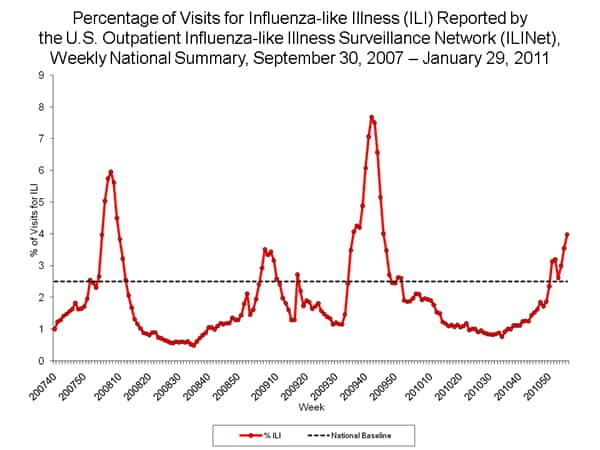
  • The proportion of outpatient visits for influenza-like illness (ILI) was 4.0%, which is above the national baseline of 2.5%. Seven of the 10 regions (Regions 1, 2, 3, 4, 5, 6, and 7) reported ILI at or above region-specific baseline levels. Seventeen states experienced high ILI activity; three states experienced
  • moderate ILI activity; New York City and 10 states experienced low ILI activity; the District of Columbia and 19 states experienced minimal ILI activity, and one state had insufficient data.
  • The geographic spread of influenza in 30 states was reported as widespread; 15 states reported regional influenza activity; the District of Columbia and one state reported local influenza activity; Puerto Rico, the U.S. Virgin Islands, and four states reported sporadic influenza activity, and Guam reported no influenza activity.

image

image

Pneumonia and Influenza (P&I) Mortality Surveillance

During week 4, 8.5% of all deaths reported through the 122-Cities Mortality Reporting System were due to P&I. This percentage was above the epidemic threshold of 7.9% for week 4.

image

Outpatient Illness Surveillance:

Nationwide during week 4, 4.0% of patient visits reported through the U.S. Outpatient Influenza-like Illness Surveillance Network (ILINet) were due to influenza-like illness (ILI). This percentage is above the national baseline of 2.5%.

national levels of ILI and ARI

»» Read More