Showing posts with label TB. Show all posts

EID Journal: Challenges To Defining TDR-TB


image

(From the 2011 TB Progress Report)


# 6600


In January of this year reports began to emerge out of India regarding what was being called Totally Drug Resistant (TDR) tuberculosis (see Crof’s report India: New TB strain is "totally drug-resistant" (updated)).


While not an officially recognized term, TDR-TB was portrayed by the media as a frightening escalation of the existing classifications of Multi-drug resistant (MDR-TB) and Extensively-drug resistant (XDR-TB).


Resistant forms of Tuberculosis have come about primarily as the result of incomplete, irregular, or inappropriate treatment and management of infected patients.


A few days later (January 14th), the World Health Organization updated their Drug-resistant tuberculosis FAQ where they take exception to the term TDR-TB.


Why are these terms not yet recognised by WHO?

Terms such as “totally drug resistant” have not been clearly defined for tuberculosis. While the concept of “total drug resistance” is easily understood in general terms, in practice, in vitro drug susceptibility testing (DST) is technically challenging and limitations on the use of results remain: conventional DST for the drugs that define MDR and XDR-TB has been thoroughly studied and consensus reached on appropriate methods, critical drug concentrations that define resistance, and reliability and reproducibility of testing

Around the same time we saw an ECDC Comment On Drug Resistant TB In India. One of the points being made in the comments section (excerpted below) is that the term TDR-TB is as yet not well defined, and may be misleading.


Total drug resistant TB is a relative notion and depends on the local drugs available and tested on. This term/expression should either be avoided or should be defined worldwide. The World Health Organization (WHO) has internationally-endorsed treatment recommendations for the treatment of drug-susceptible, MDR-TB and XDR-TB.


In March, as part of my World TB Day Roundup, the World Health Organization released this statement on the supposed TDR-TB, cautioning:


More evidence and better diagnostics needed before redefining severe forms of drug-resistant TB says WHO

Note for the media

23 March 2012 | Geneva - Reports of tuberculosis (TB) cases with severe patterns of drug resistance are increasing, said experts who attended a WHO meeting in Geneva on 21-22 March. Participants stressed that the emergence of drug resistance should be a wake-up call for Ministries of Health. The group urged the global TB community to make greater efforts to prevent drug resistance and scale up provision of appropriate care and management to avoid a scenario where TB becomes incurable.

Insufficient evidence

The meeting concluded that there is currently insufficient evidence to adopt new case definitions for drug-resistant TB. Drug susceptibility testing (DST), which is key to defining new levels of drug resistance, lacks accuracy for several of the drugs that are used to treat multi drug-resistant (MDR) and extensively drug resistant (XDR)-TB. Secondly, there is insufficient correlation of DST results with clinical response to treatment for several drugs currently used to treat XDR-TB. Thirdly, new drugs are currently undergoing clinical trials, and could prove effective against drug resistant strains. The meeting urged diagnostics companies and TB laboratories to develop better diagnostic tests and also agreed that WHO and technical partners should develop more detailed guidance on XDR-TB treatment.

(Continue . . . )


All of which brings us to a new article appearing ahead of print in the CDC’s EID Journal that looks at the:


Challenges and Controversies in Defining Totally Drug-Resistant Tuberculosis

Peter Cegielski , Paul Nunn, Ekaterina V. Kurbatova, Karin Weyer, Tracy L. Dalton, Douglas F. Wares, Michael F. Iademarco, Kenneth G. Castro, and Mario Raviglione
Abstract

In March 2012, in response to reports of tuberculosis (TB) resistant to all anti-TB drugs, the World Health Organization convened an expert consultation that identified issues to be resolved before defining a new category of highly drug-resistant TB.


Proposed definitions are ambiguous, and extensive drug resistance is encompassed by the already defined extensively drug-resistant (XDR) TB. There is no evidence that proposed totally resistant TB differs from strains encompassed by XDR TB.


Susceptibility tests for several drugs are poorly reproducible. Few laboratories can test all drugs, and there is no consensus list of all anti-TB drugs. Many drugs are used off-label for highly drug resistant TB, and new drugs formulated to combat resistant strains would render the proposed category obsolete. Labeling TB strains as totally drug resistant might lead providers to think infected patients are untreatable. These challenges must be addressed before defining a new category for highly drug-resistant TB.

(Continue . . . )


Given the complexities of evaluating for total drug resistance, attaching the label TDR-TB to these strains may well be both premature and inaccurate.


But the sobering fact remains, if you are infected with one of these XDR-TB strains - and no drug is available to you that can treat it – for you, it may as well be totally resistant.


Of course, this disparity of available medical treatment exists for a great many diseases around the world, and is not just limited to TB.


The authors of the EID study conclude with this warning:


As countries increase treatment of MDR and XDR TB, it is inevitable that resistance to second-line drugs will increase. New drugs and better diagnostic tools are needed urgently for patients with highly drug-resistant TB.


For more on the global spread of TB, you may wish to revisit:


WHO-ECDC: Joint Report On Tuberculosis In Europe
Resistant TB: The Limits Of Surveillance & Reporting
WHO: Blood Tests To Detect Active TB Unreliable

»» Read More

WHO-ECDC: Joint Report On Tuberculosis In Europe


# 6233


World TB day is March 24nd, and the ECDC, the World Health Organization, the CDC, along with many other partners (including the National TB Controllers Assoc., Stop TB USA, and the global Stop TB Partnership) have joined together around the globe to raise awareness and promote strategies to reduce TB around the world.


image


Today, the ECDC and WHO released a 172 page Tuberculosis Surveillance And Monitoring In Europe report for 2012, that finds some encouraging signs, but also cautions on the increased incidence of extensively drug resistant (XDR) TB in parts of the EU.


Here is the announcement from the ECDC.


New ECDC-WHO report: tuberculosis on the retreat in Europe but concerns about drug-resistant TB and treatment failure remain

19 Mar 2012

ECDC

In 2010, the EU/EEA countries reported nearly 74 000 tuberculosis cases – around 7% less than 2009. While the notifications for multidrug- and extensively drug-resistant tuberculosis (M/XDR TB) have been stable over the past 5 years, the proportion of extensively drug-resistant patients among this group rose from 8.2% in 2009 to 13.2% in 2010 in the EU/EEA, possibly due to increased reporting.

These rising numbers pose a serious threat in the attempt to eliminate TB, highlighting the importance of early detection and adequate treatment of tuberculosis patients in the region.


ECDC Director Marc Sprenger, stresses that “Countries with low incidence of TB – which means less than 20 patients per 100 000 population – face a particular challenge in taking the final step towards elimination of the disease as TB often concentrates in big cities. In this setting, key populations like people who inject drugs, homeless people and migrants are disproportionally affected by TB. That is why we have to exchange best practices from across Europe: if TB services are not tailored towards the needs of urban risk groups there is a continuing risk of higher rates of TB in general and drug-resistant TB in particular.”

On the occasion of World TB Day 2012, ECDC supports simultaneous Urban TB Control events in Barcelona, Milan, London and Rotterdam on 22 and 23 March.


Join us on Tuesday, 20 March, when ECDC and WHO/Euro host a joint Twitter chat on the current TB situation in Europe. Use the hashtag #TBchat.


Read more:


Read the full press release


The full ECDC-WHO report Tuberculosis surveillance and monitoring in Europe 2012


ECDC report Towards TB elimination A follow-up to the Framework Action Plan to fight TB in the EU


ECDC Spotlight Tackling Tuberculosis in Children 2011

»» Read More

NPR Science Friday: McKenna On Resistant TB


# 6069


Later today (Friday, January 13th) Maryn McKenna will be a guest during the first hour (2 –3 pm EST) on NPR’s Science Friday to discuss the recent detection of a dozen cases of tuberculosis in India said to be `totally resistant’ to current antibiotic treatment.


Friday, January 13th, 2012

New Tuberculosis Strain Thwarts All Antibiotics

Physicians in India have discovered a strain of tuberculosis they call ‘TDR’ for ‘Totally Drug-Resistant’--meaning there is no antibiotic available to fight it. Maryn McKenna, author of Superbug , discusses the possible origins of the strain, and what options--if any--doctors have to treat it.

Guests

Maryn McKenna
Author, "
Superbug: The Fatal Menace of MRSA," (Free Press, 2010)
Blogger,
Wired
Atlanta, Georgia


image


Maryn, who is Flublogia’s resident expert on everything drug resistant, has written twice this week about this new development in her Superbug Blog, links to which you’ll find below:


Totally Resistant TB: Earliest Cases in Italy

India Reports Completely Drug-Resistant TB

»» Read More

ECDC Comment On Drug Resistant TB In India


# 6067


While more than a little discomfiting, in recent years we’ve grown accustomed to hearing about MDR-TB (multi-drug resistant tuberculosis), and XDR-TB (extensively drug resistant Tuberculosis). 


These varyingly resistant forms of Tuberculosis have come about primarily as the result of incomplete, irregular, or inappropriate treatment and management of infected patients. Patient compliance for long-term treatment has long been a major obstacle.


Until now – as difficult as treatment might have been - there has always been some combination of antibiotics that could be used to treat even the most resistant of TB cases.


All that appeared to change a few weeks ago when it was announced in an ahead-of-print letter to the journal Clinical Infectious Diseases that a four cases of TDR (totally drug resistant) tuberculosis had been identified in India. A follow up news report indicated that there are now at least 12 known cases in one hospital alone.


For more background on this announcement, I would invite you to read Maryn McKenna’s recent blog entry called India Reports Completely Drug-Resistant TB.


Today the ECDC has published their own comments on this development, along with links to other TB-related documents, on their website.


One of the points being made in the comments section (excerpted below) is that the term TDR-TB is as yet not well defined, and may be misleading.


Total drug resistant TB is a relative notion and depends on the local drugs available and tested on. This term/expression should either be avoided or should be defined worldwide. The World Health Organization (WHO) has internationally-endorsed treatment recommendations for the treatment of drug-susceptible, MDR-TB and XDR-TB.


Successful treatment of TB is possible but requires full support from the health care system by offering optimal diagnostic services, high-quality drugs for the full time of treatment and support to the patient in fulfilling the treatment. To make this happen, strong TB diagnostic services and processes that ensure the rational use of TB drugs (1,2,3) are essential in order to be able to test all suspected TB cases for drug-resistance and to identify resistance as soon as possible to enable appropriate therapy. Furthermore, ensuring treatment outcome monitoring of all cases is vital.


Follow the link below to read the entire comment.


New drug resistant form of tuberculosis reported in India

12 Jan 2012

In a recent scientific article (Udwadia, F et al. Clin. Infect. Dis. 2011, Dec 21, Eprint) four cases of so-called total drug resistant tuberculosis (TB) were reported from India. According to the article, these patients have shown resistance to all the first line TB drugs and to seven second line anti-TB drugs.


With the existing forms of multi-drug and extensively drug resistant TB (M/XDR-TB) this so-called total drug resistant TB would indicate that none of the known TB combination regimens would be effective for such patients.

Read more:

Read the ECDC comment on this in our full

Public Health Development “New drug resistant form of tuberculosis reported in India”


ECDC Tuberculosis Programme


Tuberculosis, a global challenge: discover the ECDC Spotlight


Get the facts: read the ECDC special report “Progressing towards TB elimination”


Download the report “Tuberculosis surveillance in Europe 2009”


Discover the Spotlight “Tackling tuberculosis in children: towards a TB-free generation

Keep in touch with ECDC on facebook


Read the ECDC/WHO co-authored article “Tackling the spread of drug-resistant tuberculosis in Europe”


This story is just beginning to unfold, and I’m sure we’ll hear a lot more about it – and whether or not this new form of tuberculosis is indeed, as the study authors dubbed it - `totally resistant’ – in the coming months.

»» Read More

WHO: Blood Tests To Detect Active TB Unreliable


# 5703


Although following story was telegraphed earlier in the week by comments to the press by Mario Ravigli - the director of WHO's Stop TB Department – today we have the official announcement from the World Health Organization’s media centre, along with a detailed Policy Statement.


image


For the first time, the WHO has issued a “negative" policy recommendation against a well established practice used in Tuberculosis care. 


The World Health organization is calling for countries to immediately ban the use of blood tests designed to detect active TB, and rely instead upon microbiological or molecular tests for the diagnosis of Tuberculosis.


The two main measures of the accuracy of a diagnostic test are sensitivity and specificity.


  • Sensitivity is defined as the ability of a test to correctly identify individuals who have a given disease or condition.


  • Specificity is defined as the ability of a test to exclude someone from having a disease or illness.


And based on a year-long review by the WHO and global experts – which examined 94 existing studies – researchers found overwhelming evidence that these serological diagnostic tests produced an `unacceptable level of wrong results’  (compared to WHO sanctioned tests).

They found both `low sensitivity’, where the test failed to identify TB in patients (which can lead to patients not receiving the appropriate treatment).


And `low specificity’, where the test indicated TB when the patient was not infected (which could lead to unwarranted treatment and no treatment for the true cause of their illness).


First, some excerpts from the WHO’s media centre press release, followed by a link to the Policy Statement, and the strongly worded conclusion from its executive summary.


WHO warns against the use of inaccurate blood tests for active tuberculosis

A substandard test with unreliable results

News release

20 July 2011 | GENEVA - The use of currently available commercial blood (serological) tests to diagnose active tuberculosis (TB) often leads to misdiagnosis, mistreatment and potential harm to public health, says WHO in a policy recommendation issued today. WHO is urging countries to ban the inaccurate and unapproved blood tests and instead rely on accurate microbiological or molecular tests, as recommended by WHO.

TB can be wrongly diagnosed

Testing for active TB disease through antibodies or antigens found in the blood is extremely difficult. Patients can have different antibody responses suggesting that they have active TB even when they do not. Antibodies may also develop against other organisms which again could wrongly indicate they have active TB. In addition, different organisms share the same antigens, making tests results unreliable. These factors can result in TB disease not being identified or wrongly diagnosed.

A blood test for diagnosing active TB disease is bad practice

"In the best interests of patients and caregivers in the private and public health sectors, WHO is calling for an end to the use of these serological tests to diagnose tuberculosis," said Dr Mario Raviglione, Director of WHO Stop TB Department. "A blood test for diagnosing active TB disease is bad practice. Test results are inconsistent, imprecise and put patients' lives in danger."


Today's policy recommendation applies to blood tests for active TB. Blood tests for inactive TB infection (also known as dormant or latent TB) are currently under review by WHO.

(Continue . . . )


Commercial Serodiagnostic Tests for Diagnosis of Tuberculosis - Policy Statement pdf, 809kb


EXECUTIVE SUMMARY

Conclusions:  Commercial serological tests provide inconsistent and imprecise findings resulting in highly variable values for sensitivity and specificity.


There is no evidence that existing commercial serological assays improve patient-important outcomes, and high proportions of false-positive and false-negative results adversely impact patient safety.


Overall data quality was graded as very low and it is strongly recommended that these tests not be used for the diagnosis of pulmonary and extra-pulmonary TB. 


For some background on Tuberculosis, which kills 1.7 million people each year,  last March I wrote a blog titled World TB Day: March 24th. 


Some of the resources I cited that day may be of interest.


image

(From the 2011 TB Progress Report)


The World Health Organization  released a new report and a factsheet on MDR-TB & XDR-TB in advance of this yearly event on the the status of Tuberculosis around the world and the progress being made in its control.

WHO progress report 2011
Towards universal access to diagnosis and treatment of MDR and XDR-TB by 2015
»» Read More

Lancet Study: TB Screening


# 5509


The World Health Organization estimates that roughly 2 billion people – nearly 1 in 3 – are infected with the TB bacilli, and of those, 1 in 10 will develop active TB during his or her lifetime.


The incidence of Tuberculosis varies greatly around the world, with North America, Europe and Australia/New Zealand seeing the lowest rates, and with the highest rates found in Africa, India, and Asia.


image

(From Global TB Control Report 2010)


For details on declining TB rates in the United States you may wish to revisit MMWR: Tuberculosis Trends In The United States.  For a more global view, I wrote about the WHO: Global Tuberculosis Control Report 2010 last November.


Last year, you may recall, I highlighted the increasing rates of TB in the UK on a couple of occasions. 


Last July, in UK: TB Rising we looked at a report on the incidence of Tuberculosis in London, England. This from the Journal of Public Health.

Recent trends in tuberculosis in children in London

J.E.T. Ruwende
, E. Sanchez-Padilla, H. Maguire,
J. Carless
, S. Mandal, D. Shingadia

Abstract

Background Childhood tuberculosis (TB) represents a sentinel event of recent transmission and is an indication of the effectiveness of prevention and control interventions. We analysed the trends in the epidemiology of TB in children in London aged 0–14 years between 1999 and 2006.


<SNIP>


Conclusions Ethnicity, country of birth and age are important risk factors for development of. With an overall TB incidence in London exceeding 40/100 000, universal BCG immunization of all neonates should be considered across all London boroughs.


In October, in UK: TB `Rife’ in Birmingham, we looked at press reports out of England’s second most populous city proclaiming  UK: "Third World" rate of TB in Birmingham.


While nowhere near the problem that it is in many developing nations, the rate of Tuberculosis has been rising in England steadily for the past decade.


Part of this increase has been due to Immigrants arriving from countries where TB is more prevalent. Although new arrivals are required to have chest X-rays to screen them for TB, that only catches active TB.


TSKs (Tuberculin Skin Tests), are also recommended for certain age groups immigrating from specific countries. These, however, will show positive for those who have received the TB vaccine, or who have been previously exposed (but not necessarily infected), limiting their usefulness.


This from the BBC

20 April 2011 Last updated at 21:32 ET

TB screening 'missing most cases'

Current screening for TB in immigrants arriving in the UK is missing the majority of cases, say researchers.


The genesis of this media report is the following study which appears in The Lancet (free registration req.), that argues that the adoption of blood tests (interferon-γ release-assay (IGRA)) to screen specific cohorts of immigrants for latent TB is both cost effective and will result in earlier treatment for many who unknowingly are infected. 


Screening for latent tuberculosis

Screening for latent tuberculosis - Copyright: Science Photo Library Current UK policy requires that all immigrants from countries with a tuberculosis incidence higher than 40 per 100,000 have a chest X-ray on arrival to check for active tuberculosis. However, very few immigrants have active tuberculosis on arrival, and many are carriers of latent tuberculosis, which often progresses to infectious active tuberculosis within a few years of arrival in the UK. An Article, by Pareek and colleagues, estimates the yields from, and cost-effectiveness of, screening for latent infection at different thresholds in relation to incidence of tuberculosis in immigrants’ countries of origin.


The entire (very detailed) research article is called:

The Lancet Infectious Diseases, Early Online Publication, 21 April 2011

doi:10.1016/S1473-3099(11)70069-X

Screening of immigrants in the UK for imported latent tuberculosis: a multicentre cohort study and cost-effectiveness analysis


The blood test in question (IGRA) are whole-blood tests that can often diagnose Mycobacterium tuberculosis infection, in both its  latent form (LTBI) and active tuberculosis (TB) disease.


Unlike the TST (Tuberculin Skin Test), the IGRA (aka. IGT) doesn’t give a false positive in those with prior BCG (bacille Calmette-Guérin) vaccination.


The CDC maintains the following FAQ sheet on the IGRA tests.  


In June of 2010 the CDC published via the MMWR Updated Guidelines for Using Interferon Gamma Release Assays to Detect Mycobacterium tuberculosis Infection --- United States, 2010.


It should be noted that the NHS’s  NICE (National Institute of Health and Clinical Excellence) updated their 2006 guidance on screening for TB in March of this year, including the use of the IGRA blood tests.


image


These guidelines are recommendations, and it is up to local NHS agencies to decide whether to adopt them.


They now have the  combined weight of this new guidance, along with the Lancet study, to consider.

»» Read More

MMWR: Tuberculosis Trends In The United States


# 5440


Today’s MMWR from the CDC, released on this World TB Day, contains two reports on the incidence of Tuberculosis in the United States.


I’ve pulled some excerpts from each report (and reformatted for readability), but follow the links to read them in their entirety.


The first takes a closer look at an unexpected drop in TB cases in two states – Georgia and Pennsylvania – in 2009, and concludes that these reductions were real, and not the result of surveillance artifacts, health-care provider under diagnoses, or underreporting.


Assessment of Declines in Reported Tuberculosis Cases --- Georgia and Pennsylvania, 2009

Weekly

March 25, 2011 / 60(11);338-342

image

What is already known on this topic?

In 2009, tuberculosis (TB) incidence in the United States decreased to 3.8 cases per 100,000 population, the lowest recorded rate since national TB surveillance began in 1953. The 11.4% decrease from 2008 was the greatest single-year decrease ever recorded.

What is added by this report?

Findings from systematic investigations in Georgia and Pennsylvania, two states that experienced unexpectedly large decreases in TB incidence in 2009, indicate that the decline in new TB disease in those states appeared actual and not attributable to surveillance artifact, health-care provider underdiagnosis, or underreporting.

What are the implications for public health practice?

The TB surveillance systems in Georgia and Pennsylvania appear to be functioning appropriately. Current efforts to diagnose, treat, and report TB cases should be vigorously maintained as the United States moves closer to the goal of TB elimination.


The second report looks at the trends in Tuberculosis in the United States, and finds that while significant reductions in TB have been made, the stated goal back in 1989 of reaching an incidence rate of < 0.1 per 100,000 population by 2010 has not been met.


Trends in Tuberculosis --- United States, 2010

Weekly

March 25, 2011 / 60(11);333-337

In 2010, a total of 11,181 tuberculosis (TB) cases were reported in the United States, for a rate of 3.6 cases per 100,000 population, which was a decline of 3.9% from 2009 and the lowest rate recorded since national reporting began in 1953 (1). This report summarizes provisional 2010 data from the National TB Surveillance System and describes trends since 1993.


Despite an average decline in TB rates of 3.8% per year during 2000--2008, a record decline of 11.4% in 2009 (2), and the 2010 decline of 3.9%, the national goal of TB elimination (defined as <0.1 case per 100,000 population) by 2010 was not met (3).


Although TB cases and rates decreased among foreign-born and U.S.-born persons, foreign-born persons and racial/ethnic minorities were affected disproportionately by TB in the United States. In 2010, the TB rate among foreign-born persons in the United States was 11 times greater than among U.S.-born persons.


TB rates among Hispanics, non-Hispanic blacks, and Asians were seven, eight, and 25 times greater, respectively, than among non-Hispanic whites. Among U.S.-born racial and ethnic groups, the greatest racial disparity in TB rates was for non-Hispanic blacks, whose rate was seven times greater than the rate for non-Hispanic whites.


Progress toward TB elimination in the United States will require ongoing surveillance and improved TB control and prevention activities to address persistent disparities between U.S.-born and foreign-born persons and between whites and minorities.

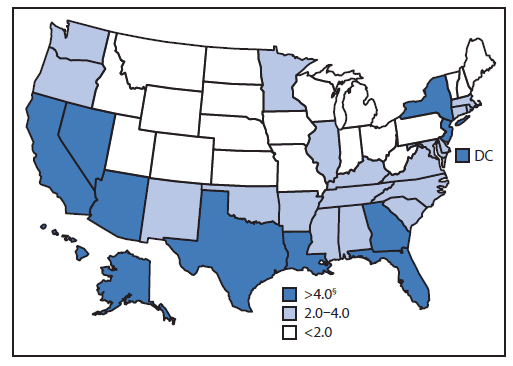
FIGURE 1. Rate* of tuberculosis (TB) cases, by state/area --- United States, 2010†

The figure shows the rate of tuberculosis (TB) cases, by state/area in the United States in 2010. In 2010, a total of 11,181 tuberculosis (TB) cases were reported in the United States, equivalent to a rate of 3.6 cases per 100,000 population. TB rates in reporting areas ranged from 0.6 (Maine) to 8.8 (Hawaii) cases per 100,000 population (median: 2.5).

Source: National TB Surveillance System.

* Per 100,000 population.

† Provisional data as of February 26, 2011.

§ 20 states had TB case rates <2.0 (range: 0.61--1.88) per 100,000

What is already known on the topic?

In 1989, the Strategic Plan for Elimination of Tuberculosis in the United States set a target date of 2010 to achieve its goal, defined as an annual tuberculosis (TB) case rate of <0.1 per 100,000 population.


What is added by this report?

For 2010, preliminary data show a national TB case rate of 3.6 per 100,000 population, a decrease of 3.9% from 2009, but the goal of eliminating TB in the United States by 2010 was not achieved, and foreign-born persons and racial/ethnic minorities continued to be affected disproportionately.


What are the implications for public health practice?

Ongoing surveillance and improved TB control and prevention activities, especially among disproportionately affected populations, are needed to eliminate TB in the United States.

»» Read More

World TB Day: March 24th


# 5437


image

(From the 2011 TB Progress Report)


Nearly 40 years ago, when I first entered the EMS arena (1972), Tuberculosis was in decline and most of the TB hospitals around the country were closing.


Antibiotics and education – a least in developed nations – were making a huge impact.


Several times a year, however, I’d be called upon to transport a TB patient to the A. G. Holly TB hospital in Lantana, Florida.  A slightly nervous four-hour ride in the back of an ambulance for an 18 year-old EMT, armed with just a surgical mask for protection.


While it seemed during the 1970s that we were on our way to beating tuberculosis (something that had hospitalized my grandmother for months in the 1930s), that victory never materialized.


Instead, we’ve seen the rise of new, drug resistant strains of the TB bacillus, and a resurgence of the disease.


Tomorrow, March 24th, is World TB Day and across the globe individuals, organizations, and agencies will be working on generating greater TB awareness and in many cases, working towards a cure.


The World Health Organization has released a new report and a factsheet on MDR-TB & XDR-TB in advance of this yearly event on the the status of Tuberculosis around the world and the progress being made in its control.


WHO progress report 2011

Towards universal access to diagnosis and treatment of MDR and XDR-TB by 2015

Towards universal access to diagnosis and treatment of multidrug-resistant and extensively drug-resistant tuberculosis by 2015ö WHO progress report 2011

Today, for World TB Day, we launch a new report Towards universal access to diagnosis and treatment of multidrug-resistant and extensively drug-resistant tuberculosis by 2015.


Progress is being made, but the response is far from sufficient given the MDR-TB threat facing the world. Two years on from the Beijing declaration - which was endorsed by all 27 high burden countries featured in this report - the commitments by some countries are too slow off the mark or simply stalled.


You’ll find the CDC is also observing World TB day, with this feature on the CDC website.


TB Elimination: Together We Can!

World TB Day is March 24. This annual event commemorates the date in 1882 when Dr. Robert Koch announced his discovery of M. tuberculosis—the bacterium that causes tuberculosis (TB).


Tuberculosis is one of the world's deadliest diseases: one-third of the world's population is infected with TB; each year, over 9 million people around the world become sick with TB; and each year, there are almost 2 million deaths worldwide. In the United States, TB rates have been declining slowly since 1993. Despite this trend, there remains a disproportionate burden of TB among racial and ethnic minorities in the United States. This is due to unequal distribution of TB risk factors that can increase the chance of developing the disease. To learn more about TB risk factors, please visit the TB website.


(Continue . . . )


Some more resources from the CDC page on World TB day include:


More Information
World TB Day Resources


image

(mash up from 2011 TB Progress Report)

»» Read More

Haiti: Inextricably Intertwined Disasters


# 5078


Long before cholera broke out in the tent cities, and decades prior to the devastating 7.0 Port-au-Prince earthquake, Haiti endured some of the highest rates of poverty and disease in the western hemisphere.


A little more than a week ago, in Haiti: Three Non-Cholera Health Threats, I wrote about the toll that Malaria, Cyptosporidium, and Acute Respiratory Infections took on that population.


Today, from IRIN PlusNews (hat tip Sharon Sanders at FluTrackers), we have a couple of feature articles on TB and HIV, and how they – along with the earthquake and the cholera epidemic - are inextricably intertwined in the cascading crisis in Haiti.


First a report on the additional threat that cholera places on the 2.2% of Haiti’s population (roughly 120,000 people) who have HIV. 


HAITI: HIV-positive people especially vulnerable to cholera


PORT-AU-PRINCE, 22 November 2010 (PlusNews) - As the death toll from the cholera epidemic sweeping through Haiti surpasses 1,000, with more than 19,000 confirmed cases, health officials say people living with HIV are especially vulnerable.


Only about 25 percent of people infected with cholera develop symptoms - mainly watery diarrhoea and vomiting - but people already weakened by illness, malnutrition or pregnancy are particularly at risk.


"[People living with HIV] are very much at risk because they already have a weakened immune system," explained Hanz Legagneur, director of the Ministry of Public Health in the country's West Department.


(Continue . . .)


Next a report on how the living conditions in the 1,300 refugee camps for the survivors of the earthquake – many of whom are crowded into communal tents - are ripe for the spread of Tuberculosis.


HAITI: Combating TB in Port-au-Prince's tent cities


Photo:
Tamar Dressler/IRIN

Thousands are still living in tiny tents in the capital, Port-au-Prince


PORT-AU-PRINCE, 17 November 2010 (PlusNews) - Health workers in Haiti are concerned about the spread of tuberculosis (TB) in the tent cities that have housed more than one million people since the massive earthquake in January.


"With the quake this became an emergency," said Macarthur Charles, a doctor with Group for the Study of Kaposi's Sarcoma and Opportunistic Infections (GHESKIO), one of the largest HIV- and TB-focused NGOs in Haiti.

(Continue . . .)


Although accurate numbers are impossible to obtain, field reports (well covered on a daily basis by Crofsblog) seem to suggest a higher than expected fatality rate among cholera patients in this epidemic.


Not so surprising given the existing burden of disease in Haiti, long-standing fragmentary health care services, poverty and neglect, and the devastation from January’s earthquake.


Disasters all. 


And all no doubt factors that conspire to severely compound the effects of this cholera epidemic.


And they also make solutions that much harder to find.

»» Read More

UK: TB `Rife’ in Birmingham


# 5001


Crof over at Crofsblog has a story from the Birmingham Mail on the alarming rate of Tuberculosis in Birmingham, England’s second most populous city, with a population of just over 1 million.


image


Follow the link to read the report on Crofsblog.  When you return, I’ll have more.


UK: "Third World" rate of TB in Birmingham

Via Birmingham Mail.net: Tuberculosis is rife in Birmingham says report. 


All of this may sound a bit familiar to constant readers since earlier this summer we saw a similarly alarming story about the level of tuberculosis being reported in London, as well (see UK: TB Rising).


A few excerpts from that report include:


This past week (July 2010) we’ve a report on the incidence of Tuberculosis in London, England.  The rate is rising, and that has some public health officials very concerned.

First, this abstract from the Journal of Public Health, doi:10.1093/pubmed/fdq046.


Recent trends in tuberculosis in children in London


J.E.T. Ruwende

, E. Sanchez-Padilla, H. Maguire,
J. Carless
, S. Mandal, D. Shingadia

Abstract

Background Childhood tuberculosis (TB) represents a sentinel event of recent transmission and is an indication of the effectiveness of prevention and control interventions. We analysed the trends in the epidemiology of TB in children in London aged 0–14 years between 1999 and 2006.


Methods Data were extracted from the Enhanced TB Surveillance System.


Results Between 1999 and 2006, there were 1370 cases of TB in children. Incidence was higher in older children and in girls. The incidence rates in London Boroughs varied from 0.4/100 000 to 32.7/100 000. Between 1999 and 2006, Black-Africans comprised 49.2% of all TB cases in children, children from the Indian Subcontinent 21.8% and Whites 8.5%. The proportion of cases born in the UK averaged 52.4% during this period. Of non-UK-born children 79.3% were diagnosed with TB within 5 years of entry.


Conclusions Ethnicity, country of birth and age are important risk factors for development of. With an overall TB incidence in London exceeding 40/100 000, universal BCG immunization of all neonates should be considered across all London boroughs.

For more background, we go to this summary report on the Emerging Health Threats Forum.

High incidence rate in London sparks call for city-wide BCG vaccination in early childhood

The incidence of tuberculosis (TB) in the UK capital has reached levels that should trigger the start of routine vaccination against the disease for all babies born in the city, according to research published this month. Writing in the Journal of Public Health, medical scientists say that almost 45% of all childhood TB cases in the UK are now occurring in London.


A policy of routine BCG immunisation has been in place in some North London boroughs for several years already. The vaccination is advised only for UK-born babies whose parents and grandparents come from countries with a high incidence of TB, and those born in such countries who were not immunised previously.


The jab is also recommended for children living in areas where TB incidence in the entire population exceeds 40 cases per 100,000 people. This is now seen consistently across London, say the authors.

(Continue . . .)


The UK’s NHS (National Health Service) maintains a major web portal on TB information, including details on the Bacillus Calmette-Guérin (BCG) vaccine which provides protection against tuberculosis.


BCG (tuberculosis) vaccination

Who should have the vaccine?

The BCG vaccine is not given as part of the routine childhood vaccination schedule unless a baby is thought to have an increased risk of coming into contact with TB.


For example, all babies born in some areas of inner-city London (where TB rates are higher than in the rest of the country) should be offered the BCG vaccination.


BCG vaccinations may also be recommended for people who have an increased risk of developing TB, such as:

  • health workers
  • people who have recently arrived from countries with high levels of TB
  • people who have come into close contact with somebody infected with respiratory TB
»» Read More

Badgers? We Don’t Need No Stinkin’ Badgers!


# 4873


Cinema lovers will no doubt recognize the above title as an homage to perhaps the 2nd most misquoted line from the movies (the first being Casablanca’s  `Play it Again, Sam’). 


In this case, it comes from another Bogart movie – The Treasure of the Sierra Madre – and the actual quote delivered by Alfonso Bedoya was:


Dobbs: "If you're the police where are your badges?"
Gold Hat: "Badges? We ain't got no badges. We don't need no badges! I don't have to show you any stinkin' badges!"


Over the years Gold Hat’s lines have morphed in popular culture and memory – aided and abetted by Mel Brook’s Blazing Saddles – into `Badges?  We don’t need no Stinkin’ Badges!’.


And of course, a thousand (now a thousand and one) parodies thereof.


Which brings us (at long last) to an infectious disease story out of the UK, where the power to cull badgers – which are viewed by many farmers as a serious threat to their cattle – is about to be granted.


Badgers can carry Mycobacterium bovis which is the cause of tuberculosis in cattle (known as bovine TB).


M. bovis is also capable of infecting humans (mainly through unpasteurized milk), although famers in contact with infected cattle are at risk as well.


In fact, of the three type of Tuberculosis bacteria (Mycobacterium bovis, M. avium, and M. tuberculosis), M. Bovis has the largest host range – being capable of infecting just about all warm-blooded vertebrates.


In countries where pasteurization of dairy products is common, human infection by M. bovis is relatively rare, but not unheard of.  


The UK’s HPA describes the risks thusly:


Humans and M bovis


TB caused by M. bovis is diagnosed in a small number of people  in the UK every year. The majority of cases are in people over 65 years old (and who drank infected unpasteurised milk in the past) or in those of any age who picked up the infection abroad. 

The number of human TB cases due to M. bovis infection is closely monitored by the Health Protection Agency in England and Wales, and Health Protection Scotland in Scotland.

Overall, human TB caused by M. bovis accounts for less than 1% of the total TB cases in the UK. However, those working closely with livestock and/or regularly drinking unpasteurised (raw) milk have a higher risk of exposure.


Over the last decade, it has been estimated that 150,000 head of cattle in the UK have been slaughtered because of M. Bovis infection – with compensation payments to farmers in 2009 running nearly £90mn.


Many farmers see badgers as the primary source of bovine TB, and blame them for reintroducing the disease into their herds each year.


Conservation and animal rights groups strongly disagree, and argue that the badger is the victim here.


They maintain that cow-to-cow transmission is the primary route of infection, and that badgers usually get the disease from cattle – not the other way around.


Both sides have their own experts, supportive studies, and a constituency behind them.  The debate has been vigorous, lengthy, and often heated as the following media reports illustrate:


13 July 2010

Welsh badger cull decision does not refute science


May 20, 2010

Minister blocks cull of badgers in bovine TB hotspots


14 Nov 2008

Cattle, not badgers, are reservoir of bovine TB

Bovine TB is not a threat to the health of Britain's badgers but farming unions are, says Trevor Lawson from the Badger Trust.


Animal rights groups hang their hat on a decade-long study by the Independent Scientific Group on Cattle TB, which concluded that culling could not “meaningfully contribute” to control of the disease.


Other researchers disagree.


The British Veterinary Association (BVA) has come down in favor of targeted, humane culling of badgers as part of an overall bTB (Bovine TB) eradication plan.


Some excerpts from their policy statement.


BVA Tuberculosis policy


The British Veterinary Association (BVA) believes that the eradication of bTB from cattle and wildlife populations must be the ultimate aim, with initial steps being taken immediately to control the spread of infection.

  • The current Government Strategy for bTB control is inadequate.
  • Control measures in cattle must be accompanied by simultaneous and coordinated measures in badgers and other wildlife and susceptible farmed species including deer and camelids for the success of any eradication programme.
  • Failure to tackle wildlife sources of infection has prolonged the presence of the disease in all affected species populations.
  • Targeted and managed badger culling is necessary in carefully selected areas where badgers are regarded as a significant contributor to the persistent presence of bTB.


Which brings us to the decision announced in today’s story, which will no doubt provoke the ire of a number of environmentalist and animal rights groups.


A hat tip to Dutchy on FluTrackers for this link.


Farmers to be handed powers to cull badgers

Farmers will be handed powers to slaughter badgers as part of a widespread cull in England aimed at halting the spread of tuberculosis in cattle herds.

(Continue. . . )


While the decision to proceed with limited culls appears to have been reached, legal challenges and the weight of public opinion may still prove to be impediments to the plan.


Not being an expert in the ecology of M. bovis, or the efficacy of badger culling, I’m hard pressed to take sides here. With conflicting studies and scientific assessments, any definitive answers as to what control methods actually work are unlikely in the near-term.


But for opposing viewpoints you may wish to visit:


The British Veterinary Association has scores of documents on the problems of bovine TB in the UK, which may be accessed at this link.


Badger Trust, which has opposed culling, presents its case on their website.

»» Read More