Showing posts with label Tuberculosis. Show all posts

Resistant TB: The Limits Of Surveillance & Reporting


# 6071


With practically any disease you’d care to mention the number of cases that we see, and are counted, generally represent only a small subset of the total.


As the chart from the CDC below indicates, public health officials are usually only aware of the `tip of the disease pyramid’.


image


Many people suffering an illness do not become sick enough to seek medical care (or may live in an area where such care, or testing is unavailable). Those that see a doctor may not be properly diagnosed.  And those that are diagnosed may not be reported to the health department.


When the World Health Organization announced the detection of the 571st human H5N1 infection, or the ECDC reports that 4,200 people were infected by the E. coli O104:H4 outbreaks in Germany and France, everyone in the public health arena understood that those numbers are unlikely to include all of the cases out there.


Reporting and surveillance – even in technologically advanced regions like the United States and Europe – are simply not that good. 


So when we learn – as we have this week – of a dozen cases of `totally resistant tuberculosis’ in India, it’s a pretty fair assumption that there are more cases out there, as yet undetected.


The question is:  How many?


While the answer to that question remains elusive, we’ve some troubling hints today from an article that appears in the Indian Express.  


The story revolves around an interview with Dr John Kenneth, Professor and Head, Infectious Diseases, St John’s Research Institute. The article can be accessed at the following link:


The new, deadly TB strain may be more widespread

Johnson T A : Bangalore, Sat Jan 14 2012, 03:47 hrs


While the headline, that this new form of resistant TB `may be more widespread’ is practically a given - what is worrisome are the percentages being reported.


Dr. Kenneth states that his group has unpublished data showing that out of one hundred TB patients they had randomly selected for drug susceptibility studies, six were found to be `totally drug resistant’.


Additionally out of these 100 cases, 30 were found to be multi-drug resistant (MDR), and 13 were defined as being extensively drug resistant (XDR).


Dr. Kenneth admits that there may be some selection bias in the 100 patients selected for this study, and that all cases tested were randomly selected from among TB patients at only one treatment facility.


Until this study is published, we are lacking details on how the screening for drug resistance was done, and exactly how `totally drug resistant’ was defined. This is an issue that the ECDC brought up earlier this week, when they cautioned against the use of the term TDR-TB (see ECDC Comment On Drug Resistant TB In India).


Whether these results reflect the prevalence of resistant TB across a wider region is – for now, at least – unknowable.


For more on all of this, you can’t do better than Maryn McKenna’s coverage on her Superbug Blog.   Her latest entry (which includes links to her radio interview yesterday) can be read at:


Totally Drug-Resistant TB: A Patient Is Missing


For some more background on Tuberculosis, which kills 1.7 million people each year,  last March I wrote a blog titled World TB Day: March 24th.


Some of the resources I cited that day may be of interest.


image

(From the 2011 TB Progress Report)


The World Health Organization  released a new report and a factsheet on MDR-TB & XDR-TB in advance of this yearly event on the the status of Tuberculosis around the world and the progress being made in its control.


WHO progress report 2011
Towards universal access to diagnosis and treatment of MDR and XDR-TB by 2015


While progress has been cited in the global fight against tuberculosis, the addition of a new supposedly `totally resistant’ form of TB to the mix complicates matters enormously. 


Yesterday the WHO published the following notice:


Tuberculosis that is “resistant to all drugs”

13 January 2012 | Geneva | WHO's Stop TB Department has just published a briefing note with "Frequently Asked Questions" to provide information on tuberculosis that is resistant to all drugs.


In 2006, the first reports of extensively drug-resistant tuberculosis (XDR-TB), an even more severe form of drug resistant TB than multidrug-resistant TB (MDR-TB), began to appear. Within a year of the first reports of XDR-TB, isolated cases were reported in Europe that had resistance to all first-line anti-TB drugs (FLD) and second-line anti-TB drugs (SLD) that were tested. In 2009, a cohort of 15 patients in Iran was reported which were resistant to all anti-TB drugs tested. The terms “extremely drug resistant” (“XXDR-TB”) and “totally drug-resistant TB” (“TDR-TB”) were given by the respective authors reporting this group of patients. Recently, another study has been published that describes 4 patients from India with resistance to all tested drugs.


»» Read More

WHO: Blood Tests To Detect Active TB Unreliable


# 5703


Although following story was telegraphed earlier in the week by comments to the press by Mario Ravigli - the director of WHO's Stop TB Department – today we have the official announcement from the World Health Organization’s media centre, along with a detailed Policy Statement.


image


For the first time, the WHO has issued a “negative" policy recommendation against a well established practice used in Tuberculosis care. 


The World Health organization is calling for countries to immediately ban the use of blood tests designed to detect active TB, and rely instead upon microbiological or molecular tests for the diagnosis of Tuberculosis.


The two main measures of the accuracy of a diagnostic test are sensitivity and specificity.


  • Sensitivity is defined as the ability of a test to correctly identify individuals who have a given disease or condition.


  • Specificity is defined as the ability of a test to exclude someone from having a disease or illness.


And based on a year-long review by the WHO and global experts – which examined 94 existing studies – researchers found overwhelming evidence that these serological diagnostic tests produced an `unacceptable level of wrong results’  (compared to WHO sanctioned tests).

They found both `low sensitivity’, where the test failed to identify TB in patients (which can lead to patients not receiving the appropriate treatment).


And `low specificity’, where the test indicated TB when the patient was not infected (which could lead to unwarranted treatment and no treatment for the true cause of their illness).


First, some excerpts from the WHO’s media centre press release, followed by a link to the Policy Statement, and the strongly worded conclusion from its executive summary.


WHO warns against the use of inaccurate blood tests for active tuberculosis

A substandard test with unreliable results

News release

20 July 2011 | GENEVA - The use of currently available commercial blood (serological) tests to diagnose active tuberculosis (TB) often leads to misdiagnosis, mistreatment and potential harm to public health, says WHO in a policy recommendation issued today. WHO is urging countries to ban the inaccurate and unapproved blood tests and instead rely on accurate microbiological or molecular tests, as recommended by WHO.

TB can be wrongly diagnosed

Testing for active TB disease through antibodies or antigens found in the blood is extremely difficult. Patients can have different antibody responses suggesting that they have active TB even when they do not. Antibodies may also develop against other organisms which again could wrongly indicate they have active TB. In addition, different organisms share the same antigens, making tests results unreliable. These factors can result in TB disease not being identified or wrongly diagnosed.

A blood test for diagnosing active TB disease is bad practice

"In the best interests of patients and caregivers in the private and public health sectors, WHO is calling for an end to the use of these serological tests to diagnose tuberculosis," said Dr Mario Raviglione, Director of WHO Stop TB Department. "A blood test for diagnosing active TB disease is bad practice. Test results are inconsistent, imprecise and put patients' lives in danger."


Today's policy recommendation applies to blood tests for active TB. Blood tests for inactive TB infection (also known as dormant or latent TB) are currently under review by WHO.

(Continue . . . )


Commercial Serodiagnostic Tests for Diagnosis of Tuberculosis - Policy Statement pdf, 809kb


EXECUTIVE SUMMARY

Conclusions:  Commercial serological tests provide inconsistent and imprecise findings resulting in highly variable values for sensitivity and specificity.


There is no evidence that existing commercial serological assays improve patient-important outcomes, and high proportions of false-positive and false-negative results adversely impact patient safety.


Overall data quality was graded as very low and it is strongly recommended that these tests not be used for the diagnosis of pulmonary and extra-pulmonary TB. 


For some background on Tuberculosis, which kills 1.7 million people each year,  last March I wrote a blog titled World TB Day: March 24th. 


Some of the resources I cited that day may be of interest.


image

(From the 2011 TB Progress Report)


The World Health Organization  released a new report and a factsheet on MDR-TB & XDR-TB in advance of this yearly event on the the status of Tuberculosis around the world and the progress being made in its control.

WHO progress report 2011
Towards universal access to diagnosis and treatment of MDR and XDR-TB by 2015
»» Read More

MMWR: Tuberculosis Trends In The United States


# 5440


Today’s MMWR from the CDC, released on this World TB Day, contains two reports on the incidence of Tuberculosis in the United States.


I’ve pulled some excerpts from each report (and reformatted for readability), but follow the links to read them in their entirety.


The first takes a closer look at an unexpected drop in TB cases in two states – Georgia and Pennsylvania – in 2009, and concludes that these reductions were real, and not the result of surveillance artifacts, health-care provider under diagnoses, or underreporting.


Assessment of Declines in Reported Tuberculosis Cases --- Georgia and Pennsylvania, 2009

Weekly

March 25, 2011 / 60(11);338-342

image

What is already known on this topic?

In 2009, tuberculosis (TB) incidence in the United States decreased to 3.8 cases per 100,000 population, the lowest recorded rate since national TB surveillance began in 1953. The 11.4% decrease from 2008 was the greatest single-year decrease ever recorded.

What is added by this report?

Findings from systematic investigations in Georgia and Pennsylvania, two states that experienced unexpectedly large decreases in TB incidence in 2009, indicate that the decline in new TB disease in those states appeared actual and not attributable to surveillance artifact, health-care provider underdiagnosis, or underreporting.

What are the implications for public health practice?

The TB surveillance systems in Georgia and Pennsylvania appear to be functioning appropriately. Current efforts to diagnose, treat, and report TB cases should be vigorously maintained as the United States moves closer to the goal of TB elimination.


The second report looks at the trends in Tuberculosis in the United States, and finds that while significant reductions in TB have been made, the stated goal back in 1989 of reaching an incidence rate of < 0.1 per 100,000 population by 2010 has not been met.


Trends in Tuberculosis --- United States, 2010

Weekly

March 25, 2011 / 60(11);333-337

In 2010, a total of 11,181 tuberculosis (TB) cases were reported in the United States, for a rate of 3.6 cases per 100,000 population, which was a decline of 3.9% from 2009 and the lowest rate recorded since national reporting began in 1953 (1). This report summarizes provisional 2010 data from the National TB Surveillance System and describes trends since 1993.


Despite an average decline in TB rates of 3.8% per year during 2000--2008, a record decline of 11.4% in 2009 (2), and the 2010 decline of 3.9%, the national goal of TB elimination (defined as <0.1 case per 100,000 population) by 2010 was not met (3).


Although TB cases and rates decreased among foreign-born and U.S.-born persons, foreign-born persons and racial/ethnic minorities were affected disproportionately by TB in the United States. In 2010, the TB rate among foreign-born persons in the United States was 11 times greater than among U.S.-born persons.


TB rates among Hispanics, non-Hispanic blacks, and Asians were seven, eight, and 25 times greater, respectively, than among non-Hispanic whites. Among U.S.-born racial and ethnic groups, the greatest racial disparity in TB rates was for non-Hispanic blacks, whose rate was seven times greater than the rate for non-Hispanic whites.


Progress toward TB elimination in the United States will require ongoing surveillance and improved TB control and prevention activities to address persistent disparities between U.S.-born and foreign-born persons and between whites and minorities.

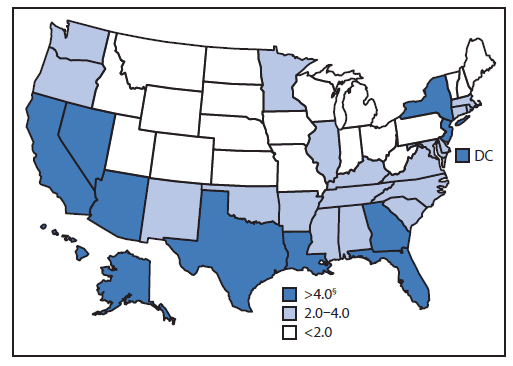
FIGURE 1. Rate* of tuberculosis (TB) cases, by state/area --- United States, 2010†

The figure shows the rate of tuberculosis (TB) cases, by state/area in the United States in 2010. In 2010, a total of 11,181 tuberculosis (TB) cases were reported in the United States, equivalent to a rate of 3.6 cases per 100,000 population. TB rates in reporting areas ranged from 0.6 (Maine) to 8.8 (Hawaii) cases per 100,000 population (median: 2.5).

Source: National TB Surveillance System.

* Per 100,000 population.

† Provisional data as of February 26, 2011.

§ 20 states had TB case rates <2.0 (range: 0.61--1.88) per 100,000

What is already known on the topic?

In 1989, the Strategic Plan for Elimination of Tuberculosis in the United States set a target date of 2010 to achieve its goal, defined as an annual tuberculosis (TB) case rate of <0.1 per 100,000 population.


What is added by this report?

For 2010, preliminary data show a national TB case rate of 3.6 per 100,000 population, a decrease of 3.9% from 2009, but the goal of eliminating TB in the United States by 2010 was not achieved, and foreign-born persons and racial/ethnic minorities continued to be affected disproportionately.


What are the implications for public health practice?

Ongoing surveillance and improved TB control and prevention activities, especially among disproportionately affected populations, are needed to eliminate TB in the United States.

»» Read More

WHO Releases New Global Action Plan On Tuberculosis


# 4980


The World Health Organization released a new action plan, which they hope will cut global TB deaths by half over the next few years.


Tuberculosis – although generally curable - kills millions of people each year around the world.   Twenty-two countries account for 80% of the world’s TB burden, with South Africa one of the worst affected.


While ambitious, WHO officials believe the targets outlined today are achievable . . . assuming the 4.2 billion dollar yearly shortfall in necessary funding can be addressed.


A difficult task given today’s economy.


Here then are excerpts from today’s press release, along with links to the plan.


New action plan lays the foundation for tuberculosis elimination

Targets are realistic, but a projected shortfall of US$ 4.2 billion per year for TB care and crucial research must be filled

13 OCTOBER 2010 | JOHANNESBURG | BERLIN | GENEVA -- The world could be on its way towards eliminating tuberculosis (TB) if governments and donors fully invest in a plan released today by the Stop TB Partnership. The global plan to stop TB 2011-2015: transforming the fight towards elimination of tuberculosis for the first time identifies all the research gaps that need to be filled to bring rapid TB tests, faster treatment regimens and a fully effective vaccine to market. It also shows public health programmes how to drive universal access to TB care, including how to modernize diagnostic laboratories and adopt revolutionary TB tests that have recently become available.

Related links
The Stop TB Partnership
The global plan to stop TB 2011-2015: transforming the fight towards elimination of tuberculosis

Action needed against TB

"There is an urgent need to scale up action against TB - 10 million people, including 4 million women and children, will lose their lives unnecessarily between now and 2015 if we fail," says Dr Margaret Chan, Director-General of WHO, which hosts the Stop TB Partnership. "TB control works, with global incidence of the disease declining since 2004, although much too slowly."


Twenty-two countries, including South Africa, bear 80% of the burden of TB worldwide. Some 9 million people become ill with active TB and nearly 2 million die each year. The new Global Plan sets out to provide diagnosis and treatment approaches recommended by the World Health Organization (WHO) for 32 million people over the next five years.


Blueprint to cut global TB deaths by half

"The Global Plan to Stop TB provides an urgently needed blueprint to cut global TB deaths by half," says Dr Aaron Motsoaledi, Minister of Health of South Africa. "In South Africa we have embarked on an ambitious agenda for reducing the toll of TB on our people, and we are committed to meeting the Global Plan's targets. We call on world leaders to invest in the plan, which can help move us towards ridding the world of TB."


Although TB is curable, the treatment requires taking a combination of drugs for at least six months. Laboratories in most countries are still using a century-old diagnostic method that involves searching for TB bacteria derived from a person's sputum under a microscope. And there is still no vaccine able to prevent pulmonary TB, the most common form of the disease.

(Continue . . .)


In a related story today, South Africa has announced that they plan to eventually test all HIV positive patients for Tuberculosis.


South Africa to test all HIV patients for TB

By JENNY GROSS, Associated Press Writer Jenny Gross,


South Africa has for many years endured an epidemic of HIV, and those whose immune systems have been weakened by that virus are more prone to contract TB. 


While the need is great today, routine testing isn’t expected to become a standardized procedure for several more years.

»» Read More

Badgers? We Don’t Need No Stinkin’ Badgers!


# 4873


Cinema lovers will no doubt recognize the above title as an homage to perhaps the 2nd most misquoted line from the movies (the first being Casablanca’s  `Play it Again, Sam’). 


In this case, it comes from another Bogart movie – The Treasure of the Sierra Madre – and the actual quote delivered by Alfonso Bedoya was:


Dobbs: "If you're the police where are your badges?"
Gold Hat: "Badges? We ain't got no badges. We don't need no badges! I don't have to show you any stinkin' badges!"


Over the years Gold Hat’s lines have morphed in popular culture and memory – aided and abetted by Mel Brook’s Blazing Saddles – into `Badges?  We don’t need no Stinkin’ Badges!’.


And of course, a thousand (now a thousand and one) parodies thereof.


Which brings us (at long last) to an infectious disease story out of the UK, where the power to cull badgers – which are viewed by many farmers as a serious threat to their cattle – is about to be granted.


Badgers can carry Mycobacterium bovis which is the cause of tuberculosis in cattle (known as bovine TB).


M. bovis is also capable of infecting humans (mainly through unpasteurized milk), although famers in contact with infected cattle are at risk as well.


In fact, of the three type of Tuberculosis bacteria (Mycobacterium bovis, M. avium, and M. tuberculosis), M. Bovis has the largest host range – being capable of infecting just about all warm-blooded vertebrates.


In countries where pasteurization of dairy products is common, human infection by M. bovis is relatively rare, but not unheard of.  


The UK’s HPA describes the risks thusly:


Humans and M bovis


TB caused by M. bovis is diagnosed in a small number of people  in the UK every year. The majority of cases are in people over 65 years old (and who drank infected unpasteurised milk in the past) or in those of any age who picked up the infection abroad. 

The number of human TB cases due to M. bovis infection is closely monitored by the Health Protection Agency in England and Wales, and Health Protection Scotland in Scotland.

Overall, human TB caused by M. bovis accounts for less than 1% of the total TB cases in the UK. However, those working closely with livestock and/or regularly drinking unpasteurised (raw) milk have a higher risk of exposure.


Over the last decade, it has been estimated that 150,000 head of cattle in the UK have been slaughtered because of M. Bovis infection – with compensation payments to farmers in 2009 running nearly £90mn.


Many farmers see badgers as the primary source of bovine TB, and blame them for reintroducing the disease into their herds each year.


Conservation and animal rights groups strongly disagree, and argue that the badger is the victim here.


They maintain that cow-to-cow transmission is the primary route of infection, and that badgers usually get the disease from cattle – not the other way around.


Both sides have their own experts, supportive studies, and a constituency behind them.  The debate has been vigorous, lengthy, and often heated as the following media reports illustrate:


13 July 2010

Welsh badger cull decision does not refute science


May 20, 2010

Minister blocks cull of badgers in bovine TB hotspots


14 Nov 2008

Cattle, not badgers, are reservoir of bovine TB

Bovine TB is not a threat to the health of Britain's badgers but farming unions are, says Trevor Lawson from the Badger Trust.


Animal rights groups hang their hat on a decade-long study by the Independent Scientific Group on Cattle TB, which concluded that culling could not “meaningfully contribute” to control of the disease.


Other researchers disagree.


The British Veterinary Association (BVA) has come down in favor of targeted, humane culling of badgers as part of an overall bTB (Bovine TB) eradication plan.


Some excerpts from their policy statement.


BVA Tuberculosis policy


The British Veterinary Association (BVA) believes that the eradication of bTB from cattle and wildlife populations must be the ultimate aim, with initial steps being taken immediately to control the spread of infection.

  • The current Government Strategy for bTB control is inadequate.
  • Control measures in cattle must be accompanied by simultaneous and coordinated measures in badgers and other wildlife and susceptible farmed species including deer and camelids for the success of any eradication programme.
  • Failure to tackle wildlife sources of infection has prolonged the presence of the disease in all affected species populations.
  • Targeted and managed badger culling is necessary in carefully selected areas where badgers are regarded as a significant contributor to the persistent presence of bTB.


Which brings us to the decision announced in today’s story, which will no doubt provoke the ire of a number of environmentalist and animal rights groups.


A hat tip to Dutchy on FluTrackers for this link.


Farmers to be handed powers to cull badgers

Farmers will be handed powers to slaughter badgers as part of a widespread cull in England aimed at halting the spread of tuberculosis in cattle herds.

(Continue. . . )


While the decision to proceed with limited culls appears to have been reached, legal challenges and the weight of public opinion may still prove to be impediments to the plan.


Not being an expert in the ecology of M. bovis, or the efficacy of badger culling, I’m hard pressed to take sides here. With conflicting studies and scientific assessments, any definitive answers as to what control methods actually work are unlikely in the near-term.


But for opposing viewpoints you may wish to visit:


The British Veterinary Association has scores of documents on the problems of bovine TB in the UK, which may be accessed at this link.


Badger Trust, which has opposed culling, presents its case on their website.

»» Read More

UK: TB Rising


# 4722


TB (Tuberculosis), which was once a scourge here in the US, had been thought on the brink of eradication in the western world by the 1970s. 


With the advent of new and powerful antibiotics and vaccines, the age of infectious diseases appeared to be nearing its end.


In 1969, the Surgeon General of the United States, William H. Stewart, famously (and prematurely) declared,  "The war against diseases has been won." 


And for a time, it seemed so.  


With the advent of the Salk Vaccine in 1955, we finally had the tool with which to eradicate the last great childhood scourge in this country; Polio.  By 1963, an early measles vaccine had been developed, and in the late 1970s significant improvements had been made in the existing mumps vaccine.


And the tremendous victory over smallpox – now vanquished from the planet for 3 decades – seemed only to prove the point.


A couple of telling graphics from the MMWR of Dec 1999, Achievements in Public Health, 1900-1999: Control of Infectious Diseases.


image

The 2nd leading cause of death in the United States in the year 1900 was Tuberculosis.


By 1997, TB wasn’t even in the top ten. 

image


But this victory was short-lived.


By the 1980s, new emerging pathogens were appearing; HIV, Hantavirus, Nipah, Hendra, Legionella, Borrelia. 


And old foes were showing up again, with new and improved defenses against our armament of antibiotics, antivirals, and vaccines; MRSA, influenza, and yes . . . Tuberculosis.


As you can see by the following graphic, the downward trend in deaths from infectious diseases in the United States began to rise noticeably from its nadir reached in 1980. 


image


Although the data above comes from the United States, the story is similar in other developed nations around the world.  


Infectious diseases are making a comeback. 


This past week we’ve a report on the incidence of Tuberculosis in London, England.  The rate is rising, and that has some public health officials very concerned.


First, this abstract from the Journal of Public Health, doi:10.1093/pubmed/fdq046.


Recent trends in tuberculosis in children in London


J.E.T. Ruwende
, E. Sanchez-Padilla, H. Maguire,
J. Carless
, S. Mandal, D. Shingadia


Abstract

Background Childhood tuberculosis (TB) represents a sentinel event of recent transmission and is an indication of the effectiveness of prevention and control interventions. We analysed the trends in the epidemiology of TB in children in London aged 0–14 years between 1999 and 2006.


Methods Data were extracted from the Enhanced TB Surveillance System.


Results Between 1999 and 2006, there were 1370 cases of TB in children. Incidence was higher in older children and in girls. The incidence rates in London Boroughs varied from 0.4/100 000 to 32.7/100 000. Between 1999 and 2006, Black-Africans comprised 49.2% of all TB cases in children, children from the Indian Subcontinent 21.8% and Whites 8.5%. The proportion of cases born in the UK averaged 52.4% during this period. Of non-UK-born children 79.3% were diagnosed with TB within 5 years of entry.


Conclusions Ethnicity, country of birth and age are important risk factors for development of. With an overall TB incidence in London exceeding 40/100 000, universal BCG immunization of all neonates should be considered across all London boroughs.


For more background, we go to this summary report on the Emerging Health Threats Forum.


High incidence rate in London sparks call for city-wide BCG vaccination in early childhood


The incidence of tuberculosis (TB) in the UK capital has reached levels that should trigger the start of routine vaccination against the disease for all babies born in the city, according to research published this month. Writing in the Journal of Public Health, medical scientists say that almost 45% of all childhood TB cases in the UK are now occurring in London.


A policy of routine BCG immunisation has been in place in some North London boroughs for several years already. The vaccination is advised only for UK-born babies whose parents and grandparents come from countries with a high incidence of TB, and those born in such countries who were not immunised previously.


The jab is also recommended for children living in areas where TB incidence in the entire population exceeds 40 cases per 100,000 people. This is now seen consistently across London, say the authors.

(Continue . . .)


The UK’s NHS (National Health Service) maintains a major web portal on TB information, including details on the Bacillus Calmette-Guérin (BCG) vaccine which provides protection against tuberculosis.


BCG (tuberculosis) vaccination

Who should have the vaccine?

The BCG vaccine is not given as part of the routine childhood vaccination schedule unless a baby is thought to have an increased risk of coming into contact with TB.


For example, all babies born in some areas of inner-city London (where TB rates are higher than in the rest of the country) should be offered the BCG vaccination.


BCG vaccinations may also be recommended for people who have an increased risk of developing TB, such as:

  • health workers
  • people who have recently arrived from countries with high levels of TB
  • people who have come into close contact with somebody infected with respiratory TB


For now, TB remains less of a problem in the United States, although with greater globalization and travel, that could change.  The BCG vaccine is not currently used in the US, since the incidence of the disease remains relatively low.


The CDC’s MMWR gives us the statistics for TB in the US as of 2006.


Trends in Tuberculosis Incidence --- United States, 2006

In 2006, a total of 13,767 tuberculosis (TB) cases (4.6 per 100,000 population) were reported in the United States, representing a 3.2% decline from the 2005 rate.

This report summarizes provisional 2006 TB incidence data from the National TB Surveillance System and describes trends since 1993.

The TB rate in 2006 was the lowest recorded since national reporting began in 1953, but the rate of decline has slowed since 2000. The average annual percentage decline in the TB incidence rate decreased from 7.3% per year during 1993--2000 (95% confidence interval [CI] = 6.9%--7.8%) to 3.8% during 2000--2006 (CI = 3.1%--4.5%).

Foreign-born persons and racial/ethnic minority populations continue to be affected disproportionately by TB in the United States. In 2006, the TB rate among foreign-born persons in the United States was 9.5 times that of U.S.-born persons.*

(Continue . . .)


Complicating matters has been the global emergence of drug resistant strains of Tuberculosis.


Last March the World Health Organization released a sobering new report on the global spread of Multidrug and Extensively Drug-Resistant  Tuberculosis  (M/XDR-TB), and   posted a press release on their website summarizing the problem.


image

77 Page PDF File


Drug-resistant tuberculosis now at record levels

18 MARCH 2010 | GENEVA | WASHINGTON DC -- In some areas of the world, one in four people with tuberculosis (TB) becomes ill with a form of the disease that can no longer be treated with standard drugs regimens, a World Health Organization (WHO) report says.


For example, 28% of all people newly diagnosed with TB in one region of north western Russia had the multidrug-resistant form of the disease (MDR-TB) in 2008. This is the highest level ever reported to WHO. Previously, the highest recorded level was 22% in Baku City, Azerbaijan, in 2007.

(Continue . . . )


With our increasingly mobile society, diseases that are today a problem in developing countries can readily find new homes in London, New York, Vancouver, Tokyo, and Sydney.


If you need more than humanitarian justification, this is reason enough to fund and support global public health initiatives, so that these threats can be dealt with before they spread any further.

»» Read More

Today Is World TB Day


# 4458


Almost 40 years ago, when I first entered the EMS arena (1972), Tuberculosis was in decline and most of the TB hospitals around the country were closing.   


Antibiotics and education – a least in developed nations – were making a huge impact.


Several times a year, however, I’d be called upon to transport a TB patient to the A. G. Holly TB hospital in Lantana Florida.  A slightly nervous four-hour ride in the back of an ambulance for an 18 year-old EMT, armed with just a surgical mask for protection.


While it seemed during the 1970s that we were on our way to beating tuberculosis (something that had hospitalized my grandmother for months in the 1930s), that victory never materialized.  


Instead, we’ve seen the rise of new, drug resistant strains of the TB bacillus, and a resurgence of the disease.


Today is World TB day, and the CDC has a webpage devoted to the agencies and activities working to eliminate this deadly scourge.   You’ll also find a number of CDC audio podcasts on Tuberculosis at the end of this post.


World TB Day 2010 TB Elimination: Together We Can!

World TB Day, March 24 - Together we can!World TB Day is March 24. This annual event commemorates the date in 1882 when Dr. Robert Koch announced his discovery of Mycobacterium tuberculosis, the bacteria that cause tuberculosis (TB).

World TB Day provides an opportunity to communicate TB-related problems and solutions and to support worldwide TB-control efforts. CDC and our partners are committed to eliminating TB in the United States.

In the United States, the theme for World TB Day 2010 is “TB elimination: Together We Can!”

Eliminating TB: Together We Can!

We can reach the goal of TB elimination by working together and strengthening partnerships.  This country’s progress in controlling TB will only be sustainable if local, state, national, and international partners from all sectors of our society join resources and collaborate together.  Our united effort is needed to reach those at highest risk for TB, and to identify and implement innovative strategies to improve testing and treatment among high-risk populations.

Stop TB USA logoCDC and its domestic and international partners, including the National TB Controllers Association, Stop TB USA, and the global Stop TB Partnership, are taking many steps to prevent further spread of TB and to reduce the overall burden of the disease. Efforts range from developing new treatment regimens and increasing the capacity of health professionals to provide adequate treatment, to issuing new recommendations for improved testing and treatment for U.S. immigrants.

Working Together to Eliminate TB

"Although preventable and treatable, malaria, tuberculosis (TB), and human immunodeficiency virus (HIV) together kill more than 5 million people annually. The burden of these diseases can be reduced—but only with increased governmental and nongovernmental resources, effective public-private partnerships, and strengthened disease-specific and general health systems." 

(Dr. Thomas R. Frieden, Director, Centers for Disease Control and Prevention, Administrator, Agency for Toxic Substances and Disease Registry)

How You Can Become a Partner
  • Find out more about TB services in your area.
  • Educate your community about TB.
  • Ensure that efforts to eliminate TB continue.

Because many people are not aware of the impact of TB, local coalitions in many states and countries are convening educational and awareness activities related to World TB Day. Look to see how you can learn more and get involved.

Podcasts

Multidrug-Resistant Tuberculosis

In this podcast, Dr. Oeltmann discusses multidrug-resistant tuberculosis. An outbreak occurred in Thailand, which led to 45 cases in the U.S. This serious illness can take up to 2 years to treat. MDR TB is a real threat and a serious condition.

TB Poem: Expressions from Us to You

Regina D. Bess from CDC's Division of Tuberculosis Elimination wrote this poem for World TB Day 2007 to convey messages of commitment and hope in the efforts to eliminate TB. It captures the essence of the TB program's mission and dedication to the communities it serves.

Emergence of Extensively Drug Resistant Tuberculosis

Extensively drug-resistant tuberculosis (XDR TB) outbreaks have been reported in South Africa, and strains have been identified on 6 continents. Dr. Peter Cegielski, team leader for drug-resistant TB with the Division of Tuberculosis Elimination at CDC, comments on a multinational team's report on this emerging global public health threat.

Mantoux Tuberculin Skin Test

Learn how to evaluate people for latent TB infection with the Mantoux tuberculin skin test. This podcast includes sections on administering and reading the Mantoux tuberculin skin test, the standard method for detecting latent TB infection since the 1930s.

»» Read More