Showing posts sorted by relevance for query NPM11. Sort by date Show all posts

NPM11: Preparedness For Kids


Note: This is day 7 of National Preparedness Month.  Follow this year’s campaign on Twitter by searching for the #NPM11 hash tag.


image

This month, as part of NPM11, I’ll be rerunning some edited and updated older preparedness essays, along with some new ones.


# 5819


As any Boy or Girl Scout will tell you, preparedness isn’t just for adults. 


And the Federal government obviously agrees since they maintain a website called Ready Kids as part of the Ready.gov program.


image


Here you’ll find a fun, interactive way to introduce young kids to the concepts of preparedness. Something that should be part of every child’s early education.


As a former scout myself, I learned elementary first aid, map reading, woodcraft & survival skills, and a host of other valuable lessons before I was even a teenager.


And growing up as young boy aboard a boat on the west coast of Florida, I learned about weather hazards, including tropical storms and lightning, and learned the value of becoming an excellent swimmer.


During the Cuban Missile crisis, at the age of 8, I got the short course in radiation sickness, fallout shelters, `duck & cover’ drills, and emergency evacuations from my local elementary school.  I recounted some of those experiences in a recent blog called NPM11: Creating A Family Communications Plan.


While I certainly don’t advocate that preparedness lessons be taught to kids today in such a stark and disturbing fashion - the Ready Kids site shows that the subject can be approached in a child-friendly non-threatening manner.


Later, while still in high school, I took Red Cross First Aid training at the local fire department. Shortly after graduation, in the summer of 1972, I took part in several rescues and helped to set up an emergency aid shelter at our local City Hall during Hurricane Agnes.


By October of that year, I was working on an ambulance and enrolled in the next available EMT class. Going full circle, a few years later as a Paramedic and a Red Cross CPR instructor, I taught hundreds of high school kids how to perform CPR.


One day, my partner and I rolled up on a heart attack scene, and found one of my students doing effective CPR on his grandfather  . . . and yes, I’m happy to report his grandfather survived.


For my family, general preparedness was just considered common sense.  Something to learn, and practice, and make into a lifelong habit.


And that attitude has served me well over the years.


In addition to the Ready Kids site above, FEMA has their own FEMA KIDS site, with loads of child-friendly preparedness resources.


image


If you have kids, or are just a kid at heart, take some time and check out these two resources.

»» Read More

NPM11: Living The Prepared Life


Note: This is the final day of National Preparedness Month.  Follow this year’s campaign on Twitter by searching for the #NPM11 hash tag.


image


This month, as part of NPM11, I’ll be rerunning some edited and updated older preparedness essays, along with some new ones.


# 5873


Since this is National Preparedness Month, I’ve been pleased to highlight the subject of disaster and emergency preparedness over the past 30 days. A search of this blog using the term NPM11 will return more than 15 recent preparedness essays.


I must confess that I never intended my life to revolve around emergency preparedness, but fate – and life choices – often end up driving us in unexpected directions.


Like many lads, I was a Boy Scout and later an Explorer Scout, and the motto `Be Prepared’ was drummed into our heads. But more importantly, as a young boy I lived for several years with my family aboard an ancient (circa 1914) 63’ wooden yacht.


image


It was an exciting lifestyle for a young boy, and while we lived mostly in a Marina, we often went out and stayed `on the hook’ for days at a time.


We were more-or-less self contained, with water holding tanks, generators, propane refrigeration, and even a small workshop aboard.


I learned to fish, swim, and handle a rowboat at a very early age. This was also during the height of the cold war, and the Cuban Missile crisis, and so civil defense and preparedness was instilled in all of us via the media and even my elementary school.


Later, as an adult, I would spend more than a dozen years living aboard a couple of different sailboats, and learned about solar power, navigation & map reading, and efficient food storage.  


image

Me, aboard `Island Time’ in 1987.


During the 1980s I took more than a year off and spent it living `on the hook’ and cruising aboard a smaller sloop.


It takes a lot of thought, and preparation, to get a small boat ready for an extended voyage.  And when you are out of radio range, which we were occasionally, calling for help was not an option.


Being prepared for emergencies was essential.


I also spent the better part of the 1970s working first as an EMT, and then as paramedic. There, I learned first-hand how quickly emergencies (large & small) can strike, and how important it was to have a good first aid kit, and the skills to use it.


image


And then, much later, for about a decade I even`went back to the land’. 


After spending all but one of my first 40 years in Florida, in 1995 I moved to 24 backwoods acres in the Midwest and attempted to carve a modicum of civilization out of the Missouri wilderness.


It was quite a learning experience.


We lived 30 minutes from the closest town, and during the winter, access to the property could be cut off for days, or even weeks, by ice or snow. We heated with wood, which we cut, split, and stacked ourselves and of course, we grew a garden.


I confess - I’m not really much of a backwoodsman - and while I learned a great deal during that time, I finally was able to return to Florida in 2005 (the statute of limitations had expired).


I hardly fit the popular image of a modern `Survivalist’, and no . . .  I’m not preparing for TEOTWAWKI (The End Of The World As We Know It). But experience has taught me that being well prepared for emergencies can pay big dividends.


I recommend - at a bare minimum – that every household should have a disaster plan, a good first aid kit (and the knowledge to use it), and emergency supplies to last a minimum of 72 hours during a disaster. 


Essentially the same advice you get Ready.gov, FEMA, and Red Cross. And if you do those few things, you will have taken important first steps towards being prepared for a disaster.


image


But there are times - as we’ve seen with the earthquake and tsunami in Japan, the tornado outbreaks in the south and Midwest this past spring, and with Hurricane Katrina in 2005 –  When 72 Hours Isn’t Enough.


Even in the wake of a low category Hurricane Irene, many residents of New England were still without power after 7 days.


Personally, I wouldn’t be happy with anything less than a 2-week stash of emergency supplies. But that’s just me, I live in hurricane country, and I’m sort of a belt-and-suspenders type of guy.


Over the years my preparations have provided me with emergency lighting, heat, and the ability to cook when the power was out for days at a time. And I’ve never had to face an empty cupboard during the aftermath of an ice storm or hurricane.


And just as importantly to me, I’ve been able to offer assistance to friends and neighbors during medical emergences and disasters.


I didn’t set out to live `the prepared life’, but time and again it has proven to be a good decision. As a result, I don’t lie awake at night worrying about massive solar flares, tsunamis, earthquakes, or zombie invasion.


I discovered long ago the secret to sleeping soundly at night; that preparing is easy.


It’s worrying that’s hard

»» Read More

NPM11: Disaster Preparedness Videos


Note: Today is day 11 of National Preparedness Month and ten years to the day since the horrific attack on 9/11/2001  – an indelible reminder that not all disasters are due to natural causes.   


It is this observance that has led to the adoption of `A Time to Remember, A Time to Prepare’ as the key message for NPM11.


image

This month, as part of NPM11, I’ll be rerunning some edited and updated older preparedness essays, along with some new ones.


# 5832


The University of California has produced a series of disaster and preparedness videos which are available on their Youtube channel UCtelevision. 


While I’ve highlighted most of these videos in the past, today I’ve added a couple of new ones; Disaster Plan and Home Preparedness in Earthquake Country.


I’ve watched most of these, and they are Highly recommended.

Disaster Preparedness

Are you ready for the next inevitable disaster? Whether you're an emergency responder, health care provider, or a community member who wants to know more about keeping your family safe, you'll want to watch this four-part video series from University of California Television and the California Preparedness Education Network. You will hear from noted health care providers and disaster response experts from around California, a state with a well-tested emergency response system that serves as a model for the rest of the country.


Thumbnail

28:41

Disaster Plan


44:02

Disaster Preparedness: Disaster Volunteerism


59:09

Disaster Preparedness: Influenza and Emerging Infections


56:55

Disaster Preparedness: Chemical and Biological Agents

53:44

Disaster Preparedness: Natural Disasters


Thumbnail

59:27


Home Preparedness in Earthquake Country

»» Read More

NPM11: The Ethics Of Preparation


Note: This is day 3 of National Preparedness Month.  Follow this year’s campaign on Twitter by searching for the #NPM11 hash tag.

image

This month, as part of NPM11, I’ll be rerunning some edited and updated older preparedness essays, along with some new ones.


# 5810


Over the years - when talking about emergency preparedness - a few people I’ve met have felt that it was somehow unfair, or even unethical, for those with greater financial means to prepare for disasters while those with fewer resources are be unable to do so.


A noble and egalitarian sounding idea, I suppose.


But the reality is that when more people are prepared before a crisis, fewer people will be competing for finite and sometimes slow-to-arrive emergency assistance in the days following a disaster.


And when you as an individual, family, or business are prepared, you are in a better position to offer help to friends, neighbors, relatives, or your community.


Which makes prepping not only ethical, but extremely practical as well.  


And it isn’t just me saying that.


In October, 2008 I wrote a blog which highlighted the John's Hopkins Study entitled Ethics and Severe Pandemic Influenza: Maintaining Essential Functions through a Fair and Considered Response.


It included the following snippet from the summary provided on  the Johns Hopkins Berman Institute of Bioethics website.


. . .  individuals and families who can afford it should do their best to prepare for any disaster. The paper notes, the more initiative the general public exercises in stockpiling several weeks' worth of food, water, paper goods, batteries medicines, and other needed supplies, the less vulnerable they will be to a break in the supply chain.


It is important for leaders to communicate to the middle class and the wealthy that it is their responsibility to prepare for self-sufficiency in order to free up scarce supplies and allow first responders to direct their attention towards those too poor or vulnerable to prepare themselves.


While this may not have been the main thrust of this paper's message, it is a powerful component. One that bloggers such as myself have been trying to promote for several years.


As long as our supply chains are intact, grocery store shelves are full and capable of being restocked, and no major shortages exist it is not hoarding, selfish, or unethical to be stockpiling a reasonable amount of emergency supplies for you, your family, and others you might be able to assist during a disaster.


During a crisis, relief agencies will have their hands full trying to help those who were unable to prepare, or who lost their preps due to a disaster.


By being prepared in advance, you take some of that burden off these agencies, which will allow them to concentrate their efforts on helping those less able to help themselves.


And by being prepared, you are in a better position to help others as well.


And that’s a win-win situation. For you, your family, and your whole community.


The American Red Cross sponsors a Do More Than Cross Your Fingers preparedness campaign. Spokesperson Jamie Lee Curtis has made a video that can get you started. 

image

You can also follow the Red Cross on Twitter by subscribing to @RedCross.


While 72 hours is considered the minimum amount of  time for which you and your family should be prepared, there is nothing that says you shouldn’t strive to do better than that.


A week or more of emergency supplies is a laudable, and easily obtainable, goal. 


The Red Cross isn’t alone in promoting disaster preparedness. Over the past decade, personal and community preparedness has become a national goal.


For more information, visit:


FEMA http://www.fema.gov/index.shtm

READY.GOV http://www.ready.gov/


It’s really the ethical thing to do.

»» Read More

NPM11: A First Aid Kit To Go

Note: This is day 6 of National Preparedness Month.  Follow this year’s campaign on Twitter by searching for the #NPM11 hash tag.

image

This month, as part of NPM11, I’ll be rerunning some edited and updated older preparedness essays, along with some new ones.


# 5816


Well equipped First Aid kits are a necessity in every home, and should also be found in every car as well.  While you can purchase a ready-made kit (the quality of which varies depending on price), I’ve always preferred to create my own.


As a former paramedic I undoubtedly have a more elaborate kit than most, but perhaps a look inside my bag will inspire some of my readers to make one of their own.


The `bag’ is an old style Laptop computer case, with a handle and a shoulder strap.  I like these, because they have numerous compartments, are soft, and are reasonably waterproof.


auto kit 009


On the `trauma’ side of the bag, I’ve got `Kling’ roll bandages, an ACE bandage, a couple of cravat `Triangle’ bandage (sling & swath), sterile 4x4 gauze pads, paper tape, Band-Aids, antibiotic cream and several absorbent feminine pads (they make excellent trauma dressings). 


auto kit 003


On the opposite side, I’ve got an `ambu’ bag-mask resuscitator along with a selection of adult and child airways, a foam C-Collar, a B/P cuff, stethoscope, flashlight, and some ammonia caps – hidden away where you can’t see them are bandage shears, tweezers, and a magnifying glass, along with a spare pair of reading glasses.

auto kit 002

There is also a penlight, a felt tipped pen, and a note pad.


Under the front `cover’ flap, I keep some basic OTC medicines, including aspirin, acetaminophen, some hand antiseptic, and a bulb syringe (can be used for minor suctioning).


auto kit 004


Under the flap on the other side, I’ve got surgical & N95 masks, exam gloves, and a `space’ blanket.


auto kit 005


Of course, having a kit isn’t enough.  You need to know how to use it.


And for that, you need first aid training.  If you haven’t already taken a course, contact your local Red Cross chapter, and find out what is available in your area.   And don’t forget the CPR training (or recertification!) as well.


Whether you buy a ready-made kit, or make your own, now is a good time to make sure you are fully equipped to deal with a medical emergency.


For more information go to:


FEMA http://www.fema.gov/index.shtm

READY.GOV http://www.ready.gov/

AMERICAN RED CROSS http://www.redcross.org/

»» Read More

NPM11: A Simple Weekend Flu Prep


Note: This is day 4 of National Preparedness Month.  Follow this year’s campaign on Twitter by searching for the #NPM11 hash tag.

image

This month, as part of NPM11, I’ll be rerunning some edited and updated older preparedness essays, along with some new ones.


# 5811


With this year’s flu season just around the corner, and on the heels of this week’s exotic flu news (see FAO Warns On Bird Flu & CIDRAP On Today’s Reassorted Swine Flu Story), today seems like a good day to rerun this simple flu-related prepping advice.


Being prepared is a habit, one that takes time (and practice) to establish. Even though I consider myself reasonably ready for most emergencies, I have – on occasion – been caught less than prepared.


The single best flu-related prep is undoubtedly getting your flu vaccination each and every year.


Flu Vaccines have an excellent safety record, and are now recommended for nearly everyone over the age of 6 months. While it may not protect against every type of respiratory infection, most years it proves effective against the most dangerous flu strains in circulation.


But even when you get the shot, it is possible to be felled by a sudden illness.


One night about 4 years ago I felt a bit unwell (feverish and tired) and laid down. The next 24 hours were lost in a feverish delirium as I came down with some kind of a  brief, but debilitating, illness.


Although the bathroom and kitchen were but a few steps away, I was too weak, and too delirious, to even fetch myself a glass of water. My cell phone was in its charger in the living room, so I couldn’t call for help.


I remember laying there knowing I should be taking some acetaminophen to quell the fever and forcing fluids . . . but I was simply unable to do so.


Luckily, I recovered enough that the next evening I was able to get up and rehydrate myself.  A few days later, I was almost human again.


I, like millions of others, live alone.


And those of us without an in-house support system (and particularly single parents raising small children) need to take extra steps to prepare for this sort of event.


Since that long night’s journey into the next day, I’ve made two simple changes.


First, I’ve moved my cell phone charger to my beside table. My phone now goes with me when I retire at night, that way I can call for help if ever the need arises.


Second, I made a simple under-the-bed flu kit. 

flu box 2

In it, I’ve got:


A couple of pouch Sports drinks (rehydration)

A bottle of acetaminophen

A bottle of expectorant pills

Imodium pills

A thermometer

Throat lozenges

Surgical masks for me to wear in case I have to call for help or have visitors.

All of which fits in a small plastic box.   Any small container would do.


And of course, my cell phone is now kept close at hand.


It’s a simple prep.  One that I put together with things I already had around the house and in my medicine cabinet. But having preps is pretty much useless if you can’t get to them when you need them.


Since then, I’ve had one occasion to use this `flu box’, although I wasn’t anywhere nearly as incapacitated as I was 3 years ago.   It was more of a `flu comfort kit’ than an emergency prep.


It did, however, serve as a reminder to replace the soon-to-be-expired sports drinks.


Putting together a little flu kit like this may seem like too insignificant of a prep to bother with, but believe me, I wish I’d thought of it before I needed it.

»» Read More

NPM11: Giving Preparedness A Shot In The Arm


Note: This is day 9 of National Preparedness Month.  Follow this year’s campaign on Twitter by searching for the #NPM11 hash tag.

image

This month, as part of NPM11, I’ll be rerunning some edited and updated older preparedness essays, along with some new ones.


# 5826


While it may not leap immediately to mind when one thinks about emergency preparedness, getting and staying current with appropriate vaccines is one of the best ways to prepare for a disaster.


As it is September, now is the time to be arranging for your yearly flu vaccination.  ACIP  recommends that virtually everyone over the age of 6 months get the flu vaccine every year.


And it’s good preparedness advice, particular since during a disaster or prolonged emergency you are more likely to be tired, run down, and are probably at a greater risk of catching the flu.


In the wake of a disaster thousands of people may find themselves temporarily crowded together in shelters, where an influenza virus could spread rapidly.


Imagine trying to evacuate your home quickly with a couple of very sick kids, or the difficulties you might encounter finding a place to stay if your family were visibly ill with a communicable disease.


A simple flu vaccination each fall could go a long way towards preventing those difficult scenarios.


Most people think of vaccines as kids stuff.  Something you outgrow the need for.  But that isn’t true. 


Adults need vaccines as well.


During a major disaster - such as an earthquake, hurricane, or flood -  thousands, perhaps tens of thousands of people may sustain injuries ranging from small cuts and scrapes to major trauma.


And any of those who have let their tetanus booster vaccination lapse are at risk of serious, even life threatening, infection.


Even if you can obtain a tetanus shot immediately after an injury (and that could be problematic in a mass casualty event), that may not prevent infection.  It can take up to two weeks to build antibodies after getting the shot.


image


Tetanus is relatively rare in the United States (see Tetanus Surveillance --- United States, 1998—2000) due to aggressive vaccination campaigns, but worldwide, this infection still claims hundreds of thousands of lives each year. 


And the Tetanus booster shot also protects against Diphtheria and Pertussis (Whooping Cough) – an old scourge that once was almost vanquished here in the United States, but has returned with a vengeance in recent years (see California Reports 9th Pertussis Fatality of 2010)


If you have kids, talk to their pediatrician or your family doctor about what vaccinations they require. Adults can either ask their physicians, or refer to this handy vaccination schedule for adults provided by Immunize.org.


image

(Click to load)


Vaccines have excellent safety records. Yes, taking any medicine – including a vaccine – entails some (usually miniscule) degree of risk. But those risks pale when compared to the dangers of catching the diseases they are designed to prevent.


Influenza alone kills tens of thousands of people every year in this country.


Ready.gov urges all Americans to follow these 3 steps to better preparedness:

image

GET A KIT

MAKE A PLAN

BE INFORMED


But if you want to be truly prepared, I would recommend you consider adding an important 4th step.


Get a shot


image

»» Read More

NPM11: Disaster Buddies


Note: This is day 14 of National Preparedness Month.  Follow this year’s campaign on Twitter by searching for the #NPM11 hash tag.

image

This month, as part of NPM11, I’ll be rerunning some edited and updated older preparedness essays, along with some new ones.


# 5839


I began promoting the idea of `Flu Buddies’ in 2007, but only really fleshed out the idea in a 2008 blog called Lifelines In A Pandemic, where I wrote:


Each of us need, in advance, to make `Flu Buddies'.  And not just people who live alone, although they are at the greatest risk.


An arrangement with one or more people (or families) that you will come to their aid during a crisis, and that they will come to yours if needed. For most, these `buddies' will probably be family members, good friends, or neighbors.


People we care about.


If someone on your `buddy list' gets sick, they will have buddies to help them through it.  Someone to fetch medicine, bring food and water, and make sure they take their meds.


I returned to this theme often during the 2009 pandemic, including Pandemic Solutions: Flu Buddies,  UK: Call To Appoint Swine `Flu Friends’ and Canada Urges People To Find `Flu Buddies’.


After the pandemic receded I reworked the idea into a more generic `Disaster Buddy’ concept in a blog called  In An Emergency, Who Has Your Back?.


It doesn’t require a pandemic, earthquake, or hurricane to put you in perilous straits. A house fire, car accident, sudden illness, or some other more limited emergency can overwhelm as well, and having a pre-existing support system makes a lot of sense.


Nearly 1 person in 10 in the United States lives alone.   That’s roughly 27 million adults.


Add to that the number of households with one adult caring for one or more minor children or caring for elderly, disabled, or otherwise unable to fend-for-themselves individuals, and the number goes up dramatically.


People who live alone, or who are the sole responsible adult in a household, have the greatest need to establish some kind of disaster `safety net’ with friends, relatives, or neighbors.


And the best way is by arranging to have (and to be) a `Disaster Buddy’.


A `Disaster Buddy’ is simply someone you have prearranged that you can call on during a crisis, and who in turn, can call on you if they need help. 


It only works if it is reciprocal.


Frankly, having (and being) a `Disaster Buddy’ to friends, neighbors, and relatives should be part of everyone’s family disaster plan. 


No one likes to impose on a friend, of course.


But if you’ve already established a `disaster buddy’ relationship  – one that is fair and reciprocal – it shouldn’t be considered an imposition.


In the parlance of paramedics, cops, firefighters and the military . . .   “you have their back, and in return, they have yours.”


It is a simple concept, but one that needs to be talked out in advance, not simply assumed.


It is also worth mentioning that there has never been a better time to volunteer to help with the American Red Cross, The Medical Reserve Corps, CERT, or your Neighborhood watch.


We are truly only prepared as our friends, families, and surrounding community are.  There are roles to play for everyone, including civic organizations, schools, and church. 


Now - before a disaster occurs - is the time to sit down and talk to your friends, family, and neighbors about how you will help one another during a personal or community wide crisis.


For more potentially life saving preparedness information, I invite you to visit:


FEMA http://www.fema.gov/index.shtm

READY.GOV http://www.ready.gov/

AMERICAN RED CROSS http://www.redcross.org/

»» Read More

NPM11: Creating A Family Communications Plan


Note: This is day 5 of National Preparedness Month.  Follow this year’s campaign on Twitter by searching for the #NPM11 hash tag.

image

This month, as part of NPM11, I’ll be rerunning some edited and updated older preparedness essays, along with some new ones.


# 5813


Those of us who were living in Florida during the `bad old days’ of the cold war remember well the Cuban Missile Crisis of 1962.


Although it is hard to imagine it today, much of Florida was on a war footing with fears of a nuclear attack that might come at any time, thousands of military streaming into the state, and schools running daily `duck & cover’ and emergency evacuation exercises.


Kids were sent home with civil defense pamphlets on the basics of radiation poisoning and how to build an in-home fallout shelter.


image


As an 8-year-old with a scientific bent, these were exciting times.


What I didn’t full appreciate at the time was my parents were faced with an agonizing dilemma. My twin-brother and I attended a nearby elementary school, while my 17-year old sister attended high school some distance away.


If the alert went up, they realized they might only have time to get to one school to pick up their kids.


Logic dictated that the pick up my brother and I, based on our ages, and the fact that there were two of us. My sister was given instructions to go to the home of one of her high school friends, and our folks would  either contact her or pick her up there.


Nearly 50 years ago, in the face of a potential crisis, my family cobbled together their own emergency communications plan including an alternate rendezvous point.


While a nuclear attack is (thankfully) far less likely today, the same principles hold true when it comes to having a communications plan, and a meet-up point.


And since a tornado, earthquake, house fire, or some other disaster can strike without warning . . .  these are the sorts of plans every family needs to make now.


Before they are needed.


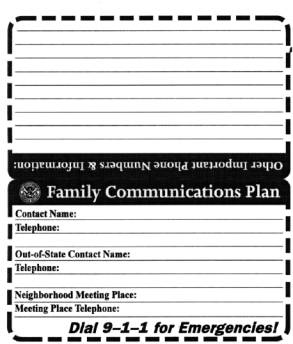
Luckily FEMA and READY.GOV have made things a bit easier today.  They’ve developed a Family Emergency Communications Kit, which can be downloaded free from the net. 


With just a few minutes effort, you can have your own emergency communications plan and emergency meeting place set up.


Family Communications
Image of family communication plan

Your family may not be together when disaster strikes, so plan how you will contact one another. Think about how you will communicate in different situations.


Complete a contact card for each family member. Have family members keep these cards handy in a wallet, purse, backpack, etc. You may want to send one to school with each child to keep on file. Pick a friend or relative who lives out-of-state for household members to notify they are safe.


Family Communications Plan which should be completed and posted so the contact information is readily accessible to all family members. A copy should also be included in your family disaster supplies kit.


Appendix C of the Are You Ready? Guide (contains blank contact cards and a family communications plan form)


You’ll find the Ready.gov version of the kit available HERE.

»» Read More

NPM11: Early CPR Saves Lives


Note: This is day 19 of National Preparedness Month.  Follow this year’s campaign on Twitter by searching for the #NPM11 hash tag.

image

This month, as part of NPM11, I’ll be rerunning some edited and updated older preparedness essays, along with some new ones.


# 5851


As a paramedic I did nearly all of my rescue work in three cardiac prone cities (St. Petersburg Fl, Phoenix AZ, Bradenton Fl), so heart attacks and codes (cardiac arrests) were pretty much a part of every shift.


Even with the addition of ALS (Advance Life Support - defibrillators, cardiac meds, and telemetry) most of our attempts to resuscitate patients in full cardiac arrest failed.


It was simply a matter of timing.


Once the heart stops beating, the patient has maybe 4 to 6 minutes before irreparable damage occurs. Only rarely does an ambulance or rescue squad arrive within that window of opportunity.


There were some happy endings, of course.  Not as many as I’d have liked, but sometimes we got lucky. And a lot of those `saves’ could be credited to quick acting bystanders who began CPR before we arrived.


One of the big contributors to sudden cardiac death at home is a failure to call 911 when coronary symptoms first appear.  Often people will wait hours, hoping the chest pain will go away, before calling for help.


From the CDC’s Heart Attack Information page:

Symptoms of a Heart Attack

The five major symptoms of a heart attack are—

  • Pain or discomfort in the jaw, neck, or back.
  • Feeling weak, light-headed, or faint.
  • Chest pain or discomfort.
  • Pain or discomfort in arms or shoulder.
  • Shortness of breath.

If you think that you or someone you know is having a heart attack, you should call 9–1–1 immediately.


The most dire situation is a sudden cardiac arrest, where the patient’s heart and breathing have stopped. Resuscitation efforts need to be started immediately else the patient is unlikely to survive.


In 2010 the American Heart Association unveiled new CPR Guidelines which encourages lay bystanders to provide compression-only CPR.


Excerpts from the 2010 press release follow:


A New Order for CPR, Spelled C-A-B

Statement Highlights:

- The 2010 AHA Guidelines for CPR and ECC update the 2005 guidelines.

- When administering CPR, immediate chest compressions should be done first.

- Untrained lay people are urged to administer Hands-Only CPR (chest compressions only).


AHA-Stayin-Alive-Web-Page_2STEPS_2

The following video  explains the changes in the new 2010 Guidelines for CPR.


Using humor to drive the point home, the following AHA video carries an important message: 80% of all cardiac arrests occur at home.


Learning CPR means that person you are most likely to save will be a member of your own family.


Today, CPR is easier to do than ever.


Compression-only CPR is now the standard for laypeople, and so you don’t have to worry about doing mouth-to-mouth.


A CPR class, where you will get to learn more and practice these skills only takes a few hours, and it could end up helping you save the life of someone you love.


To find a local CPR course contact your local chapter of the American Red Cross, the American Heart Association, or (usually) your local fire department or EMS can steer you to a class.


For more on the recent changes to bystander CPR, you may wish to visit these recent blogs.


CPR As A Requirement For High School Graduation

AHA Unveils 2010 CPR Guidelines

JAMA: Compression Only CPR

MMWR: Sudden Cardiac Arrest Awareness Month

»» Read More

NPM11: Survey Shows An Inappropriate Level Of Preparedness


Note: This is day 12 of National Preparedness Month.  Follow this year’s campaign on Twitter by searching for the #NPM11 hash tag.

image

This month, as part of NPM11, I’ll be rerunning some edited and updated older preparedness essays, along with some new ones.


# 5833


In a recent survey prepared by the Marist Institute for Public Opinions for the National Center For Disaster Preparedness at Columbia University’s Mailman School of Public Health we learn that 10 years after 9/11 half of all American families still have no disaster plan, and 30% of those with plans lack critical components in their disaster kits.


You can find more details in an Associated Press article that appeared in the WSJ called :


Survey: US public still unprepared for catastrophe


Despite ample evidence to the contrary, far too many Americans have the unrealistic expectation that in a disaster, help would arrive at their door within an hour or two of calling 911.


You can access the executive summary of this survey at:


The American Preparedness Project


Where the US Public Stands in 2011 on Terrorism, Security, and Disaster Preparedness


Disasters, large and small, happen every day around the world.   It doesn’t take a pandemic, or an earthquake, or a hurricane to ruin your entire day.


As a paramedic I often came face-to-face with the unhappy results that occur when people are  unprepared to deal with an emergency.


I’ve seen people badly injured (and sometimes killed) because they, or someone around them, lacked the knowledge of what to do in an emergency or because they simply didn’t have a proper first aid kit.


This year we saw a destructive tornado season across our southern and Midwestern states, and having lost my roof to one back in 1978, I can assure you there is nothing more abrupt (and likely to make a a lifelong impression) than being struck by one of these monsters in the middle of the night.


image


This map below shows the areas of greatest danger, but practically all regions of the nation can see tornadoes.


image


We are just over half way through a very active Hurricane season, and wildfires and drought continue to plague several states in the western and southern part of the country.


And it’s always earthquake season.


image

Are you ready?


According to this latest poll, many Americans are not.  This despite dozens of major disasters (often weather related) that occur every year in this country. Already this nation has seen 10 billion-dollar plus weather disasters in 2011.


And each and every day, thousands of people are injured in automobile, work related, and household accidents.


Everyone should have a well equipped first aid kit in their car, workplace, and home . . . and everyone should know the basics of first aid. If you’ve never taken a first aid course, contact your local chapter of the American Red Cross.


Agencies like FEMA, READY.GOV and the HHS are constantly trying to get the preparedness message out, so that when (not `if') a disaster does occur, human losses can be minimized.


For more information on how to prepare for emergencies the following sites should be of assistance.


FEMA http://www.fema.gov/index.shtm

READY.GOV http://www.ready.gov/

AMERICAN RED CROSS http://www.redcross.org/


At a bare minimum, every household should have a disaster plan, a good first aid kit (and the knowledge to use it), and emergency supplies to last a minimum of 72 hours during a disaster.  


Anything less is simply inappropriate.

And personally, I wouldn’t feel comfortable with anything less than a week.


I can’t tell you when the next disaster will strike, or where, or even by what means. But I can assure you that millions of people will be affected by some type of disaster or emergency in the coming year.


And history has shown, the advantage always goes to those who are prepared.

»» Read More

NPM11: Are You Earthquake Prepared?

Note: This is day 15 of National Preparedness Month.  Follow this year’s campaign on Twitter by searching for the #NPM11 hash tag.

image

This month, as part of NPM11, I’ll be rerunning some edited and updated older preparedness essays, along with some new ones.


# 5841


While many natural disasters – like hurricanes, wild fires, and tornados – have a `season’, earthquakes can come at any time and without warning.  As last month’s quake in Virginia demonstrated, even areas that rarely see seismic activity can be at risk.


While large earthquakes in the eastern half of the country are relatively rare, they do happen. As you can see by the map below, most of the United States is seismically active – with Alaska, Hawaii, the west coast, and the Midwest seeing the most – and strongest, quakes.


image

USGS map


We live on a planet where earthquakes, volcanoes and tsunamis occur with some regularity. Major earthquakes (7.0 Mag or greater) occur somewhere in the world roughly 17 times each year.


image

1. Based on observations since 1900.

2. Based on observations since 1990.

NOTE: The NEIC estimates that several million earthquakes occur in the world each year. Many go undetected because they hit remote areas or have very small magnitudes.

Source: National Earthquake Information Center, USGS

image

Seismically active areas of the world


Over the past two years earthquakes in Haiti, Chile, New Zealand, and Japan have killed tens of thousands of people, along with disrupting the lives of millions of others. 


An Active Ring of Fire

image

Original Map – USGS


And the effects of an earthquake can go far beyond the loss of life and property damage.  Ripple effects caused by economic losses can affect regions far removed from the epicenter.


Last June, in The Ripple Effect, we saw that 2/3rds of all businesses in New Zealand were economically impacted by the Christchurch earthquakes.


Before that, in Estimating The Economic Impact Of A San Andreas Quake, we saw a U.S. Bureau of Labor Statistics report  that estimated the crippling impact a highly feasible (and long overdue) 7.8 magnitude Southern California earthquake would have on jobs and local businesses.

image

Download PDF file


The point being that when earthquakes happen, you don’t have to be physically injured to be seriously impacted. 


Hence the need for earthquake preparedness, even if you don’t live directly over a major fault line.


Working to improve earthquake awareness, preparation, and safety is Shakeout.org, which promotes yearly earthquake drills and education around the country.


image


Upcoming drills include:

Future ShakeOuts (new and repeating):
The Great British Columbia ShakeOut, October 20, 2011 
The Great California ShakeOut, October 20, 2011
The Great Nevada ShakeOut, October 20, 2011
The Great Guam ShakeOut, October 20, 2011
The Great Utah ShakeOut, April 17, 2012
The Great Central U.S. Shakeout On February 7, 2012


For more on how you can prepare for `the big one’ (even if you live someplace other than Los Angeles), I would recommend you download, read, and implement the advice provided by the The L. A. County Emergency Survival Guide.


image


When it comes to extremely large quakes in North America, one of the areas considered most at risk is the Pacific Northwest (see Just A Matter Of Time).


Last January I profiled a Washington state based preparedness educator Carol Dunn, who maintains an excellent website on the hazards faced by those living in the Pacific Northwest called 2Resilience.


image


You’ll find numerous resources geared for professional first responders, citizen volunteers, and families, individuals, and businesses looking to improve their level of knowledge and preparedness.


Last December in Resolve To Be Ready In 2011 Toolkit, I highlighted a 24-page toolkit produced by FEMA, Ready.gov, and the Department of Homeland Security, along with the Ad Council to help promote better individual and community preparedness in 2011.


image


You can find the details on the Ready.gov website at:


http://www.ready.gov/resolve2011

This toolkit is well worth downloading (and sharing).


And to become better prepared as an individual, family, business owner, or community to deal with all types of disasters, I would invite you to visit the following preparedness sites.


FEMA http://www.fema.gov/index.shtm

READY.GOV http://www.ready.gov/

AMERICAN RED CROSS http://www.redcross.org/


Because no matter where you live, its just a matter of time before the next disaster strikes.

»» Read More