Showing posts with label deaths. Show all posts

Revisiting The Numbers Racket


# 6739


An excellent piece by Kelly Crowe of CBC News over the weekend questions the credibility of flu mortality numbers and reminds us, once again, that in public health easy answers are often the hardest to deliver.


First a link to the article, which I encourage you to read in its entirety. 


Flu deaths reality check

Credibility of flu models disputed
By Kelly Crowe, CBC News
Posted: Nov 25, 2012 5:14 PM ET

Do thousands of Canadians really die every year from the flu? The flu folks keep saying so. I've already heard it repeated several times this year and flu season has just started. This is what the Public Health Agency of Canada said in a recent press release: "Every year, between 2,000 and 8,000 Canadians die of the flu and its complications."

(Continue . . . )


Long time visitors to this blog will recall that we’ve trod this perilous path before - for both seasonal and pandemic flu - along with a variety of other diseases.  


Quite understandably, the public and the media expect public health officials to have some kind of handle on the number of deaths caused by infectious diseases in our society. 


Particularly with something as ubiquitous as flu.


But the truth is, no one really knows.


After more than a decade of promoting the `flu kills roughly 36,000 Americans each year’ meme, the CDC revised (and hopefully improved) their estimates in 2010 ( see MMWR: Estimates Of Yearly Seasonal Influenza Deaths)


For deaths with underlying pneumonia and influenza causes (the most narrow definition of flu-related fatalities used) the models estimated a yearly average of 6,309 (range: 961 in 1986--87 to 14,715 in 2003--04) influenza-associated deaths.


Using a broader criteria (underlying respiratory and circulatory causes including pneumonia and influenza causes)  the models estimated an annual average of 23,607 (range: 3,349 in 1986--87 to 48,614 in 2003--04) influenza-associated deaths.


Despite the 12-fold difference in deaths between the 1986-87 and 2003-04 seasons, the operative word here remains `estimated’. 


  • Estimates are extrapolated based on a surveillance subset of the country, not the whole nation
  • There are often co-circulating viruses that may influence overall mortality.
  • Surveillance, testing, and reporting may change over time
  • Different mathematical models can produce differing results
  • There are varying opinions as to what constitutes an influenza-related fatality.


When combined with the inevitable variations in the severity of influenza seasons (H3 years are usually more severe than H1 years), this makes it impossible to derive a single number that `works’.


In an attempt not to compound a felony, I try to leave it as influenza `kills thousands each year’ or `is the cause of substantial mortality’ in this blog. Sometimes I’ll use the range (3,000-48,000) offered by the CDC, but most of the time I don’t.


The same holds true for just about any illness or disease you’d care to mention. 


Ask the CDC how many people contracted West Nile Fever this summer, and they will tell you that (as of Nov. 20th) they had recorded  5,207 cases of West Nile virus disease in people, including 234 deaths, but that the real number may be 50 times higher.


Severe (neuroinvasive) cases are pretty easy to spot, but they estimate only 1%-3% of mild cases of West Nile Fever are diagnosed and reported.


If we do the math, and assume the 2654 non-neuroinvasive cases officially reported constitute between 1% and 3% of the total number of actual cases we get a range of between 250,000 and 85,000 infections.


The chart below illustrates the problem nicely. 


surveillance


Relying only on lab confirmed fatalities isn’t much of a solution, either. The `official’ death toll for the 2009 pandemic - as reported by the World Health Organization  - was roughly 18,000 deaths globally.


The WHO offered this disclaimer:


The reported number of fatal cases is an under representation of the actual numbers as many deaths are never tested or recognized as influenza related.World Health Organization.


Unfortunately, the mainstream media often reported the low official number of deaths without adequately explaining the acknowledged gaps in the data, leading many to believe that the 2009 pandemic was a damp squib.


In contrast, earlier this year, in Lancet: Estimating Global 2009 Pandemic Mortality, we saw a study who’s estimate found:


We estimate that globally there were 201 200 respiratory deaths (range 105 700—395 600) with an additional 83 300 cardiovascular deaths (46 000—179 900) associated with 2009 pandemic influenza A H1N1. 80% of the respiratory and cardiovascular deaths were in people younger than 65 years and 59% occurred in southeast Asia and Africa.


With no way to accurately count cases, analysts are reduced to creating mathematical models, fueled by both hard data and assumptions, in order to extrapolate the impact of diseases on the population.


The old adage (well, not that old, as it is attributed to George E. P. Box, Professor Emeritus of Statistics at the University of Wisconsin) is that:


“All models are wrong, but some models are useful.”


To that I would add, that while useful, mathematical models can be extraordinarily difficult to defend.


It requires agreement over assumptions.  And among academics, that’s never easy to reach.


Going hand-in-hand with the estimates of flu deaths each year has been the purported effectiveness of the seasonal flu shot.


Up until about a year ago the CDC’s mantra has been for healthy adults under the age of 65, in years when the vaccine is a good match to circulating strains, effectiveness ranges from 70%-90%.


Despite these important qualifiers, the message often ended up being shortened in the media to the flu vaccine being `up to 90% effective’.


A little more than a year ago the CDC updated their FAQ on Flu Vaccine effectiveness, and as part of a much longer detailed posting, lowered their estimate of the inactivated flu shot’s effectiveness to read:


. . . recent RCTs of inactivated influenza vaccine among adults under 65 years of age have estimated 50-70% vaccine efficacy during seasons in which the vaccines' influenza A components were well matched to circulating influenza A viruses.


A number that pretty much matched CIDRAP’s finding (see A Comprehensive Flu Vaccine Effectiveness Meta-Analysis) which would be released a couple of weeks later. That analysis showed the trivalent inactivated vaccine (TIV) had a combined efficacy of 59% among healthy adults (aged 18–65 years).


So what are we left with?


Well, every time we get into statistics (admittedly not my strong suit) I’m reminded of the story of the statistician who drowned trying to ford a river that was, on average, only 3 feet deep.


Still I think we can safely draw a few conclusions.


Influenza-like-Illnesses (ILIs) obviously contribute to a good deal of morbidity and mortality each year. 


In addition to influenza, these illnesses can be caused by the metapneumovirus, parainfluenzavirus, respiratory syncytial virus (RSV), adenoviruses, or any of the myriad Rhinoviruses (Common cold).  Among others.


The percentage of these illnesses that are actually due to the influenza virus varies considerably from year to year, and so only a portion of these deaths are actually `vaccine preventable’.


Today’s influenza vaccine, whose effectiveness is described as just `moderate’ by CIDRAP’s recent 160-page Comprehensive Influenza Vaccine Initiative (CCIVI) report, undoubtedly saves lives and reduces hospitalization, but is not the panacea that many would hope for.


image


Hence the call for better vaccines.  


Despite their limitations, I still get a flu vaccine each year, as I believe partial protection beats no protection any day of the week.


As far as the estimate of deaths from influenza are concerned, I doubt this debate can really be solved to everyone’s satisfaction. There is no single, `good’ answer when the parameters change as often as they do with influenza.


We live in a world driven by easily adopted memes, 10 second sound bytes, and 140 character tweets.


As a result, officials are often tempted to provide us with simplified, easy to digest, answers. While brevity may have many advantages, scientific precision is rarely one of them. 


Of course, if someone comes up with a better way to measure the number of deaths from influenza each year, I’ll feature it in this blog.  Until that happens, I’ll simply leave it as the cause of `substantial mortality’.

»» Read More

New England Seal Deaths Tied to H3N8 Flu Virus


# 6022


We’ve a follow up from NOAA today on the mysterious deaths of seals along the New England coastline earlier this fall.  In early November I reported (see NOAA: New England Dead Seals Test Positive For Flu) that initial tests indicated an influenza A virus, but more testing was needed to determine the exact strain.


In the past, we’ve seen rare and isolated influenza infections resulting in seal deaths from the H7N7 and H4N5 avian flu viruses.


Today we learn that the viral culprit in this latest incident is a variant of the H3N8 avian flu strain, versions of which are known to also infect horses and dogs.


My thanks to @JustinNOAA for the link to this news release.


Science team identifies influenza virus subtype that infected five dead seals

Risk to humans and pets low; tests continue

PDF/Print version


Harbor Seals (Credit NOAA)

A virus similar to one found in birds but never before in harbor seals was the cause of five of 162 recent deaths of the animals  in New England, according to a group of federal agencies and private partners.


This Influenza A virus subtype, H3N8, appears to have a low risk of transmission to humans. Experts continue to analyze this virus, and any findings of public health significance will be immediately released. The virus is not the infamous H5N1  virus that caused a global pandemic in 2007, or the H1N1 virus from 2009.


Any member of the public who sees a seal in distress is reminded to:

  • Stay at least 150 feet away
  • Keep dogs leashed and away from seals
  • Call NOAA Fisheries Service's stranding hotline at 1-866-755-NOAA (6622)

“The work that NOAA and its partners have done to help identify and confirm the virus strain H3N8 in these animals has been an important first step in the investigation into this event,” said Dr. Teri Rowles, lead veterinarian and coordinator of the Marine Mammal Health and Stranding Program for NOAA Fisheries Service. “We are now conducting tests on additional animals to learn more about the role this virus may have played in the die-off and to better understand the virus itself.”


Experts believe that Influenza A virus caused a bacterial pneumonia which was responsible for the death of the five seals. Most terrestrial animals infected with the previously known H3N8 virus suffered upper respiratory infections, and most recovered.


"This H3N8 virus is usually associated with wild birds, and a separate group of H3N8 infects horses and dogs,” said Dr. Hon Ip, of the USGS’s National Wildlife Health Center. "This is the first time that a virus which is similar to the H3N8 avian influenza virus has been associated with a large scale mortality in marine mammals."

(Continue . . . )

»» Read More

Iraq: Media Report Of Numerous Poultry Deaths


# 5535


There are many places in the world where getting accurate and timely reports on outbreaks of infectious diseases – whether they affect animals or humans – can be very difficult.  


They may occur in remote regions with poor lines of communication, in areas without modern medical testing or surveillance capabilities, or in nations dealing with armed conflict or natural disasters, or in countries with repressive governments or limited press freedoms.


Many places could put a checkmark beside two or more of those conditions.  Which makes it hard to access the true impact of many diseases around the world.


One of those places is Iraq, which is still reeling from decades of military conflict and political turmoil.


image


Although surrounded by countries that have reported outbreaks of H5N1 in the past (most notably Turkey and Saudi Arabia), we’ve seen relatively few reports of bird flu coming out of Iraq in recent years. 


In 2008 we saw Iraq: H9 Bird Flu Detected In Duhok, Reports Of Extensive Bird Culling In Iraq, and KUNA: Bird Flu Detected In Iraqi Birds.  


And if you go back to 2006, three human infections were confirmed by the World Health Organization  (see  Avian influenza – situation in Iraq - update 5).


We occasionally see media reports in the Arab press of bird die offs, sometimes attributed to `bird flu’.  Rarely do we get updates, or laboratory confirmation of the kind of `bird flu’ involved. 


Today, we’ve another such report, out of Diyala, Iraq.  It is reported in Arabic by the Independent Iraqi news service Aswat al-Iraq.


While the strain of bird flu is not mentioned, based on the `loss of thousands of chickens’, one would assume if this is avian influenza, it is a highly pathogenic strain.


There are, of course, other poultry diseases that could account for these kinds of losses, including Newcastle and fowl cholera (Pasteurella multocida). So, until we see some laboratory results, I’d recommend taking the diagnosis of `bird flu’ with a grain of salt.


The following was discovered and posted by Sharon Sanders on FluTrackers, and is a machine translation from the original Arabic.   


The bird flu epidemic threatens thousands of poultry in Diyala (FT link)


28/04/2011 14:54


Diyala / Aswat al-Iraq: Member of the Committee warned services in the province of Diyala on Thursday, a disaster and epidemic led to the deaths of thousands of poultry in the province, as an agricultural source said that the epidemic is widespread in the areas of the Khanaqin.


The Prince Abdul Sajid told (Voices of Iraq) that "the Diyala province, suffer from the spread of bird flu pandemic, which led to the deaths of thousands of chickens in different parts of Diyala, including seven of thousands of chickens in the elimination of Baquba."


Talib Abd al-Amir and the Department of Agriculture and Livestock to "show greater attention to addressing the epidemic through the provision of pesticides needed."


For his part, said an official source at the Agriculture Department of Diyala, "The flu is widespread in the areas of the Khanaqin (155 km north east of Baquba), noting that" the epidemic is widespread in areas Qrtbp and powerful and led to the loss of thousands of chickens. "


He attributed the source of many of the most important reasons for the indiscriminate importation of eggs as well as the poor quality of the vaccines used, he said.


Baquba, capital of Diyala province, lies 57 km northeast of the capital Baghdad.

(Arabic Source Link)


For whatever reason, an English version of this story does not appear to have been published on the Aswat al-Iraq English language page.


Obviously we’ll keep an eye on this for future updates.

»» Read More

FluView Week 12


# 5458


Although influenza season is winding down in the northern hemisphere the latest FluView report from the CDC indicates that this year’s visitation isn’t completely over.  


Pediatric deaths, once again, were above average with 12 reported during the last surveillance week. 


This year, there have been at least 89 children under the age of 18 killed by influenza in the United States. While fewer than during the pandemic (n=282) this is at the upper end of the numbers reported in recent years with several reporting weeks left to go.


A few excerpts follow from this week’s report ending March 26th.


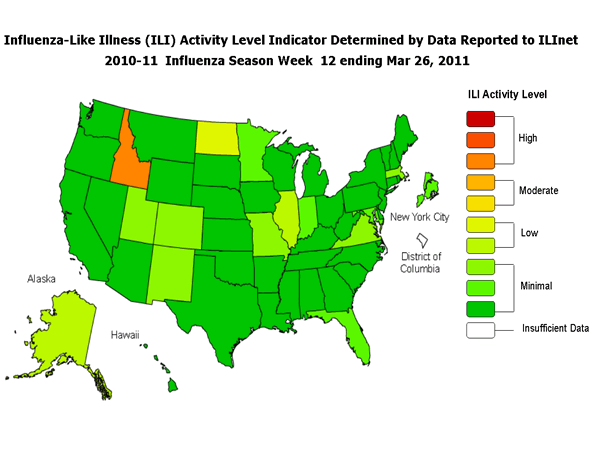
2010-2011 Influenza Season Week 12 ending March 26, 2011

All data are preliminary and may change as more reports are received.

Synopsis:

During week 12 (March 20-26, 2011), influenza activity in the United States decreased.

  • Of the 5,319 specimens tested by U.S. World Health Organization (WHO) and National Respiratory and Enteric Virus Surveillance System (NREVSS) collaborating laboratories and reported to CDC/Influenza Division, 737 (13.9%) were positive for influenza.
  • The proportion of deaths attributed to pneumonia and influenza (P&I) has been at or above the epidemic threshold for the ninth consecutive week.
  • Twelve influenza-associated pediatric deaths were reported, bringing the season total to 89. Four of these deaths were associated with influenza B viruses; four were associated with 2009 influenza A (H1N1) viruses; one was associated with influenza A (H3N2) virus, and three were associated with an influenza A virus for which the subtype was not determined.
  • The proportion of outpatient visits for influenza-like illness (ILI) was 2.0%, below the national baseline of 2.5%. Two of the 10 regions (Regions 2 and 10) reported ILI at or above region-specific baseline levels. One state experienced high ILI activity; three states experienced low ILI activity; 46 states and New York City experienced minimal ILI activity, and the District of Columbia had insufficient data.
  • The geographic spread of influenza in 10 states was reported as widespread; 21 states reported regional influenza activity; the District of Columbia and 12 states reported local influenza activity, and Guam, Puerto Rico, the U.S. Virgin Islands and six states reported sporadic influenza activity.

Click on map to launch interactive tool

INFLUENZA Virus Isolated

Pneumonia and Influenza (P&I) Mortality Surveillance

During week 12, 8.7% of all deaths reported through the 122-Cities Mortality Reporting System were due to P&I. This percentage was above the epidemic threshold of 8.0% for week 12 and is the ninth consecutive week in which P&I has been at or above the epidemic threshold.

Pneumonia And Influenza Mortality

Influenza-Associated Pediatric Mortality

Twelve influenza-associated pediatric deaths were reported to CDC during week 12. Four of these deaths were associated with influenza B viruses, four were associated with 2009 influenza A (H1N1) virus, one was associated with influenza A (H3N2) viruses, and three were associated with an influenza A virus for which the subtype was not determined.

Influenza-Associated Pediatric Mortality

»» Read More

More On the MMWR Influenza Mortality Report


UPDATED  with Maryn McKenna’s Post (see bottom)


# 4837


We’ve a couple of more items of interest revolving around the report issued today by the CDC on influenza-related deaths from seasonal flu (see MMWR: Estimates Of Yearly Seasonal Influenza Deaths).


First, the CDC has posted a Q&A page on the study, called:


Questions & Answers

Estimating Seasonal Influenza-Associated Deaths in the United States: CDC Study Confirms Variability of Flu


And second, Lisa Schnirring of CIDRAP news has an overview of the MMWR report and details from today’s pre-release press conference.


CDC's new seasonal flu death estimates reflect disease variability

Lisa Schnirring * Staff Writer

Aug 26, 2010 (CIDRAP News) – The US Centers for Disease Control and Prevention (CDC) released new death estimates for seasonal flu today that are designed to move away from a single number and instead take into account the disease's unpredictability and the extra toll inflicted when influenza A H3N2 is the dominant strain.


A 2003 CDC estimate of 36,000 flu deaths a year has been used by the media and some researchers as a general benchmark, but some experts have criticized that use of the number, because it is likely to overestimate deaths, given that the estimate is based on flu seasons during the 1990s when H3N2 was the main circulating strain during eight of nine flu seasons.

(Continue. . . )


The challenge will be in finding ways to portray these revised estimates in the media, since there is no easy `number’ to toss out as has been done so often in the past.


Admittedly still a bit rough, but I suppose I’ll try to employ language such as:


Most years, influenza-related illness claims tens of thousands of lives in the United States - but that number can vary widely depending on the strain in circulation – along with many other factors.


or


Over the past 3 decades flu-associated deaths in the United States ranged from a low of about 3,000 to a high of about 49,000 people with the higher numbers seen in years when H3N2 predominated.


While these may sound like vague answers, they take into account the extreme variability of influenza, and so they are actually truer depictions of burden of flu-related deaths each year in the United States.


They just don’t fit easily into a sound bite.


UPDATED: 2040hrs EST 8/26


Author and journalist Maryn McKenna has weighed in on these new numbers on her Superbug Blog, outlining her concerns over how the media can convey these revised estimates to the public. 


As my examples given above prove, it is going to be a bit awkward. But Maryn delves far deeper into the dilemma these numbers present for journalists in:


New CDC flu numbers: This may not go well
»» Read More

Report: Bird & Poultry Die Off In Myanmar


# 4362


image


Earlier this month we received reports of H5N1 bird flu in poultry on farms near Rangoon, the capitol of Myanmar (see Reports Out Of Myanmar).


Today we’ve another report, this time from several hundred kilometers to the north – near the border with Bangladesh – of poultry and wild birds dying in large numbers from an unknown disease.


According to this report, these bird deaths began after poultry was imported from Rangoon, where H5N1 was recently reported.    While suspicious, we don’t have any confirmation of H5N1 in this incident.


The source is Narinjara News, which is run by a group of Arakanese living in exile in Bangladesh. 


Getting reliable reports out of Myanmar is always problematic, given the tight controls the ruling military junta imposes on the press, so we’ll simply have to wait and hope we hear more about this incident.


A hat tip goes to Twall on FluTrackers for posting this report.


Bird and Chicken Deaths on the Rise in Western Burma

2/19/2010

Maungdaw: Thousands of chickens and other birds have died along the western Burmese border over the last ten days, but authorities have not yet made an announcement regarding the reason behind the deaths.


An official from Maungdaw said, "An official team led by Maungdaw Township Chairman U Tin Own went on Wednesday to Bagon Na Village to investigate where over 100 chickens died in a outbreak all together of an unknown disease."


Bagon Na Village is located on the outskirts of the town of Maungdaw. Veterinarians on the team brought some of the chickens that died at the poultry farm to Maungdaw in order to send them to Rangoon for preliminary tests.


A retired police officer from Wima La Ward said, "The deaths of chickens and birds in Maungdaw Township have increased recently. This is not just an outbreak in a rural area but has also happened in downtown Maungdaw. Many chickens, crows, and other kind of birds are dying in our town."


The worst hit areas are rural areas of Maungdaw Township, where large numbers of birds are dying on a daily basis.

Many people are now avoiding eating chicken or eggs, even though there has been no official alert about the disease in Maungdaw.


A hostess said, "People in Maungdaw are not eating chicken or eggs at present, nor are they going to the chicken markets because they are worrying about the disease infecting people."


(Continue . . . )


»» Read More

Zhong Nanshan On China’s Death Toll


# 4040


A hat tip to Crof at Crofsblog for picking up this Reuters report overnight out of Beijing, which quotes Zhong Nanshan – a hero of China’s SARS crisis in 2003 – on his doubts over the official death counts coming out of that country.


China's official H1N1 death count suspect: report


Wed Nov 18, 2009 11:43pm EST

Thursday, 12 Nov 2009 05:24pm EST

BEIJING (Reuters) - China may have had more H1N1 flu deaths than have been reported, with some local governments possibly concealing suspect cases, a prominent Chinese medical expert said in an interview published on Thursday.


Zhong Nanshan, a doctor based in the far southern province of Guangdong, said he doubted the current official death toll from the influenza strain, also called "swine flu," that has medical experts worldwide worried.


"I just don't believe that nationwide there have been in all 53 H1N1 deaths," Zhong told the Southern Metropolis Daily, a popular Guangdong newspaper.


Zhong said that "some areas have not been testing deaths from severe (pneumonia) and treating them as cases of ordinary pneumonia without a question," the paper reported.


(Continue. . . )


While valid, the same criticism could be levied at nearly every nation around the globe.  The degree of undercounting may vary from one country to the next, but quite obviously the numbers we get are but a fraction of the real death toll.

The US is the only country that I’m aware of that has at least tried to come up with an estimate of deaths.  And as of more than a month ago, that mid-level estimate was roughly 4,000 deaths.


Most countries insist on counting only laboratory confirmed deaths, and then do very little testing or surveillance.  Their numbers, therefore, remain reassuringly low.


As of November 12, the UK had only reported 124 flu related deaths, or a per capita death rate that is 1/6th of that estimated by the US. The DOH even provides this disclaimer:


This figure represents the number of deaths in individuals with swine flu but does not represent the number of deaths that can be attributed to swine flu.


Canada, with a population half that of the UK, as of late last week had reported 161 deaths.  And while twice the rate of the UK, that is still far below the US estimates.


And France, with a population comparable to the UK, is only reporting about 70 deaths, or a per capita death rate 1/10th that estimated in the US. 


When the World Health Organization releases weekly global case and death counts, it comes with this disclaimer:


Given that countries are no longer required to test and report individual cases, the number of cases reported actually understates the real number of cases.


Admittedly, counting flu deaths isn’t easy.  For all practical purposes, it probably isn’t even possible.   Which is why we rely on estimates and mathematical models to come up with a reasonable figure.


While many look at the WHO global counts of just over 6,000 dead and wonder what the fuss is about this pandemic virus, the real impact probably won’t be calculated until this pandemic is over.


For more on the difficulties of counting flu-related deaths – something I’ve written about extensively -  you might wish to read When No Number Is Right.

»» Read More

MMWR: 22 New Pediatric Flu Deaths


# 3905


Although we’ll get an update tomorrow in Friday’s FluView report,  today’s release of the MMWR indicates that 22 new pediatric influenza deaths were reported in the United States last week.  


Some of those may be from previous weeks, as sometimes there is a bit of lag time in testing and reporting. 


But the 5-year weekly average for this time of year is Zero

MMWR

Week 42: 22 new deaths reported
Cumulative 2009: 192 total deaths reported
By states: WI (1), SD (1), GA (1), FL (1), TN (2), TX (9), MT (1), AZ (3), WA (1), OH (1), GU (1)


These would be considered extraordinary numbers in the middle of February, to be occurring in October is particularly worrisome.


Since August 31st, the total is sadly 74 children lost to this virus.


Pediatric influenza deaths are the only notifiable flu deaths in the US, and so we have a much better handle on how many really are occurring around the country.  


image

This is LAST WEEK’S chart (update comes tomorrow 10/30/09).

»» Read More

Dead Reckoning


# 3817


Dead reckoning (DR) is the process of estimating one's current position based upon a previously determined position, or fix, and advancing that position based upon known or estimated speeds over elapsed time, and course. - Wikipedia


One of the ploys of the pandemic deniers is to use the `official’ tally of deaths, both here in the US and around the world, to `prove’ the H1N1 virus is not a genuine threat.  


After all, as of October 2nd, even the WHO (World Health Organization) can only come up with a little more than 4,100 deaths worldwide since this outbreak began in April.


And they should know, shouldn’t they?


Unfortunately, they don’t.  No one does. 


Why?  Because we aren’t trying to count the number of deaths anymore, and even when we were -  back in the summer - we weren’t doing a particularly good job of it.


This is a problem I’ve discussed many times over the past few months, including in:


Numbers Don’t Tell The Whole Story
A Decided Lack Of Data
Measuring The Severity Of A Pandemic
Arizona & Illinois Report Swine Flu Related Deaths


Mike Stobbe, of the AP, has a good article on the problem this morning, which explains that the US, along with many other countries around the world, have quit trying to count pandemic cases.


First the article, then some discussion.


US, other nations stop counting pandemic flu cases

(October 9th, 2009 @ 2:11am)

By MIKE STOBBE
AP Medical Writer

ATLANTA (AP) - U.S. health officials have lost track of how many illnesses and deaths have been caused by the first global flu epidemic in 40 years.


And they did it on purpose.


Government doctors stopped counting swine flu cases in July, when they estimated more than 1 million were infected in this country. The number of deaths has been sitting at more than 600 since early September.


(Continue . . . )


As I wrote back in May, we really have no idea how many people die of influenza during a normal season.  The CDC’s estimate of 36,000 deaths each year is just that – an estimate – an average based on mathematical modeling 


No one counts individual flu deaths.  


Every day in the US, somewhere over 6,000 people die from a variety of causes.   Despite the CSI-induced fantasy that every death gets investigated down to the last hair or fiber, the truth is, unless there is reason to suspect foul play or unusual circumstance, most deaths are handled as routine events.


If someone dies at home, and they are under the routine care of a physician (the definition varies by state), it is considered `an attended death’. In that case, the patient’s doctor may elect to sign the death certificate without ever examining the deceased, and no autopsy is performed.


While rarely stated, there is actually a bit of a built-in disincentive for conducting a post mortem exam. An autopsy could conceivably uncover a missed diagnosis, and that could prove problematic for the doctor.


In funeral home parlance, this is sometimes referred to as `burying one’s mistakes’.


Even in cases where an autopsy is performed, testing for the influenza virus generally isn’t a part of the procedure.  If there are gross signs of lung inflammation, then pneumonia may be cited as a cause of death.


Unless someone dies in the hospital while being treated for influenza or pneumonia, it is highly unlikely that influenza will be listed as an official cause of death. 


One exception to this rule is when the deceased is exceptionally young.   Generally speaking, the younger the victim, the more scrutiny we give the cause of death. 


Here in the US, pediatric deaths (under age 18) from influenza and pneumonia are a reportable disease.  During an average year somewhere between 50 and 100 pediatric deaths are attributed to influenza. 


In 2005-06 there were only 46 pediatric deaths, in 2006-07 there were 78, and in 2007-08 there were 88


As of last week, there were 128 for this year.   Later today we will get a new tally, and based on yesterday’s MMWR report, that number will jump appreciably. 


What is particularly worrying is that over the summer, during a time when we might normally see no more than 1 or 2 pediatric flu deaths, we’ve seen at least 60 due to swine flu.


This grim metric may be our best, most accurate indicator of the impact of the pandemic. It is literally the only individual influenza fatality counting going on in this country, and while it may miss some cases, it is probably fairly accurate.


image


The other prime indicator in the US is the 122 MRS, which monitors the number of pneumonia & Influenza deaths in 122 American cities. 


While this monitoring won’t pick up every death, we have good baselines with this model, and should be able to monitor the relative strength of the epidemic outbreak.


We’ve other metrics, of course.  The number of P&I hospitalizations, outpatient visits for ILI (Influenza-like-illness), and the like.  But the one metric every one looks to – the number of deaths caused by this virus –  is the hardest to measure.


Complicating matters is the fact that (fortunately) this virus appears to be causing a high morbidity-low mortality pandemic. 


In other words – it causes a lot of illness - which stresses our health care delivery system and economy,  but relatively few fatalities.  So far, anyway.


Deaths, in all fairness, are not the only measure of a pandemic.


While the surveillance and reporting of influenza deaths in the US may seem less than optimal, when compared to most of the rest of the world, we are very diligent in these matters.


In many nations, medical care and surveillance is rare or non-existent. People die, and are quickly buried, without a cause of death being established. 


In Sub-Saharan Africa and parts of Asia, thousands die every day from AIDS, Tuberculosis, Malaria, contaminated water, hunger, tropical diseases and poverty. 


No one is counting how many were hurried along this dismal path by influenza.


All of this means that the numbers being quoted by the WHO and individual countries (including the US) are practically meaningless.


Worse, they are highly misleading.  


The truth is, we will never know with any precision how many lives this pandemic will claim.  Just as we have no clear idea of how many died in 1968, 1957, or 1918.  


Undoubtedly, over the next few years there will be studies, mathematical models, and estimates proffered by scientists from all around the world. They will be hotly debated in the science journals, among bloggers, and in the halls of academia.


At some point, a consensus will be reached, and a number (probably a broad range) will be announced.


Only then will we have some idea how this pandemic compares to 1968 or 1957.

»» Read More