Showing posts with label H3N2v. Show all posts

FluView Week 49

image


# 6783


Given the reports we’ve seen since the Thanksgiving holidays, it’s no surprise that this week’s CDC FluView  report shows another rise in influenza activity around the nation.


The most widespread activity remains in the southern tier of states.


We also learn in this update of another variant flu infection, this time from Minnesota.  


2012-2013 Influenza Season Week 49 ending December 8, 2012

All data are preliminary and may change as more reports are received.

Synopsis:

During week 49 (December 2-8), influenza activity increased in the U.S.

  • Viral Surveillance: Of 7,663 specimens tested and reported by U.S. World Health Organization (WHO) and National Respiratory and Enteric Virus Surveillance System (NREVSS) collaborating laboratories during week 49, 2,172 (28.3%) were positive for influenza.
  • Novel Influenza A Virus: One human infection with a novel influenza A virus was reported.
  • Pneumonia and Influenza Mortality: The proportion of deaths attributed to pneumonia and influenza (P&I) was below the epidemic threshold.
  • Influenza-Associated Pediatric Deaths: One influenza-associated pediatric death was reported and was associated with an influenza B virus.
  • Outpatient Illness Surveillance: The proportion of outpatient visits for influenza-like illness (ILI) was 2.8%, which is above the national baseline of 2.2%. Seven of ten regions reported ILI above region-specific baseline levels. Eight states experienced high ILI activity, 2 states experienced moderate ILI activity; New York City and 9 states experienced low ILI activity; 31 states experienced minimal ILI activity, and the District of Columbia had insufficient data.
  • Geographic Spread of Influenza: The geographic spread of influenza in 18 states was reported as widespread; 17 states reported regional activity; the District of Columbia and 11 states reported local activity; Guam and 4 states reported sporadic activity, and Puerto Rico and the U.S. Virgin Islands did not report.

image


More than 28% of samples tested this past week were positive for influenza, with H3N2 leading the way. Here are the details on the novel flu infection.


Novel Influenza A Virus:

One infection with an influenza A (H3N2) variant virus (H3N2v) was reported to CDC during week 49 by Minnesota. Close contact between the case patient and swine in the week preceding illness was reported. The patient has fully recovered and no further cases have been identified in contacts of the case patient. This is the second H3N2v infection reported for the 2012-13 influenza season, which began on September 30, 2012.


A total of 312 infections with variant influenza viruses (308 H3N2v viruses, 3 H1N2v viruses, and 1 H1N1v virus) have been reported from 11 states since July 2012. More information about H3N2v infections can be found at http://www.cdc.gov/flu/swineflu/h3n2v-outbreak.htm.


While it is obvious that flu season has started early this year, it is too soon to know how severe – or prolonged – this season will turn out to be.


The CDC would like you to know, however, that it isn’t too late to get a flu shot, as the peak of influenza activity often doesn’t occur until February or March.

»» Read More

Asymptomatic Pigs: Revisited

image

Credit Wikipedia


# 6660


A couple of months ago in EID Journal: Flu In Healthy-Looking Pigs we looked at a report indicating that it isn’t always possible to identify pigs carrying an influenza virus based simply on their appearance.


A dispatch from the EID Journal reported that nearly 1 in 5 healthy-looking pigs they tested at the Minnesota State Fair during the 2009 H1N1 influenza pandemic were actually infected with a flu virus.


This came out during the midst of several swine variant flu outbreaks this summer, involving several hundred people across 10 states. Viruses apparently contracted from pigs on display at local fairs (see MMWR: H3N2v Related Hospitalizations In Ohio – Summer 2012).


While fair officials were turning away pigs with overt signs of infection, this report suggested that perhaps those measures might not be sufficient.


Today, a pair of studies from Ohio State University -  one that finds a surprisingly large percentage of flu infected swine to be asymptomatic - and another that establishes just how closely linked the human and swine variant strains of influenza this summer really were.


In both cases, the lead author is Andrew Bowman, a  Ph.D. candidate in veterinary preventive medicine at Ohio State.


First, from the EID Journal, research that found more than 80% of the pigs that tested positive for influenza at the Ohio State fair between 2009 and 2011 showed no signs of illness.


Subclinical Influenza Virus A Infections in Pigs Exhibited at Agricultural Fairs, Ohio, USA, 2009–2011

Andrew S. BowmanComments to Author , Jacqueline M. Nolting, Sarah W. Nelson, and Richard D. Slemons
Author affiliations: The Ohio State University, Columbus, Ohio, USA
Abstract

Agricultural fairs are associated with bidirectional, interspecies transmission of influenza virus A between humans and pigs. We examined pigs exhibited at agricultural fairs in Ohio during 2009–2011 for signs of influenza-like illness and collected nasal swab specimens from a representative subset of these animals.


Influenza virus A was recovered from pigs at 12/53 (22.6%) fairs during the 3-year sampling period. Pigs at 10/12 (83.3%) fairs from which influenza virus A was recovered did not show signs of influenza-like illness. Hemagglutinin, neuraminidase, and matrix gene combinations of the isolates were consistent with influenza virus A concurrently circulating among swine herds in the United States.


Subclinical influenza virus A infections in pigs at agricultural fairs may pose a risk to human health and create challenges for passive surveillance programs for influenza virus A in swine herds.

(Continue . . . )


Ohio State University has published a lengthy press release that discusses both papers.


Studies: Pigs Look Healthy But Test Positive for Flu at Fairs; Flu Transmission Seen Between Pigs and Humans

COLUMBUS, Ohio – More than 80 percent of pigs that tested positive for influenza A virus at Ohio county fairs between 2009 and 2011 showed no signs of illness, according to a new study.


Ohio State University researchers tested 20 pigs each at 53 fair events over those three summers and found at least one flu-positive pig at 12 fairs – almost a quarter of fairs tested.


The influenza strains identified in pigs in this study include H1N2 and H3N2 viruses – strains that have been circulating in pigs since 1998. In 2011, all of the H3N2 and H1N2 isolates found in pigs at the fairs contained a gene from the 2009 pandemic strain of H1N1, which is similar to the H3N2v strain causing human illness this year.


Though this finding alone is no cause for panic, it does show how quickly influenza viruses can change, said Andrew Bowman, lead author of the study and a Ph.D. candidate in veterinary preventive medicine at Ohio State.


In a second study led by Bowman, researchers compared the genomic sequences of influenza A viruses recovered in July 2012 from pigs and people. The analysis, showing a greater than 99 percent genetic similarity among the viruses, confirms that pigs and humans were infected with the same virus, indicating interspecies transmission.

(Continue . . .)


This second study appears in the journal Emerging Microbes & Infections.


Although the timing of the illnesses (and initial sub-typing) in humans and swine at the Ohio State Fair last July strongly suggested interspecies transmission, a >99% genomic match pretty much erases all doubt.


Molecular evidence for interspecies transmission of H3N2pM/H3N2v influenza A viruses at an Ohio agricultural fair, July 2012

Andrew S Bowman1, Srinand Sreevatsan2, Mary L Killian3, Shannon L Page4, Sarah W Nelson1, Jacqueline M Nolting1, Carol Cardona2 and Richard D Slemons1


Evidence accumulating in 2011–2012 indicates that there is significant intra- and inter-species transmission of influenza A viruses at agricultural fairs, which has renewed interest in this unique human/swine interface.


Six human cases of influenza A (H3N2) variant (H3N2v) virus infections were epidemiologically linked to swine exposure at fairs in the United States in 2011. In 2012, the number of H3N2v cases in the Midwest had exceeded 300 from early July to September, 2012.


Prospective influenza A virus surveillance among pigs at Ohio fairs resulted in the detection of H3N2pM (H3N2 influenza A viruses containing the matrix (M) gene from the influenza A (H1N1) pdm09 virus). These H3N2pM viruses were temporally and spatially linked to several human H3N2v cases.


Complete genomic analyses of these H3N2pM isolates demonstrated >99% nucleotide similarity to the H3N2v isolates recovered from human cases. Actions to mitigate the bidirectional interspecies transmission of influenza A virus between people and animals at agricultural fairs may be warranted.

(Continue . . .)


While the vast majority of the swine-to-human flu transmissions this year have involved the H3N2v virus, as you can see from the following table, small number of H1N1v and H1N2v infections have been reported as well. 


image


Given the limits of surveillance, testing, and reporting – we really don’t know what the normal `background rate’ of these types of novel flu infections are in humans.


The smattering of reports since 2005 indicate they may be fairly rare, but are certainly not unheard of.


The majority of human swine variant flu infections this summer were relatively mild (out of 300+ infections, 16 were hospitalized, and 1 died), but it is always of concern anytime a novel influenza virus jumps from another species to humans.


Each time a novel flu jumps from a pig to a human it gives the virus another opportunity to adapt to human physiology. The CDC’s most recent assessment on the H3N2v virus reads:


It's possible that sporadic infections and even localized outbreaks among people with this virus will continue to occur.

While there is no evidence at this time that sustained human-to-human transmission is occurring, all influenza viruses have the capacity to change and it's possible that this virus may become widespread.


So far, the severity of illnesses associated with this virus in people has been similar to the severity of illnesses associated with seasonal flu virus infections. Limited serologic studies indicate that adults may have some pre-existing immunity to this virus while children do not.


CDC is closely monitoring human infections with all novel influenza viruses, including H3N2v viruses, and will provide more information as it becomes available.


With further evidence of asymptomatic influenza infection in pigs, fair officials and public health agencies will need to decide on the best policies to limit future exchanges (in either direction) of flu viruses between people and pigs.

»» Read More

MMWR: H3N2v Related Hospitalizations In Ohio – Summer 2012

image

Credit Wikipedia


# 6590


During this summer’s outbreak of H3N2v swine-origin influenza that infected at least 305 people across 10 states, only Indiana (n=138) reported more cases than did Ohio (n=106).


While the number of new cases being reported has declined dramatically over recent weeks, the epidemiological investigation continues. For earlier reports on this outbreak, see HERE, HERE, and HERE.


Today the CDC’s MMWR presents an overview of 11 patients from Ohio that required hospitalization, which represents nearly 70% of all those hospitalized with the virus across the country, and the nation’s only H3N2v related fatality.


It’s a long report, providing extended case histories on two of the patients (including the fatality), and providing (via a chart) basic information on all 11 cases – including likely route of exposure.


Of the 11 cases reported on, only one did not report direct or indirect exposure to swine; a 6 year old that reportedly had:


No contact. No attendance at fairs. Saw grandmother on Aug 23, who works with horses on a farm where pigs are also kept. Grandmother had no recent illness. No known illness in pigs.


Follow the link to read it in its entirety, but I’ve posted a few excerpts.


Influenza A (H3N2) Variant Virus-Related Hospitalizations — Ohio, 2012

Weekly

September 28, 2012 / 61(38);764-767

Since July 2012, 305 cases of infection with influenza A (H3N2) variant (H3N2v) virus containing the influenza A (H1N1)pdm09 M gene have occurred in multiple U.S. states, primarily associated with swine exposure at agricultural fairs (1). In Ohio, from July 28 to September 25, 2012, a total of 106 confirmed H3N2v cases were identified through enhanced surveillance. Whereas most H3N2v patients experienced mild, self-limited influenza-like illness (ILI), 11 of the Ohio patients were hospitalized, representing 69% of all H3N2v hospitalizations in the United States. Of these hospitalized H3N2v patients, six were at increased risk for influenza complications because of age or underlying medical conditions, including the only H3N2v-associated fatality reported in the United States to date. This report summarizes the epidemiology and clinical features of the 11 hospitalized H3N2v patients in Ohio. These findings reinforce the recommendation for persons at high risk for influenza complications to avoid swine exposure at agricultural fairs this fall (2). In addition, persons not at high risk for influenza complications who wish to reduce their risk for infection with influenza viruses circulating among pigs also should avoid swine and swine barns at agricultural fairs this fall.

<SNIP>

Case Reports

Patient A. A woman aged 61 years with type 2 diabetes, congestive cardiomyopathy, hypertension, and a past history of B-cell lymphoma, experienced cough and sneezing on August 10 (Table, patient 11). Beginning 6 days earlier, she spent 4 days at a county fair where she visited a swine barn and had direct swine contact. Over the next 2 weeks, she experienced cough and fever and was treated with antibiotics for a sinus infection. On August 25, she sought care at an emergency department with worsening symptoms. The patient was transferred to a tertiary care center with hemodynamic instability and respiratory distress, and required mechanical ventilation. Her condition deteriorated, and she died on August 26. Blood cultures obtained on August 25 yielded Pseudomonas aeruginosa, and a nasopharyngeal swab was positive for H3N2v virus by rRT-PCR at ODH. Genetic sequencing of H3N2v virus from a clinical specimen from this patient at CDC was nearly identical to sequencing from several nonfatal H3N2v cases in Ohio, and from H3N2pM* viruses identified among pigs at fairs in Ohio.

(Continue . . .)


The MMWR report provides a summary of the findings, which reads:


What is already known on this topic?

Beginning in the summer of 2012, CDC reported increases in numbers of cases of human infections with influenza A (H3N2) variant (H3N2v) viruses associated with swine exposure at agricultural fairs. Nationwide, 305 cases, 16 hospitalizations, and one death across 10 states have been reported since July 2012.


What is added by this report?


Of 16 patients hospitalized with confirmed H3N2v virus infection, 11 were Ohio residents, including the only H3N2v-associated fatality to date. All but one of the Ohio patients were children, and six were considered high-risk for complications of influenza because they were aged <5 years or had underlying medical conditions; four high-risk persons became ill after indirect contact with pigs. These findings support current CDC recommendations that persons at high risk for complications of influenza should avoid exposure to swine at agricultural fairs this fall.


What are the implications for public health practice?

County and state fairs in the United States continue to occur through the month of October, highlighting the potential for continued cases of H3N2v virus infection. Persons at high risk for complications of influenza should avoid exposure to swine at agricultural fairs. Patients with suspected influenza, including H3N2v, who are hospitalized or at increased risk for influenza complications, should receive antiviral treatment with oral oseltamivir or inhaled zanamivir as soon as possible. Antiviral treatment also is encouraged for outpatients with suspected H3N2v who are not at increased risk for influenza complications.

»» Read More

FluView & Variant Flu Update: Week 36


# 6555


I’m sitting in on the AMA/IDSA Pandemic Preparedness webinar this morning, so this will be a quick update.


The CDC has released their weekly FluView and Variant Flu update, and the number of new H3N2v flu cases shows only a small increase (n=9) over last week.


image


This week’s FluView has details on these 9 cases, plus one additional H1N1v case identified in  Missouri.


2011-2012 Influenza Season Week 36 ending September 8, 2012

image

Novel Influenza A Virus:

From July 12 through September 13, 2012, a total of 305 infections with influenza A (H3N2) variant (H3N2v) viruses have been reported from ten states. This is an increase of 9 over last week’s report. Cumulative totals by state since July 15 are: Hawaii [1], Illinois [4], Indiana [138], Maryland [12], Michigan [6], Minnesota [4], Ohio [106], Pennsylvania [11], West Virginia [3], and Wisconsin [20]. Sixteen H3N2v-associated hospitalizations and one H3N2v-associated death have been reported. The vast majority of cases have occurred after prolonged swine exposure, though instances of likely human-to-human transmission have been identified. At this time no ongoing human-to-human transmission has been identified.


Public health and agriculture officials are investigating the extent of disease among humans and swine, and additional cases are likely to be identified as the investigations continue. Because of reporting schedules, state totals posted by CDC may not always be consistent with those reported by state health departments. If there is a discrepancy between state and CDC case counts, data from the state health department should be used as the most accurate number.


As a result of enhanced surveillance activities for H3N2v, one infection with an influenza A (H1N1) variant (H1N1v) virus has been detected in Missouri in a patient who became ill after contact with swine. The patient has recovered from their illness. Confirmatory testing at CDC identified H1N1v with the matrix (M) gene from the 2009 H1N1 influenza virus in specimens collected from this patient. Cases of H1N1v have been detected previously, and the current case marks the second report of H1N1v with the M gene from the 2009 H1N1 virus. This H1N1v case, in addition to the H3N2v cases outlined above and the H1N2v cases reported previously, brings the total number of variant influenza virus infections detected since July 2012 to 309.

»» Read More

CDC & ICAAC Updates On H3N2v


# 6550


A bit of a twofer today, as we’ve two videos featuring the CDC’s Dr. Lyn Finelli discussing the recent emergence of the H3N2v swine-origin virus, and how to reduce the risk of it spreading.


First stop, a 6-minute  podcast, released earlier this week by the CDC, called:


CDC Recommendations to Reduce the Risk of H3N2v Flu Virus Infection for Fairgoers and Swine Exhibitors

image

You’ll find a video of this podcast, and the transcript, available at the above link.


The second video comes from the closing day of 2012’s ICAAC conference in San Francisco, where Dr. Finelli is interviewed by Jeff Fox in a 30 minute presentation.


Dr. Finelli indicates that, out of the 300 or so new human cases of H3N2v infection this summer, about 10 instances of human-to-human transmission have been detected.  


So far, the vast majority of cases have had direct, and prolonged contact with swine.


Complicating matters, we now have four cases of a different swine variant virus – H1N2v – recently detected in Minnesota. 


And much like the newly emergent H3N2v virus – this reassortant swine flu has picked up the M gene segment from the 2009 H1N1 virus (see CDC Updates Minnesota H1N2v Cases).


In another related story, on Monday we learned (see PNAS: Virulence & Transmissibility Of H1N2 Influenza Virus In Ferrets) that Korean researchers had detected a swine flu H1N2 strain that produced serious (even lethal) illness in ferrets, and spread easily among then. 


For more on this story, Robert Roos of CIDRAP wrote last night:


Ferret study underlines persistent threat of swine flu viruses

Robert Roos * News Editor

Sep 11, 2012 (CIDRAP News) – A Korean-US research team has identified an H1N2 strain of swine influenza capable of killing ferrets and spreading among them by respiratory droplets, underlining the continuing threat of swine flu to humans amid a wave of swine-origin flu cases in Americans exposed to pigs at agricultural fairs.

(Continue . . . )


The concern has long been that swine are highly susceptible to the influenza virus, and are capable of serving as `mixing vessels’, allowing them to reassort into new hybrid strains. 


Since end of  the 2009 H1N1 pandemic we’ve begun to see reassortments of other swine flu viruses (H3N2 & H1N2) with genetic elements picked up from the previously `humanized’ H1N1 pandemic strain.


image


For now, these reassortant viruses haven’t evolved into efficiently transmitted human flu strains, and so their public health impact is limited. 


The caveat being, that as this virus jumps to humans it could begin to `figure us out’, and become more easily transmissible.


Which is why the CDC, along with local & state health departments, plan to remain vigilant this fall and winter as they look for any signs of increased human transmission.

»» Read More

CDC Variant Flu Update & FluView Week 35

image

Credit CDC – 9/7/12 Update


# 6541


The CDC has updated their case counts of human infections with the swine H3N2v virus, indicating another 8 cases have been confirmed, along with 1 additional hospitalization. 


image

image


This is the second week in a row with a relatively low increase in the number of new confirmed infections, although it should be mentioned that there remain a number of `suspected or probable cases’ that are not in today’s tally.


Pennsylvania, for instance, is reporting 11 confirmed cases, but lists another 30 `probable’ on their website this morning.

image


And it is likely that many mild, or sub-clinical cases simply go untested. 


The CDC’s Assessment of the situation reads:


CDC Assessment

It's possible that sporadic infections and even localized outbreaks among people with this virus will continue to occur. While there is no evidence at this time that sustained human-to-human transmission is occurring, all influenza viruses have the capacity to change and it's possible that this virus may become widespread. So far, the severity of illnesses associated with this virus in people has been similar to the severity of illnesses associated with seasonal flu virus infections. Limited serologic studies indicate that adults may have some pre-existing immunity to this virus while children do not. CDC is closely monitoring human infections with all novel influenza viruses, including H3N2v viruses, and will provide more information as it becomes available.


Even if you consider the gaps in surveillance, and likely under-reporting of infections from this virus, H3N2v obviously isn’t spreading anything like the H1N1pdm09 virus did during its debut in the spring of 2009.


To put this into perspective, we are roughly 7 weeks since the first clusters began to appear in the Midwest (July 12th, 2012), and we are (just barely) below 300 confirmed cases across 10 states. 


The following blast from the past shows the number (and wide geographic spread) of 2009 H1N1 virus detections being reported to the World Health Organization in early June 2009, roughly 7 weeks after it was first detected. 


Influenza A(H1N1) - update 45

8 June 2009 -- As of 06:00 GMT, 8 June 2009, 73 countries have officially reported 25,288 cases of influenza A(H1N1) infection, including 139 deaths.

image

There were, by the way, plenty of gaps in testing and surveillance for the H1N1 virus back in 2009 as well.  The numbers reported above are generally considered to be an undercount.


While the H3N2v virus may very well develop `legs’ over time - and eventually pose a larger public health threat - right now it obviously isn’t spreading anything like its H1N1pdm cousin did.


Today’s FluView Report has a summary of the novel H3N2v activity and the three H1N2v cases reported last week (see Minnesota Reports Swine H1N2v Flu)


2011-2012 Influenza Season Week 35 ending September 1, 2012

All data are preliminary and may change as more reports are received.

Novel Influenza A Virus:

From July 12 through September 6, 2012, a total of 296 infections with influenza A (H3N2) variant (H3N2v) viruses have been reported from ten states. This is an increase of 8 over last week’s report. Cumulative totals by state since July 15 are: Hawaii [1], Illinois [4], Indiana [138], Maryland [12], Michigan [5], Minnesota [2], Ohio [102], Pennsylvania [11], West Virginia [3], and Wisconsin [18]. Sixteen H3N2v-associated hospitalizations and one H3N2v-associated death have been reported. The vast majority of cases have occurred after prolonged swine exposure, though instances of likely human-to-human transmission have been identified. At this time no ongoing human-to-human transmission has been identified.


<SNIP>

As a result of enhanced surveillance activities for H3N2v, three infections with influenza A (H1N2) variant (H1N2v) virus have been detected in Minnesota in patients who became ill after contact with swine. One patient was hospitalized, but all have recovered from their illness. Confirmatory testing at CDC identified H1N2v with the matrix gene from the 2009 H1N1 influenza virus in specimens collected from all three patients. Although cases of H1N2v have been detected previously, the current cases mark the first reports of H1N2v with the matrix gene from the 2009 H1N1 virus.


Otherwise, surveillance of flu activity around the country shows very little activity, despite the scattered reports of H3N2v in the Midwest.


national levels of ILI and ARI


And the 122 Cities Pneumonia & Influenza mortality surveillance continues to indicate deaths are running well below the seasonally adjusted epidemic level.


Pneumonia and Influenza (P&I) Mortality Surveillance:

During week 35, 5.6% of all deaths reported through the 122-Cities Mortality Reporting System were due to P&I. This percentage was below the epidemic threshold of 6.5% for week 35.

Pneumonia And Influenza Mortality


With cooler weather on the way, another 6 to 8 weeks of state and county fairs (mostly in the south), and schools now going back into session, we’ll be watching closely to see if this two-week decline in new cases is a temporary lull, or a sustained trend.


Stay tuned.

»» Read More

CDC Updates H3N2v Numbers, 1 Death Reported

image


# 6529


The CDC has posted their weekly update on the emerging H2N2v (variant) flu virus, and there’s good news and sad news:


The good news is that only a dozen additional cases have been confirmed, and no additional states have reported infections. It is highly likely, however, that some number of cases are going unreported.


That said, were this virus spreading in an efficient and sustained manner in the human population, we would expect to see a lot more cases being reported. 


The sad news – not unexpectedly – is that a death has finally been attributed to this variant virus.


This was pretty much Inevitable, given that this virus has been described as being roughly equivalent in virulence to seasonal flu, which claims thousands of lives each year.


The CDC reports:


Influenza A (H3N2) Variant Virus Outbreaks

Today, CDC is reporting 12 additional cases of H3N2 variant virus (H3N2v) infection, as well as the first H3N2v-associated death, which was reported by the state of Ohio. The death occurred in an older adult with multiple underlying health conditions who reportedly had direct exposure to pigs in a fair setting.


While limited person-to-person spread of this virus has been detected and likely continues to occur sporadically, no sustained community transmission has been found. CDC is monitoring this situation and working with states to respond to these evolving outbreaks. The agency continues to urge people at high risk from serious flu complications to stay away from pigs and pig arenas at fairs this summer.


<SNIP>


The 12 new cases reported this week are from the states of Minnesota (1), Ohio (3), Pennsylvania (1), and Wisconsin (7). Cumulative totals for 2011 and 2012 by state are available in the H3N2v case count table.

(Continue . . . .)


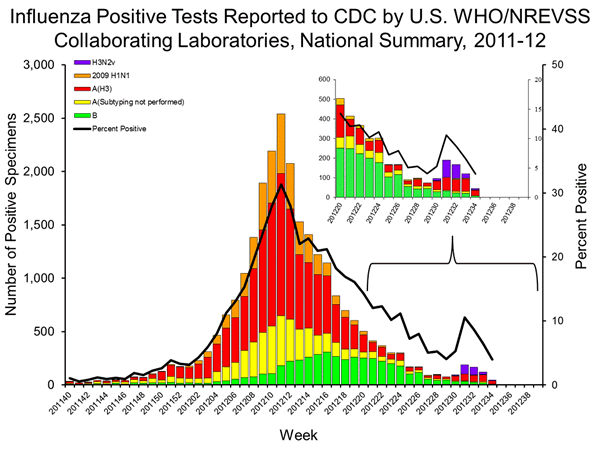
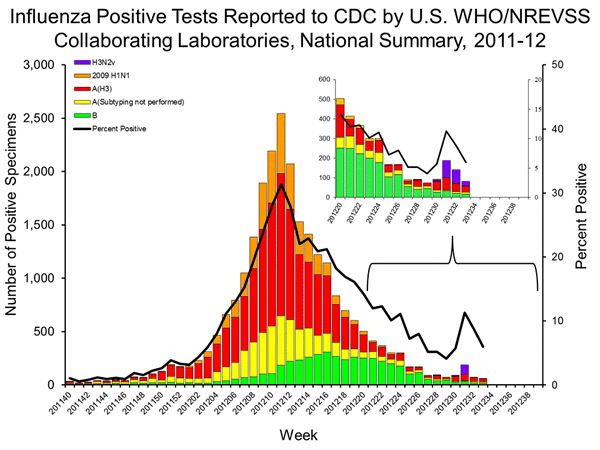
Graphs from today’s FluView report also illustrate the drop in new cases, and provides some detail on the level of H3N2v activity.


2011-2012 Influenza Season Week 34 ending August 25, 2012

All data are preliminary and may change as more reports are received.

U.S. Virologic Surveillance:

WHO and NREVSS collaborating laboratories located in all 50 states and Washington, D.C. report to CDC the number of respiratory specimens tested for influenza and the number positive by influenza type and subtype. Region specific data can be found at http://gis.cdc.gov/grasp/fluview/fluportaldashboard.html.

INFLUENZA Virus Isolated

Novel Influenza A Virus:

From July 12 through August 30, 2012, a total of 288 infections with influenza A (H3N2) variant (H3N2v) viruses have been reported in ten states (Hawaii [1], Illinois [4], Indiana [138], Maryland [12], Michigan [5], Minnesota [2], Ohio [101], Pennsylvania [7], West Virginia [3], and Wisconsin [15]). So far during the current outbreaks, 15 confirmed cases have been hospitalized as a result of their illness; one death has occurred.


The vast majority of cases have been associated with swine exposure though likely instances of human-to-human transmission have been identified. At this time no ongoing human-to-human transmission has been identified.


Public health and agriculture officials are investigating the extent of disease among humans and swine, and additional cases are likely to be identified as the investigation continues. Because of reporting deadlines, the state totals reported by CDC may not always be consistent with those reported by state health departments. If there is a discrepancy between these two counts, data from the state health departments should be used as the most accurate number.


The concern here is less about the public health threat this variant virus poses today - and more about the threat it could pose in the future - if it better adapts to transmit between humans.


Each human infection, unfortunately, gives the virus another opportunity to adapt, making prevention of infection all the more important.


Meanwhile, we continue to watch these weekly tally’s with considerable interest, looking for any indications that something has changed.

»» Read More

H3N2v Update: CDC Reports 52 New Cases, Limited H2H Transmission


image

Credit Wikipedia


# 6517


The mantra of the CDC over the past few weeks regarding the H3N2v flu virus is that sustained and efficient transmission between humans has not been detected.  They have allowed the possibility, however, that some limited person-to-person transmission may have occurred.


And today’s numbers, indicating just 52 new cases reported over the past week, continues to support that analysis.


While some cases may be going unrecorded, this total is lower than one would expect to see if the virus were being readily transmitted.


Good news for now, but with the caveats that surveillance by definition is a look backwards in time – not ahead - and this virus is still learning about human physiology.


Given enough opportunities - H3N2v could one day adapt to become a more formidable human pathogen.


Here then are some excerpts from today’s CDC FluView Report and their weekly H3N2v update:


2011-2012 Influenza Season Week 33 ending August 18, 2012

 INFLUENZA Virus Isolated
 

Novel Influenza A Virus:

From July 12 through August 23, 2012, a total of 276 infections with influenza A (H3N2) variant (H3N2v) viruses have been reported in ten states (Hawaii [1], Illinois [4], Indiana [138], Maryland [12], Michigan [5], Minnesota [1], Ohio [98], Pennsylvania [6], West Virginia [3], and Wisconsin [8]). So far during the current outbreaks, 13 confirmed cases have been hospitalized as a result of their illness; no deaths have occurred. The vast majority of cases have been associated with swine exposure though three likely instances of human-to-human transmission have been identified. At this time no ongoing human-to-human transmission has been identified. Public health and agriculture officials are investigating the extent of disease among humans and swine, and additional cases are likely to be identified as the investigation continues. Because of reporting deadlines, the state totals reported by CDC may not always be consistent with those reported by state health departments. If there is a discrepancy between these two counts, data from the state health departments should be used as the most accurate number.


H3N2v Update: New Cases Reported, Limited Person-to-Person Transmission Detected

August 24, 2012 -- Today, 52 additional cases of H3N2v are being reported, bringing the total number of such infections since July 2012 in the United States to 276 across 10 states. Investigations into H3N2v cases indicate that the main risk factor for infection is exposure to pigs, mostly in fair settings; however, CDC also is reporting three instances of likely human-to-human spread of this virus during the current outbreaks. Found in pigs in 2010 and first detected in humans in July 2011, this H3N2 variant virus appears to be more transmissible from pigs to people than other variant viruses. The Centers for Disease Control and Prevention (CDC) is working with states to respond to this evolving situation and continues to monitor the situation closely.


According to CDC’s Dr. Joseph Bresee “limited human-to-human spread of this virus has been seen in the past, but the H3N2v virus has not previously -- and is not now -- spreading easily from person-to-person.” According to Bresee, “Most cases are occurring in children who are exhibiting pigs, or helping to exhibit pigs and have occurred after a lot of very close contact with pigs over a relatively long period of time.” Dr. Bresee is Chief of the Epidemiology and Prevention Branch in CDC’s Influenza Division.


The 52 new cases reported this week are from the states of Illinois (1), Maryland (12), Michigan (4), Minnesota (1), Ohio (26), Pennsylvania (2), and Wisconsin (6). This is the first report of H3N2v with the pandemic M gene from Maryland and Minnesota. The 6 cases in MarylandExternal Web Site Icon are reported to have had contact with pigs prior to their illness. The one case in MinnesotaExternal Web Site Icon was confirmed following a visit to a live animal market where pigs were present. Cumulative totals for 2011 and 2012 by state are available in the H3N2v case count table. The remaining cases being reported this week are associated with exposure to pigs at fairs.


The three instances of likely person-to-person spread of H3N2v were recently identified during investigations of cases and their household contacts and are not epidemiologically linked to one another. In all three cases, transmission is thought to have occurred from one person to another person without further spread to additional people. Each of these three instances of likely person-to-person spread happened between 2 people living in the same household, with the initial infection in each household being associated with pig exposure at an agricultural fair.


“We’re not particularly surprised to see what looks like limited human-to-human transmission,” says Bresee. Limited human-to-human spread has been seen in the past, both with this variant virus as well as other variant viruses. “It’s clear though,” Bresee adds, “that this virus is much better able to spread to people. It’s reassuring that we are seeing most cases in people with prolonged contact with pigs and that we are not seeing any sustained community transmission, but this situation definitely warrants our close attention,” says Bresee.


CDC is monitoring for changes in the virus and potential person-to-person transmission of H3N2v. This week CDC updated its guidance to states for enhanced surveillance for influenza-like-illness (ILI) in all people, including people reporting pig exposure. So far, genetic analysis of the viruses submitted to CDC show that all viruses are nearly identical, and very similar to the H3N2v viruses found in 2011.


Illness associated with this virus so far continues to be mostly mild with symptoms similar to seasonal flu. Like seasonal flu, however, serious illness with H3N2v infection is possible. To date, 13 hospitalizations have occurred, but all patients have recovered. Last week CDC issued information for clinicians on H3N2v; guidance which underscores the importance of rapid antiviral treatment of H3N2v virus infections in high risk patients.


The CDC makes the following recommendations to limit the risks of infection from the H3N2v virus.


Preventive Actions

CDC Recommendations For People At High Risk:

  • If you are at high risk of serious flu complications and are going to a fair where pigs will be present, avoid pigs and swine barns at the fair this year. This includes children younger than 5 years, people 65 years and older, pregnant women, and people with certain long-term health conditions (like asthma, diabetes, heart disease, weakened immune systems, and neurological or neurodevelopmental conditions).

If you are not at high risk, take these precautions:

  • Don’t take food or drink or eat, drink or put anything in your mouth in pig areas.
  • Don’t take toys, pacifiers, cups, baby bottles, strollers, or similar items into pig areas.
  • Wash your hands often with soap and running water before and after exposure to pigs. If soap and water are not available, use an alcohol-based hand rub.
  • Avoid close contact with pigs that look or act ill.
  • Take protective measures if you must come in contact with pigs that are known or suspected to be sick. This includes minimizing contact with pigs and wearing personal protective equipment like protective clothing, gloves and masks that cover your mouth and nose when contact is required.
  • To further reduce the risk of infection, minimize contact with pigs and swine barns.
»» Read More

CDC: Updated H3N2v Surveillance & Testing Guidance


image

Photo Credit CDC


# 6508


Nearly all of the recent cases of H3N2v infection in the Midwest have thus far been associated with exposure to pigs at state and county fairs. Admittedly, testing for the virus has been concentrated mostly among those with known recent swine contacts, and that may entail some bias.


It’s a logical place to start looking, given the swine-origin of the virus. But it’s a surveillance strategy that has the potential to miss other cases in the community.


Yesterday, in an attempt to cast a wider surveillance net, the CDC updated their guidance recommendations to state and local health departments on testing for the H3N2v virus.  


Interim Guidance for Enhanced Influenza Surveillance: Additional Specimen Collection for Detection of Influenza A (H3N2) Variant Virus Infections

Posted August 20, 2012

Summary

This document is an update to interim enhanced surveillance guidance first posted in December 2011. In light of the increasing numbers of cases of H3N2 variant virus (H3N2v) and increasing numbers of states reporting H3N2v cases, states should consider expanding surveillance to include rRT-PCR testing of specimens from ILINet providers statewide, and of specimens collected from people with unusual or severe presentations of ILI. States should also consider collection of specimens from outbreaks of ILI among children in child-care and school settings, since these settings have been associated with person-to-person H3N2v virus transmission in 2011. CDC will continue to evaluate new information as it becomes available and will update this guidance as needed.

<SNIP>

CDC would like state and local health departments to consider the following recommendations for influenza surveillance and testing.

  1. All state public health laboratories should use the CDC Human Influenza Real-Time rRT-PCR FLU Diagnostic Panel to screen specimens for InfA, InfB, and RP.
  2. Test all InfA-positive specimens with the CDC Influenza A Subtyping kit using all primer/probe sets: H1, H3, pdmInfA and pdmH1. Detailed guidance for testing can be found in the influenza surveillance diagnostic testing algorithm disseminated recently by Association of Public Health Laboratories  [27 KB, 1 page]. Specimens that are presumptive positive for H3N2v virus should be sent to CDC Influenza Division for additional testing as soon as possible.
  3. Conduct contact tracing of confirmed and probable influenza A (H3N2)v cases to gather more information about the epidemiology of the virus and modes of transmission. Contact tracing is essential to evaluate potential person-to-person transmission.
  4. Currently, while seasonal influenza viruses are circulating at low levels, CDC recommends increasing collection of specimens from patients with influenza-like-illness (ILI), and having these specimens sent to the state or local laboratory for rRT-PCR testing. States should specifically consider increasing collection of specimens across the state from patients presenting with ILI in the following high priority areas:
    1. All ILINet providers statewide.
    2. ILI outbreaks statewide, particularly among children in child care and school settings, since these settings were associated with person-to-person influenza A (H3N2)v virus transmission in 2011.
    3. Unusual or severe presentations of ILI statewide, including hospitalized persons.
    4. Medically attended ILI and acute respiratory infection (ARI), especially in children in counties or states where confirmed H3N2v cases have occurred.


With schools across the Midwest beginning their fall session this month, and scores of county and state fairs scheduled over the next couple of months, the need to pin down how this virus behaves – and whether any human-to-human transmission is occurring – increases.


Meanwhile, the debate over whether pigs should be excluded from public venues continues, as illustrated by this story that appeared last night on CIDRAP News, written by Lisa Schnirring.  


H3N2v infections spark debate about barring pigs from fairs

Lisa Schnirring * Staff Writer

Aug 21, 2012 (CIDRAP News) – The type of flu transmission occurring mainly in young people directly exposed to pigs at fairs this summer is unprecedented, and health officials should consider keeping pigs away from the events, according to one infectious disease expert who has gone on record with his concerns.


As Minnesota announced its first confirmed and suspected variant H3N2 (H3N2v) infections yesterday, just a few days before the start of its state fair, local and national media outlets such as the Canadian Press aired concerns from Michael Osterholm, PhD, MPH, director of the University of Minnesota's Center for Infectious Disease Research and Policy (CIDRAP), publisher of CIDRAP News, who said that fair organizers should bar swine from fairs this year.

(Continue . . . )

»» Read More

UK: HPA Takes Notice Of H3N2v


image

Photo Credit CDC


# 6505


Although no cases of human H3N2v infection have been reported outside of the United States, other nations are understandably watching the situation closely, and are preparing for the possibility of seeing this flu virus imported into their region.


Last week Hong Kong made H3N2v a reportable disease (see Hong Kong Takes Notice Of H3N2v), while the ECDC published a risk assessment on the virus last Friday (see H3N2v: CDC Update & ECDC Risk Assessment).


Although the threat from this virus is considered low at this time, today the HPA published recommendations that travelers returning from the United States with `an influenza-like illness who have had contact with pigs in the USA within five days of the onset of their illness, should be investigated further’.


Update on new swine flu in the US

21 August 2012

The Health Protection Agency (HPA) is aware there have been nearly 250 human cases of swine-origin influenza A(H3N2)v virus in the recent USA outbreak since it was first identified in August 2011.


The virus has mainly affected children and young adults and is mild in nature. Most cases have documented contact with pigs, although in one small cluster of six cases reported in December 2011, there may have been limited human to human transmission. This virus has not been identified in pigs or humans in the UK.


The HPA has recommended that returning travellers with an influenza-like illness who have had contact with pigs in the USA within five days of the onset of their illness, should be investigated further. The HPA is contacting GPs to ensure they are aware of this recommendation in light of this outbreak and we are updating the website with information on this new strain.


The US Centre for Disease Control and Prevention (CDC) has advised this summer that in the US, those at increased risk of the complications of influenza, including older people, small children and those with chronic diseases, should consider avoiding pigs and swine barns.


The strain of H3N2 in the current seasonal flu vaccine is different to the A(H3N2)v although, since the virus is related to the human H3N2 influenza virus that was circulating in the 1990s, studies suggest that adults may have some immunity to this virus whereas children will not.


Professor Nick Phin, from the HPA’s influenza department said:


“There are no UK cases of this strain of H3N2 in humans or pigs and it has not spread to other countries in Europe, so the threat to the UK public is very low. We are keeping a very close watch on the situation in the US and are in contact with our American colleagues to regularly assess the risk.


“We are reassured that there is little evidence to support human to human spread and that virtually all of the cases can be associated with direct contact with pigs.


“We are now approaching this year’s flu season and so I want to take this opportunity to remind anybody who is in an ‘at risk’ group to ensure they get their flu vaccination as soon as the vaccination programme begins to ensure the best protection over the coming winter.”

(Continue . . .)

»» Read More

Osterholm: Time To Close The Pig Barns

image

Credit Wikipedia


# 6504


While the CDC has yet to find evidence of sustained and efficient human-to-human transmission of the emerging H3N2v flu virus, more than 200 human cases reported over the past couple of weeks have made it pretty apparent that this virus jumps readily from pigs to humans.


The CDC – citing the lack of H2H transmission and the relative mildness of infections – has advised county fairs and animal exhibits to screen pigs for signs of illness and urge better hygiene among visitors, but has stopped short of recommending the closing of pig barns to the public.


Complicating matters, last week we saw a study that showed pigs often carry flu viruses asymptomatically (see EID Journal: Flu In Healthy-Looking Pigs), which makes the advice to identify and isolate sick pigs problematic.


This morning, Helen Branswell has a long interview with well known flu expert and CIDRAP  director Michael Osterholm, who believes the time has come to close the pig exhibits at county fairs.


Osterholm stresses that we don’t yet know where this virus is going, or how much of a public threat it poses, but that the level of transmission at these venues is sufficient to warrant stronger measures.


A link to Helen’s article, then I’ll return with a postscript.


August 21, 2012 | 7:00 am

Time to close the pig barns, flu expert says

By Helen Branswell The Canadian Press

TORONTO – It’s been found in pigs and-or people in more than 10 U.S. states and counting. In less than a month, more than 200 people — most young children — have been infected by an unwanted visitor to many of the state and county fairs that are held at this time of year.


A new swine flu virus is infecting a growing number of people in the United States. But the official response to this outbreak is substantially different from the one that greeted the swine H1N1 virus that emerged in 2009.

(Continue . . .)


As I’ve pointed out before, every time this virus jumps from a pig to a human it gets another chance to better adapt to human physiology. Given enough chances, it could evolve into a greater public health threat.


So far, we’ve been lucky enough not to have seen a child’s death, or serious illness from this virus.


But when we do, you can be sure some aspects of the media a will have a field day excoriating the county fair, local officials, and health department that `let it happen’.


Admittedly, the suggestion to close the pig exhibits to the public will not be popular in the farm belt, or among pork producers (who have gone to great lengths to distance themselves from any connection to `swine flu’).


But whether the industry likes to admit it or not, pigs are highly susceptible to the influenza virus - and can even serve as `mixing vessels’ - allowing viruses to reassort into new hybrid strains.


Reassortant pig[6]


The pandemic virus that emerged in the spring of 2009 was the end product of several influenza strains that had kicked around the world’s swine population for many years, trading bits of genetic material back and forth, until they produced a version capable of jumping to humans.


The H3N2v virus is likewise a reassortant virus; swine H3N2 combined with the M (matrix) gene from the 2009 H1N1 virus. While the odds of seeing a pandemic emerge from this H3N2v virus appear low right now, they are not zero. 


Whatever negative publicity the pork industry might suffer from temporarily shuttering pig exhibits would pale in comparison to the backlash they would see should another swine-origin flu virus take off in a big way in the human population.


Nevertheless, the proposal to shutter pig barns is bound to be a sensitive one. It is going to be interesting to see how public health departments, fair officials, and the pork lobby react to Dr. Osterholm’s suggestion in the coming days. 


For more on the flu risks from swine reassortments, I’d heartily recommend Helen Branswell’s terrific piece in SciAm  from late 2010 called Flu Factories.

Flu Factories

The next pandemic virus may be circulating on U.S. pig farms, but health officials are struggling to see past the front gate

By Helen Branswell  | December 27, 2010 |


And for some of my earlier looks at swine influenza, you may wish to revisit:


H3N2v: When Pigs Flu

You Say You Want An Evolution?

The (Swine) Influenza Reassortment Puzzle

»» Read More

Minnesota Reports First H3N2v Case


image


# 6503


Today Minnesota announced that they have joined the short list of states reporting H3N2v flu infections that have predominately been associated with exposure to pigs at county fairs. 


This brings to 10 the number or states reporting cases since July 12th, 2012.


Thus far, nearly all of the cases reported have had had direct contract with pigs or their environment, and the CDC has not found sustained and efficient transmission among humans.


The concern, of course, is that over time this virus might evolve to a more human-adapted virus. So public health officials track these outbreaks with considerable interest.


Today’s announcement from the Minnesota Health Department follows:


News Release
August 20, 2012
Minnesota Department of Health - Minnesota Department of Agriculture - Minnesota Board of Animal Health

First cases of new influenza strain reported in Minnesota

Minnesota has recorded its first confirmed case and a second probable case of a new influenza strain that people acquire through contact with pigs.


The two cases were reported in a pre-school-age child and an older sibling from a family living in the Twin Cities metro area. Both children developed symptoms of the illness two days after the family visited a live animal market in Dakota County on Aug. 10. Neither child required hospitalization, and both are recovering.


Both children were tested for the virus that causes the new flu strain, but only the younger child tested positive. However, the older child is considered a “probable” case, based on the child’s history of flu-like illness and the family connection to the younger child.


Officials at the Minnesota Department of Health (MDH) believe both children were most likely exposed to the new flu strain from pigs while they were at the animal market.


People usually get the new strain of flu – known as variant H3N2 (H3N2v) - from pigs rather than other people. A few cases have been reported where an individual got the illness from another person, but there was no further spread of the illness to additional people.


In addition to the Minnesota case, over 200 cases of the illness have been reported in eight states since the beginning of the year. Most have occurred in children who were exhibiting pigs at state or county fairs, or people who visited swine exhibits at fairs.

(Continue . . . )


In a related story, the CDC updated their webpage on preventing the transmission of the H3N2v virus late this afternoon as well.


Take Action to Prevent the Spread of Flu Between People and Pigs at Fairs

Pigs have their own influenza viruses (called swine influenza) that are usually different from human flu viruses. While rare, influenza can spread from pigs to people and from people to pigs. When people get swine flu viruses, it’s usually after contact with pigs. This has happened in different settings, including fairs. Right now, the Centers for Disease Control and Prevention (CDC) is concerned about a new flu virus that has been found in U.S. pigs and that has infected people too. This virus – called H3N2v – may spread more easily to humans from pigs than is usual for swine flu viruses.

There are ways to reduce the spread of influenza viruses between pigs and people.

CDC Recommendations For People At High Risk:

  • If you are at high risk of serious flu complications and are going to a fair where pigs will be present, avoid pigs and swine barns at the fair this year. This includes children younger than 5 years, people 65 years and older, pregnant women, and people with certain long-term health conditions (like asthma, diabetes, heart disease, weakened immune systems, and neurological or neurodevelopmental conditions).

CDC Recommendations for People Not at High Risk:

  • Don’t take food or drink or eat, drink or put anything in your mouth in pig areas.
  • Don’t take toys, pacifiers, cups, baby bottles, strollers, or similar items into pig areas.
  • Wash your hands often with soap and running water before and after exposure to pigs. If soap and water are not available, use an alcohol-based hand rub.
  • Avoid close contact with pigs that look or act ill.
  • Take protective measures if you must come in contact with pigs that are known or suspected to be sick. This includes wearing protective clothing, gloves, masks that cover your mouth and nose, and other personal protective equipment.
  • Watch your pig (if you have one) for signs of illness and call a veterinarian if you suspect it might be sick.
  • Avoid contact with pigs if you have flu-like symptoms. Wait 7 days after your illness started or until you have been without fever for 24 hours without the use of fever-reducing medications, whichever is longer. If you must have contact with pigs while you are sick, take the protective actions listed above.

A seasonal flu vaccine will not protect against H3N2v, but influenza antiviral drugs that can treat H3N2v as well as seasonal flu illness in people. These are prescription drugs. Early treatment is better, so see your health care provider as soon as you get sick if you have been exposed to pigs and get flu-like symptoms. Tell your doctor about your exposure and whether you have a high risk factor.

»» Read More

H3N2v: CDC Update & ECDC Risk Assessment


# 6500


Friday means the weekly CDC FluView report is out, and right now, the only flu to talk about in the U.S. is H3N2v. We also have a risk assessment from the ECDC  today on this emerging virus, and another state (Pennsylvania) to add to the list of places reporting human infections (4 confirmed, 6 suspected)


First stop though, is the CDC’s H3N2v update page, where the latest state totals are listed. Since last week Pennsylvania, Wisconsin, West Virginia, and Michigan have reported their first cases.


image


There you will also find the CDC’s assessment of this virus, and the risks it currently poses to the public’s health.


CDC Assessment

It's possible that sporadic infections and even localized outbreaks among people with this virus will continue to occur. While there is no evidence at this time that sustained human-to-human transmission is occurring, all influenza viruses have the capacity to change and it's possible that this virus may become widespread. So far, the severity of illnesses associated with this virus in people has been similar to the severity of illnesses associated with seasonal flu virus infections. Limited serologic studies indicate that adults may have some pre-existing immunity to this virus while children do not. CDC is closely monitoring human infections with all novel influenza viruses, including H3N2v viruses, and will provide more information as it becomes available.


An assessment that is in-line with the latest risk assessment from the ECDC, which finds the risk to public health from this virus to be very low at this time.


image

ABSTRACT

Following recent increased reporting of human infections in the US with an influenza A(H3N2) variant virus of swine origin (A(H3N2)v), ECDC has updated its risk assessment. It concludes that the swine-origin influenza A(H3N2)v viruses do not currently pose a serious risk to human health in general and Europe in particular. Should increased pathogenicity and/or transmissibility be acquired this assessment will be revised as well as further developments presented on the ECDC web-site.

image 

Conclusions and recommendations


The swine-origin influenza A(H3N2)v viruses do not currently pose a serious risk to human health in general and Europe in particular. Should increased pathogenicity and/or transmissibility be acquired this assessment will be revised as well as further developments presented on the ECDC web-site. 


Beyond a few hundred cases of H3N2v, flu activity around the country remains at inter-seasonal low levels, as illustrated by these FluView Reports.

 image

 image

Today’s FluView contained the following statement on H3N2v.


Novel Influenza A Virus:

Novel Influenza A Virus: From July 12 through August 16, 2012, a total of 224 infections with influenza A (H3N2) variant (H3N2v) viruses have been reported in eight states (Hawaii [1], Illinois [3], Indiana [138], Michigan [1], Ohio [72], Pennsylvania [4], West Virginia [3], and Wisconsin [2]). So far during the current outbreaks, eight confirmed cases have been hospitalized as a result of their illness; no deaths have occurred. At this time no ongoing human-to-human transmission has been identified. Public health and agriculture officials are investigating the extent of disease among humans and swine, and additional cases are likely to be identified as the investigation continues. Because of reporting deadlines, the state totals reported by CDC may not always be consistent with those reported by state health departments. If there is a discrepancy between these two counts, data from the state health departments should be used as the most accurate number.


CDC is required to report all cases of human infection with novel (non-human) influenza viruses – including influenza viruses of swine origin – to the World Health Organization (WHO)External Web Site Icon as part of the International Health Regulations (IHR)External Web Site Icon. Domestically, CDC reports these cases in this report and on its website. Early identification and investigation of human infections with novel influenza A viruses is critical in order to evaluate the extent of the outbreak and possible human-to-human transmission. Additional information on influenza in swine, variant influenza infection in humans, and strategies to interact safely with livestock can be found at http://www.cdc.gov/flu/swineflu/influenza-variant-viruses-h3n2v.htm.


While it may not serve to sell newspapers or drive web traffic, this virus is a long way from being any kind of serious public health threat. 


That could change over time, of course.


Viruses are constantly evolving, and what was true yesterday about H3N2v may not be true next week, or next year. 


So we’ll continue to watch these outbreaks with interest. Not because they necessarily portend a pandemic, but because they can teach us a lot about how variant viruses develop and spread.

»» Read More