Showing posts with label Scam. Show all posts

Webcast: Demystifying The Higgs Results


image

Inside the LHC – Photo Credit CERN 


# 6005


Like millions of others this morning, I’ve been following the announcements coming out of Geneva on the search for the elusive Higgs Boson particle at the LHC (Large Hadron Collider).


And I suspect that I, along with most of the folks out there, only grasp a small percentage of what is being discussed. 


Later today those of us without degrees in advance physics can get some clarification by way of a webcast, aimed at the general public, that will try explain some of the news coming out of Switzerland today.


This announcement from Scientific American.


Demystifying the Higgs Results: A Panel Discussion for the General Public, 12:30–1:30 PM ET [Live Stream]

In the meantime, watch the announcements from CERN live


What do the results of the Higgs boson, the "God particle," mean for science? Join researchers from the Perimeter Institute, Canada's premier center for theoretical physics, for an interactive, live webcast as they discuss the latest findings from the Large Hadron Collider (LHC) at CERN, the biggest, most ambitious scientific experiment in human history.


This event, geared towards high school students, teachers and the public, will discuss the findings, background and implications in clear, accessible language.

(Continue . . . )


While tantalizing evidence of the existence of the Higgs particle has been detected, researchers believe it will take another year of experimentation before they can declare its discovery.
»» Read More

Referral: Maryn McKenna On The Reported CIA Vaccination Ruse


# 5690


Over the past 24 hours the media, and that includes the Internet’s blogosphere, has been filled with reactions over the reported (by the Guardian Newspaper, and the NY Times) `vaccination ruse’ used by CIA operatives in Pakistan to try to obtain Osama Bin Laden’s DNA.


While this may seem like small potatoes to some people, Maryn McKenna has penned a terrific article today on why this was a extraordinarily bad idea.


The best thing I can do is step aside, and let you go read:


File Under WTF: Did the CIA Fake a Vaccination Campaign?

»» Read More

Flu Email Scams


# 4108


Although disasters and crises often bring out the best in people, they sometimes bring out the worst in a few.   


We’ve already seen how quickly entrepreneurs (I’d call them `vultures’, but it unfairly maligns the bird) have jumped in to sell bogus cures and over-priced protective gear via the internet. 


The FDA maintains a listing of many of these products (see The FDA’s H1N1 Fraudulent Products List).


Now we are hearing about a new `phishing’ scam, one designed to steal personal information  has been reported to the CDC.  


An email has been circulating telling people they must create a vaccination profile with the CDC, and directing them to a phony website.  Once there, they are asked to fill out a form with their private information.  


The sort of information that can be used to steal their identity. Additionally, your computer may have malware installed when you visit this site. 


If you receive an email asking you to go to a CDC site to register, it is a scam.  The CDC does not collect personal information this way.


Here is the CDC’ announcement.


Fraudulent emails referencing CDC-sponsored State Vaccination Program

(December 1, 2009)

CDC has received reports of fraudulent emails (phishing) referencing a CDC sponsored State Vaccination Program.


The messages request that users must create a personal H1N1 (swine flu) Vaccination Profile on the cdc.gov website. The message then states that anyone that has reached the age of 18 has to have his/her personal Vaccination Profile on the cdc.gov site.


The CDC has NOT implemented a state vaccination program requiring registration on www.cdc.gov. Users that click on the email are at risk of having malicious code installed on their system. CDC reminds users to take the following steps to reduce the risk of being a victim of a phishing attack:

  • Do not follow unsolicited links and do not open or respond to unsolicited email messages.
  • Use caution when visiting un-trusted websites.
  • Use caution when entering personal information online.

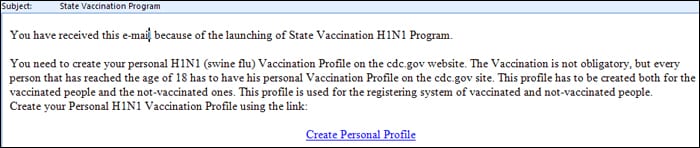
An example of the Phishing email follows:

Sample H1N1 phishing e-mail


===================================================

Personal Note: 


My blogging will be a bit light for the next few days, as my 85-year-old father, and my sister were in a car wreck yesterday.

Both are hospitalized, but neither are in serious condition.

»» Read More