Showing posts with label Liverpool. Show all posts

Pseudo Pandemics And Viral Interlopers


# 5978


With the recent detections of a novel trH3N2 virus (see MMWR dispatch) among a handful of people across four states, today seems like a opportune time to look back at some viral contenders that threatened . . . but failed to produce a full blown pandemic.


Given that surveillance and testing methods have improved over the years, it is possible (perhaps even likely) that similar novel influenza viruses have briefly emerged in the past and simply gone undetected.


image


But interspersed between the pandemics of 1918, 1957, 1968 and 2009 we are aware of at least four other influenza strains that could have sparked a pandemic, but didn’t.


One was extremely mild and widespread, another extremely virulent but geographically limited and short lived, the third disappeared mysteriously, and the fourth affected mostly children and adolescents.


The first example comes from shortly after the end of WWII with what would become known as the `pseudo-pandemic’ or vaccine failure of 1947.


In 1943, the US military – fearing that crowded ships and barracks could give rise to a reprise of the 1918 pandemic – commissioned Dr. Thomas Francis of the University of Michigan and his protégé Jonas Salk to come up with a viable influenza vaccine.  


Within a year a vaccine based on the 1934 and 1943 flu strains was in wide use in the military, and for several years the Francis/Salk vaccine worked well. 


But in 1947, a new variant of the H1N1 virus appeared on military bases – first in Japan – and quickly spread from there infecting hundreds of millions around the globe (see 2002 PNAS article).


While it produced a generally mild illness, and few excess deaths, this new strain apparently had drifted enough antigenically to evade both the vaccine and community immunity acquired from earlier strains.


1947 is little remembered today, except for the lesson it taught us; that vaccines must be updated each year to take into account antigenic drift (or newly emerging flu strains).


Four years later, a far more ominous viral strain made an appearance on the global stage, during what was an otherwise mild and unremarkable 1950-51 flu season. 


This outbreak is commonly called the Liverpool Flu.


For about six weeks, a highly virulent influenza erupted in Liverpool, England and then spread across the UK and to Canada – that for a time was as deadly as the 1918 pandemic.


image


This startling graphic comes from the March 16th, 1951 Proceedings of The Royal Society of Medicinepage 19 – and shows in detail the tremendous spike in influenza deaths in early 1951 over the (admittedly, unusually mild) 1948 flu season. 


The CDC's EID Journal  has a stellar account of this 1951 event, and is very much worth reading.


Viboud C, Tam T, Fleming D, Miller MA, Simonsen L. 1951 influenza epidemic, England and Wales, Canada, and the United States. Emerg Infect Dis [serial on the Internet]. 2006 Apr [date cited].


This aberrant strain never spread much beyond the UK and eastern Canada, and died out as the flu season came to a close. Thankfully, it did not return the following year. 


What made it so virulent, and why it failed to return the following year, remains a medical mystery.


The 1957 and 1968 pandemics – while mild in comparison to the Spanish Flu of 1918 – followed.


In February of 1976, a young recruit at Ft. Dix, New Jersey fell ill and died within 24 hours. The virus went on to infect more than 200 soldiers and caused severe respiratory disease in 13 of them. It circulated on the base for nearly a month.


The virus was isolated and dubbed A/New Jersey/76 (Hsw1N1). How it arrived on the base was unknown. While the death rate was very low, this virus appeared to easily transmissible among humans.


And the fear was, it might develop a higher mortality rate as it mutated.


This led to the swine flu pandemic scare of 1976, which I chronicled several years ago in Deja Flu, All Over Again


The feared swine flu pandemic never materialized, and for reasons we cannot explain, the virus simply disappeared.


But a year later, we did see an epidemic, at least among children, with the return of the H1N1 virus after a 20 year absence.


The 1918 H1N1 virus, and its descendents, monopolized the world’s influenza scene for nearly 40 years until the H2N2 strain appeared in 1957, and replaced it. Another replacement occurred in 1968, when the H3N2 strain supplanted H2N2.


It appeared that in the normal scheme of things, only one major Influenza A strain could circulate at a time.


But that theory was turned on its head when, in 1977, H1N1 resurfaced. How and why it returned is a mystery, although many believe it was the result of an accidental release from a Russian or Chinese research laboratory (see Vince Racaniello’s  Origin of current influenza H1N1 virus).


It was dubbed the `Russian Flu’, and quickly spread among the under-20-somethings who had no immunity. 


But this time things were different. It didn’t replace or drive out the existing (H3N2) virus.


The two strains (H3N2 and H1N1) co-circulated, and since then having two main `A’ strains in circulation (along with some `B’ viruses) has become the norm.


The reason most commonly given is that older people were less affected by the returning H1N1 virus – since those born before 1957 had previous exposure – and so they remained a reservoir of the H3N2 virus.


The seasonal H1N1 virus was supplanted in 2009 by the arrival of the  pandemic H1N1 virus, which, while no longer a pandemic strain, co-circulates today with H3N2.


None of this tells us what will become of the trH3N2 virus we are currently watching, or any of the other novel strains that we’ve seen jump to humans over the past few years.


But it does provide some perspective.


It shows that new, emerging influenza viruses can appear - and even transmit efficiently among humans –and still fail to spark a global pandemic. These viral interlopers can sometimes simply run out of steam and die out, for no discernable reason. 


And even if one spreads globally – as we saw in 1947 – it can turn out to be exceedingly mild.


Of course, the opposite can be true. The pandemics of 1918, 1957, 1968, and 2009 show us that.


The bottom line is that influenza viruses are notoriously unpredictable. They certainly deserve our attention and respect.


Whether trH3N2 becomes a contender, or ends up a footnote in the history of influenza, is something we will have to wait to see.


But with a wide constellation of viruses out there, constantly evolving, looking for new hosts and an evolutionary advantage, the smart money is on being prepared.


Because, regardless of its source, pandemics happen.


It’s just a matter of time.

»» Read More

CIDRAP: Conflicting Theories On the 1918 Pandemic


# 5875


The largest die-off of humans in modern history took place between 1918 and 1919 during the great influenza pandemic. Estimates vary, but most scholars put the number of deaths between 40 million and 100 million worldwide.


More than 90 years later, there is still great disagreement and controversy over exactly what happened.


We know that there was a `herald wave’ in the spring of 1918, with apparently very low mortality.  The flu arrived again in late summer, but this time was far deadlier. This 2nd wave lasted throughout the fall and was followed, in the spring of 1918, by a less severe 3rd wave.


image

Source CDC EID

Almost a century later, many questions abound. 

Was the mild spring wave caused by the same virus as the deadlier wave that appeared in the fall?


If so, why was it so much deadlier in the 2nd wave?


Did catching the milder flu in the spring protect against catching the deadlier fall flu?


As Robert Roos of CIDRAP explains, recent attempts to resolve these questions have returned diverse and conflicting answers. 


At this point I’ll just step out of the way, and invite you to read his terrific report:


Study suggests 1918 flu waves were caused by 'distinct' viruses


The 1951 flu season mentioned by John Barry in this article, where the seasonal flu inexplicably turned deadly across England and parts of eastern Canada for about 6 weeks, remains one of the great medical mysteries of the 20th century.


I’ve written about this event several times (see UK: Revisiting An Earlier Flu Epidemic and  Sometimes . . . Out Of The Blue), but briefly:


During an otherwise unremarkable and mild influenza season, for about six weeks a highly virulent influenza erupted in Liverpool, England and then spread across the UK and to Canada – that for a time was as deadly as the 1918 pandemic.


image

This startling graphic comes from the March 16th, 1951 Proceedings of The Royal Society of Medicinepage 19 – and shows in detail the tremendous spike in influenza deaths in early 1951 over the (admittedly, unusually mild) 1948 flu season. 


The CDC's EID Journal  has a stellar account of this 1951 event, and is very much worth reading.


Viboud C, Tam T, Fleming D, Miller MA, Simonsen L. 1951 influenza epidemic, England and Wales, Canada, and the United States. Emerg Infect Dis [serial on the Internet]. 2006 Apr [date cited].


This aberrant strain never spread much beyond the UK and eastern Canada and died out as the flu season came to a close. Thankfully, and for reasons that remain a mystery,  it did not return the following year.


What made it so virulent remains unknown, but it serves as a stark reminder that influenza can be unpredictable, and that even a mild season can turn deadly without warning.


For those who like their science neat and tidy, devoid of ambiguity, and rock solid . . .  dueling studies such as the ones described above are no doubt more than a little disconcerting.


And we’ve seen similar (unresolved) debates over the efficacy of Tamiflu, the value of surgical masks in preventing respiratory infections, and the effectiveness of flu vaccines.


A few previous blogs on these uncertainties include:


RCTs: All That’s Gold Standard Doesn’t Glitter

When Studies Collide (Revisited)

When Studies Collide


None of this is intended to suggest that scientific research is useless, or fundamentally flawed.


Only that gaining scientific knowledge is a process . . . one that evolves over time and rarely proceeds in a linear fashion . . . and that scientific certainty is an elusive, sometimes unobtainable goal.


So the next time you see a study cited here (or any place else for that matter), keep in mind that while it may be useful . . . and it might even be correct . . .  


You can’t count on it being the last word on the subject.

»» Read More

There Once Was A Virus From Norway . . .


There once was a virus from Norway
That spread in a relative poor way
But since influenza can drift
or worse it could shift!
It could always discover one more way


# 5011


The not-unexpected news last week that the 2009 H1N1 virus has `drifted’ slightly (see Eurosurveillance On Recently Isolated H1N1 Mutations), and concerns over the still-rare `Norway’ mutation (see D222G And Deep Lung Infections), remind us that influenza is a moving target and that changes in the virus are not only possible . . . they are inevitable.


Last year, in the opening days of the pandemic, I described (see Pandemic Variables) the process this way.


A pandemic isn’t a static event, and the virus – carried simultaneously by millions of hosts – doesn’t change direction and speed in concert like a school of fish.


Instead, what you have are millions of hosts incubating trillions of virus particles – with mutational changes occurring all of the time.  Most of these changes do not benefit the virus and lead nowhere, but out of trillions of rolls of the dice, some small number do.


It is survival – and propagation – of the biologically fittest.


Evolution in action.


With viruses that are better adapted to humans out-replicating, out-shedding, and out-transmitting lesser versions of the pandemic strain.


And that means that the virus we have in circulation today may not be the same virus we have running around in the fall, next winter, or next year sometime.   We could potentially see changes in virulence or antiviral sensitivity over time.


Prophetic?  


Hardly.  This is a process that happens every year.   Which is why we need a new, and updated, flu vaccine formulation each year.


Most of the time these changes are small, incremental, and have relatively little impact on virulence. 


Rarely, as in the case of a pandemic, we see a major shift in the influenza virus, which can affect its severity or transmissibility (or both).  


But a major shift doesn’t always spark a pandemic. On very rare occasions, the influenza virus can just temporarily go rogue.


Which brings us to one of the great medical mysteries of the last century:  The largely unexplained, but nonetheless fascinating  Liverpool Killer Flu of 1951.

image


This startling graphic comes from the March 16th, 1951 Proceedings of The Royal Society of Medicinepage 19 – and shows in detail the tremendous spike in influenza deaths in early 1951 over the (admittedly, unusually mild) 1948 flu season. 


For most of the world, however, 1951 remained an average flu year.  The dominate strain of influenza that year was the so-called `Scandinavian strain', which produced mild illness in most of its victims.


In fact, if you look at the graph for the United States, running from 1945 to 1956, you'll see nary a blip.


1946-1956


But in December of 1950 a new strain of virulent influenza appeared in Liverpool, England, and by the end of the flu season, had spread across much of England, Wales, Canada and even parts of the US.


The CDC's EID Journal  has a stellar account of this 1951 evemt, and much of what follows I've gleaned from this report:


Viboud C, Tam T, Fleming D, Miller MA, Simonsen L. 1951 influenza epidemic, England and Wales, Canada, and the United States. Emerg Infect Dis [serial on the Internet]. 2006 Apr [date cited].

ABSTRACT

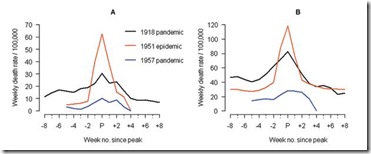
Influenza poses a continuing public health threat in epidemic and pandemic seasons. The 1951 influenza epidemic (A/H1N1) caused an unusually high death toll in England; in particular, weekly deaths in Liverpool even surpassed those of the 1918 pandemic.


We further quantified the death rate of the 1951 epidemic in 3 countries. In England and Canada, we found that excess death rates from pneumonia and influenza and all causes were substantially higher for the 1951 epidemic than for the 1957 and 1968 pandemics (by >50%).


The age-specific pattern of deaths in 1951 was consistent with that of other interpandemic seasons; no age shift to younger age groups, reminiscent of pandemics, occurred in the death rate. In contrast to England and Canada, the 1951 epidemic was not particularly severe in the United States.


Why this epidemic was so severe in some areas but not others remains unknown and highlights major gaps in our understanding of interpandemic influenza.


According to this study, the effects on the city of origin, Liverpool, were horrendous.


In Liverpool, where the epidemic was said to originate, it was "the cause of the highest weekly death toll, apart from aerial bombardment, in the city's vital statistics records, since the great cholera epidemic of 1849" (5). This weekly death toll even surpassed that of the 1918 influenza pandemic (Figure 1)


liverpool


This extraordinary graph shows the excess deaths in Liverpool during this outbreak (red line),  while the black line shows the peak deaths during the 1918 pandemic.  This chart shows excess deaths by   A) respiratory causes (pneumonia, influenza and bronchitis) and B) all causes.


For roughly 5 weeks Liverpool saw an incredible spike in deaths due to this new influenza.   And it did not remain localized to Liverpool. 


While it appears not to have spread as easily as the dominant Scandinavian strain, it managed to infect large areas of England, Wales, and Canada over the ensuing months.


The authors of this study describe the spread of this new influenza:


Geographic and Temporal Spread

Influenza activity started to increase in Liverpool, England, in late December 1950 (5,13). The weekly death rate reached a peak in mid-January 1951 that was ≈40% higher than the peak of the 1918–19 pandemic, reflecting a rapid and unprecedented increase in deaths, which lasted for ≈5 weeks [5 ] and Figure 1).


Since the early 20th century, the geographic spread of influenza could be followed across England from the weekly influenza mortality statistics in the country's largest cities, which represented half of the British population (13). During January 1951, the epidemic spread within 2 to 3 weeks from Liverpool throughout the rest of the country.


For Canada, the first report of influenza illness came the third week of January from Grand Falls, Newfoundland (19). Within a week, the epidemic had reached the eastern provinces, and influenza subsequently spread rapidly westward (19).


For the United States, substantial increases in influenza illness and excess deaths were reported in New England from February to April 1951, at a level unprecedented since the severe 1943-44 influenza season. Much milder epidemics occurred later in the spring elsewhere in the country (9).


For reasons we don't understand, this new strain never managed to spread much beyond England, Wales, Canada, and parts of New England.


It dissipated as suddenly as it appeared, failing to return the following year.


Whatever change or mutation sparked this sudden surge in virulence remains a medical mystery.


None of this is offered as a prediction as to what the H1N1 virus will do next. Frankly, I’ve no special insight into what the recently reported swine flu variant, or the `Norway D222G’ mutation will mean over time.


I present this bit of influenza lore simply because I find it intriguing, and it demonstrates that even seasonal flu can be a highly unpredictable, and oft times dangerous pathogen.


Even in a non-pandemic influenza season.

»» Read More