Showing posts with label ACIP. Show all posts

ACIP Broadens Adult Immunization Recommendations


image

Photo Credit PHIL

# 6113


ACIP, the CDC's Advisory Committee on Immunization Practices, has published their revised recommendations for adult immunizations today in the February 1st edition of the Annals of Internal Medicine.


Among the changes, ACIP now recommends routine HPV vaccination for males aged 11 to 12 years, and has broadened their recommendations for administering the Hepatitis B vaccine.


The entire recommendation can be read at:


Recommended Adult Immunization Schedule: United States, 2012*

  1. Advisory Committee on Immunization Practices†


But for the short version, we have this press release from the American College of Physicians.


2012 adult immunization schedule broadens recommendations for HPV and hepatitis B vaccinations

Annals of Internal Medicine early release article for Feb. 1, 2012

Philadelphia, February 1, 2012 – The CDC's Advisory Committee on Immunization Practices (ACIP) now recommends routine HPV vaccination for males aged 11 to 12 years and catch-up vaccination for males aged 13 to 21. These are just two of the changes to the 2012 Recommended Adult Immunization Schedule being published February 1 in Annals of Internal Medicine (www.annals.org), the flagship journal of the American College of Physicians (ACP).


In addition to the changes in the HPV vaccine, the ACIP now recommends vaccination against Hepatitis B for adults younger than age 60 who have diabetes, as soon as possible after diabetes is diagnosed. Hepatitis B vaccinations should also be given to adults with diabetes aged 60 years or older based on a patient's need for assisted blood glucose monitoring, likelihood of acquiring hepatitis B, and likelihood of immune response to vaccination.


The ACIP is comprised of the ACP and 16 other medical societies representing various medical practice areas. Each year, the ACIP reviews the CDC's Recommended Adult Immunization Schedule to ensure the schedule reflects current clinical recommendations for licensed vaccines. The recommendations are intended to guide physicians and other clinicians about the appropriate vaccines for their adult patients. In October 2010, the ACIP adopted an evidence-based process that considers quality of evidence, benefits and harms, values and preferences of affected populations, and economic impact. Voting to expand routine HPV vaccination to males and hepatitis B vaccinations to young adult diabetics was the first exercise of this approach.


Changes were also made to when mothers should receive the tetanus, diphtheria, and acellular pertussis (Tdap) booster that is designed to protect infants from pertusiss. According to the 2012 schedule, women should receive the vaccine during pregnancy, preferably after 20 weeks of gestation. Protective maternal antibodies will pass to the fetus.


Adult patients should continue to be vaccinated against influenza. Egg allergy is no longer a contraindication, but patients with an egg allergy should get the inactivated flu shot because that is what has been studied.


A footnote was added to the schedule directing readers to links for the full ACIP vaccine recommendations. Specific vaccine recommendations for travelers also were added. In another new addition, the schedule now includes a table summarizing precautions and contraindications for vaccines.

###

The full 2012 Recommended Adult Immunization Schedule can be viewed at www.annals.org.

»» Read More

MMWR: ACIP Updated Flu Vaccination Recommendations


# 5764


ACIP, the Advisory Committee on Immunization Practices, issued their recommendations that practically everyone over the age of 6 months receive a yearly flu vaccine back in 2010.  


ACIP reinforces that recommendation in today’s release of the CDC’s MMWR providing updated guidance for the approaching flu season.  


Prevention and Control of Influenza with Vaccines: Recommendations of the Advisory Committee on Immunization Practices (ACIP), 2011

Early Release

August 18, 2011 / 60(Early Release);1-6


(EXCERPTS)

Vaccine Strains for the 2011--12 Influenza Season

The 2011--12 U.S. seasonal influenza vaccine virus strains are identical to those contained in the 2010--11 vaccine. These include A/California/7/2009 (H1N1)-like, A/Perth/16/2009 (H3N2)-like, and B/Brisbane/60/2008-like antigens. The influenza A (H1N1) vaccine virus strain is derived from a 2009 pandemic influenza A (H1N1) virus (3).

Recommendations for Vaccination

Routine annual influenza vaccination is recommended for all persons aged ≥6 months (1). To permit time for production of protective antibody levels (4,5), vaccination should optimally occur before onset of influenza activity in the community, and providers should offer vaccination as soon as vaccine is available. Vaccination also should continue to be offered throughout the influenza season.


Although influenza vaccine strains for the 2011--12 season are unchanged from those of 2010--11, annual vaccination is recommended even for those who received the vaccine for the previous season. Although in one study of children vaccinated against A/Hong Kong/68 (H3N2) virus, vaccine efficacy remained high against this strain 3 years later, the estimated efficacy of vaccine decreased over the seasons studied (6). Moreover, several studies have demonstrated that postvaccination antibody titers decline over the course of a year (7--10). Thus, annual vaccination is recommended for optimal protection against influenza.

Vaccine Doses for Children Aged 6 Months Through 8 Years

Children aged 6 months through 8 years require 2 doses of influenza vaccine (administered a minimum of 4 weeks apart) during their first season of vaccination to optimize immune response. In a study of children aged 5 through 8 years who received trivalent inactivated vaccine (TIV) for the first time, the proportion of children with protective antibody responses was significantly higher after 2 doses than after 1 dose (11).

(Continue . . .)


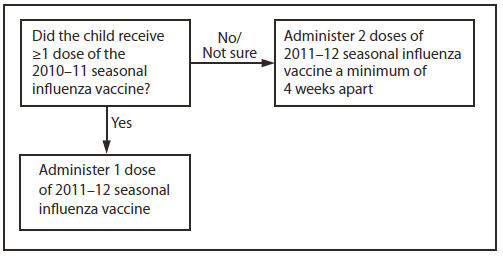
The figure shows an influenza vaccine dosing algorithm for children aged 6 months through 8 years. If the child did not receive ≥1 dose of the 2010-11 seasonal influenza vaccine or if the provider is not sure, 2 doses of 2011-12 seasonal influenza vacine should be administered a minimum of 4 weeks apart. If the child did receive ≥1 dose of the 2010-11 seasonal influenza vaccine, 1 dose of 2011-12 seasonal influenza vacine should be administered.

FIGURE 1. Influenza vaccine dosing algorithm for children aged 6 months through 8 years --- Advisory Committee on Immunization Practices (ACIP), 2011--12 influenza season


This ACIP release also focuses on those with egg allergies, who in the past have been advised against taking the flu vaccine.


Recent studies have indicated that many with mild to moderate allergies to eggs can safely take the flu vaccine, and so this release offers the following recommendations.


Recommendations Regarding Persons with Egg Allergy

Each of the following recommendations applies when considering influenza vaccination of persons who have or report a history of egg allergy.

  1. Persons who have experienced only hives following exposure to egg should receive influenza vaccine with the following additional measures (Figure 2):
    a) Because studies published to date involved use of TIV, TIV rather than LAIV should be used.
    b) Vaccine should be administered by a health-care provider who is familiar with the potential manifestations of egg allergy.
    c) Vaccine recipients should be observed for at least 30 minutes for signs of a reaction following administration of each vaccine dose.
    Other measures, such as dividing and administering the vaccine by a two-step approach and skin testing with vaccine, are not necessary.

  2. Persons who report having had reactions to egg involving angioedema, respiratory distress, lightheadedness, or recurrent emesis, or persons who required epinephrine or other emergency medical intervention, particularly those that occurred immediately or within minutes to hours after egg exposure are more likely to have a serious systemic or anaphylactic reaction upon reexposure to egg proteins. Before receipt of vaccine, such persons should be referred to a physician with expertise in the management of allergic conditions for further risk assessment (Figure 2).

  3. All vaccines should be administered in settings in which personnel and equipment for rapid recognition and treatment of anaphylaxis are available. ACIP recommends that all vaccination providers be familiar with the office emergency plan (18).

  4. Some persons who report allergy to egg might not be egg allergic. Those who are able to eat lightly cooked egg (e.g., scrambled eggs) without reaction are unlikely to be allergic. Conversely, egg-allergic persons might tolerate egg in baked products (e.g., bread or cake); tolerance to egg-containing foods does not exclude the possibility of egg allergy (35). Egg allergy can be confirmed by a consistent medical history of adverse reactions to eggs and egg-containing foods, plus skin and/or blood testing for immunoglobulin E antibodies to egg proteins.

  5. A previous severe allergic reaction to influenza vaccine, regardless of the component suspected to be responsible for the reaction, is a contraindication to receipt of influenza vaccine.

»» Read More

OAHPP & ACIP Media Events


# 5633


A brief head’s up on two upcoming media events you can access via the Internet.


First up, later today (June 16th) there will be a free webinar and Teleconference as part of the OAHPP (Ontario Agency for Health Protection and Promotion) Grand Rounds that will provide the latest information on last week’s announced reassortment between the pH1N1 and seasonal H3N2 virus in Canada.


Registration is Free and Easy on the Eventbrite website

The details from the webinar announcement follow:


OAHPP Rounds: pH1N1 – H3N2: A Novel Influenza Virus Reassortment


Thursday, June 16, 2011 from 12:00 PM - 1:00 PM (ET)
Toronto Ont.,

Presenter:

Dr. Jonathan Gubbay- Medical Microbiologist, OAHPP

Discussant:

Dr. Natasha Crowcroft- Director, Surveillance and Epidemiology, OAHPP

Abstract

Dr. Jonathan Gubbay, medical microbiologist at the Toronto Public Health Laboratory, will present on a new influenza virus that has been discovered by the Ontario Agency for Health Protection and Promotion (OAHPP). It is the first Canadian confirmed finding of a patient with a coinfection of seasonal H3N2 and pH1N1 followed by reassortment. To the best of our knowledge, this is the first case ever reported globally. The sample was submitted to OAHPP laboratories and testing identified co-infection and reassortment of the two viruses. These results were validated by National Microbiology Laboratory in Winnipeg.


The new virus is a hybrid of two viruses currently circulating in humans, both of which are covered by the current seasonal influenza vaccine (the H3N2 virus and the H1N1 virus). There have been no reports of additional cases or human-to-human transmission. Dr. Gubbay will be discussing the above case as well as molecular changes within the seasonal H3N2 influenza that have been seen this season.


Dr. Natasha Crowcroft will be the discussant, commenting on the public health significance of this finding.


Also, next week is the CDC’s big ACIP meeting, which has a wide variety of immunization issues on the agenda, including presentations and/or discussions on the Herpes Zoster, Varicella, Meningococcal, MMR, Pertussis, HPV and Influenza vaccines.


CDC's Advisory Committee on Immunization Practices Meeting

Please Note the Need to RSVP

WHAT

Meeting of the Advisory Committee on Immunization Practices (ACIP)

WHEN

Wednesday and Thursday, June 22-23, 2011, from 8:00am to 5:30pm ET

WHERE

Centers for Disease Control and Prevention
1600 Clifton Road NE
Atlanta, GA 30329
Tom Harkin Global Communications Center (Building 19)
For directions to CDC, please visit
http://www.cdc.gov/about/resources/visitGuide.htm#direction.

WEBSTREAM

If you cannot attend the meeting in person, it will be webstreamed. More information can be found at http://www.cdc.gov/vaccines/recs/acip/downloads/internet-access-instruc.pdf.

BACKGROUND

An agenda for the meeting can be found at http://www.cdc.gov/vaccines/recs/acip/.

»» Read More

The Monsters Are Due On Vaccine Street


# 5023


image


Fear and hysteria are wonderful weapons - and can undermine the sensibilities of even normally reasonable people -  as Rod Serling demonstrated so aptly in the classic 1960 episode of the Twilight Zone, The Monsters are Due on Maple Street.


All it takes is for someone to instill a bit of doubt .  . .   a modicum of suspicion . . .  backed up by random, but seemingly connected events . . . and our insecurities, fears, and prejudices do the rest.


In the 1950s, our collective paranoia was focused externally  . . . on the communist threat, and on nuclear annihilation.


Today, our animus is more likely to be reserved for our own government, and for large, profitable corporations (who we all know are evil incarnate). 


Over the past couple of decades, we’ve become generation X-files, where we believe there is a governmental conspiracy behind absolutely everything.


Belief in these all-powerful, manipulative, and evil plots gives us comfort, I suppose . . . since they absolve us of any responsibility for our own failings and disappointments.


We shake our fists and rail at `them’ because it’s so much easier than dealing with the alternative.


And it is at this point that I must admit to not being completely immune to this collective form of insanity.


While I like to think of myself as being strictly an `evidence based’, rational thinker . . . I’m willing to at least entertain the idea that some conspiracy theories are more `plausible’ than others.


I’m just damn selective in what unsupported scenarios I’m willing to abide (or worse, embrace), and try to show a little restraint in publicly voicing them.


It’s one thing to believe in a theory when there is little evidence to the contrary, but quite another when the evidence is overwhelmingly against it.


But for the anti-vaccine contingent, that doesn’t seem to be much of an impediment.  


Practically every day I see articles on the internet purporting to tell the `truth’ about vaccines, and in nearly every case it is about as far removed from the truth as you can get and still remain on this planet.


Their techniques are simple, but effective. 


First, they use  biased and inflammatory language, filled with incendiary adjectives like `deadly’, `useless’, `dangerous’, or `untested’ practically anytime the word `vaccine’ is used.


Second, they build a straw man, by claiming that vaccines are supposed to be 100% safe and effective (which no one in medicine claims), and then proceed to knock that down with some story about a purported bad reaction or side effect.


And third . . . and used with great effect online . . . they cherry pick a news article that somehow bolsters their claims, without acknowledging any evidence to the contrary.


An ongoing example are the stories proliferating on the Internet claiming that Australia Banned The 2010 Flu Vaccine due to side effects.


A quick Google of `Australia banned vaccine’ comes up with these top 4 web headlines.


About 252,000 results (0.18 seconds)

Australian Health Authorities Banned The 2010 Flu Vaccine

Flu Vaccine Banned in Australia but safe in the US?????

Australia bans flu vaccines in children after vomiting, fevers ...

Australian Health Authorities Banned The 2010 Flu Vaccine


Is it true?    Well . . . no, not really.


A temporary moratorium was put in place on giving the 2010 flu shot to children under the age of 5 after an unusual number of febrile convulsions were observed (see Australia Investigating Adverse Vaccine Reactions).


That moratorium was LIFTED a full month before these web stories appeared (see Ban on flu vaccine for young children lifted), after only CSL’s Fluvax was found to have caused an unusual number of reactions.  


But those are just messy details that get in the way of a good story.


The Narcolepsy-Pandemrix story from last August is another example.


Questions were raised about the H1N1 Pandemrix vaccine after a small, but unusual number of cases of narcolepsy were observed in Finland, Sweden and France.  


The anti-vaccine forces immediately started calling this a `probable link’, even though there was no evidence to support that assertion. 


In fact, within a couple of weeks it became apparent that any evidence of a link – if one exists at all – is pretty darn faint (see EMA Update On The Pandemrix-Narcolepsy Investigation and Sweden: No Link Between Pandemrix And Narcolepsy).


Yes, studies are ongoing.  And it is possible that some link may be established in the future.   But right now, there is no `probable link’.


Today a `shocking report’ is making the rounds that more than 3,500 miscarriages and/or still births may have been caused by last year’s H1N1 vaccine in the United States.  I’m hesitant to even provide a link to this story, but here it is nonetheless.


Go ahead and read it.  I’ll wait.


The story demonizes the CDC, ACIP, and of course, flu vaccines by quoting an activist organization (NCOW) – using their own polling and data from VAERS reports – that has estimated that 1588 fetal deaths may have been caused by the vaccine.  


What this story doesn’t tell the reader is that there are nearly 1 million miscarriages every year in the United States.  Roughly 2,500 a day.


And if you vaccinated all of the pregnant women in the country today, tomorrow, 2,500 would have a miscarriage. 


And 2,500 would the day after that, and another 2,500 the next day . . .


And it would have nothing to do with having taken the vaccine.


Could the flu vaccine have contributed to some small number of miscarriages?


Well, yes.  It is certainly possible.


But that sort of thing is awfully hard to accurately ascertain when we are talking about 1,500 possible cases amongst a background rate of 1 million miscarriages a year.


But you don’t need proof to bring out the monsters on to Vaccine Street. 


All you need is the allegation.


Never mind the good that vaccines do, or the lives they save (subjects rarely addressed by the anti-vaccine crowd).  If they are shown to be anything less than perfect - or not 100% benign - they are apparently worthy of our suspicion and mistrust.


A impossibly high standard, by the way, that no medicine or drug can hope to reach.


In searching for a closing for this blog, I can come up with nothing that comes close to the closing narration by that master of prose . . . Rod Serling, from more than 50 years ago.


“The tools of conquest do not necessarily come with bombs and explosions and fallout. There are weapons that are simply thoughts, attitudes, prejudices, to be found only in the minds of men.


For the record, prejudices can kill and suspicion can destroy, and a thoughtless, frightened search for a scapegoat has a fallout all of its own - for the children, and the children yet unborn.


And the pity of it is that these things cannot be confined to the Twilight Zone”


A pity, indeed.


Note: This first week of November a number of vaccine critics have announced their intent to promote an Internet `Vaccine Awareness Week’ to promote their agenda.


Hence my humble offering this morning.

»» Read More

CDC Podcast: ACIP Vaccination Recommendations


# 4936


The CDC  provides a wide variety of health-related podcasts for the public – and in some cases, for clinicians – on their website.  Some are just audio files (MP3) while others are offered as videos as well.


Most are short, running less than 10 minutes. 


Recent topics include Recognizing Whooping Cough, Bloodstream Infections with Mycobacterium Tuberculosis among HIV patients, and Type 2 Diabetes Mellitus and Increased Risk for Malaria Infection.


An eclectic selection, but just a small sample of hundreds available. To view the latest offerings use THIS LINK.


With the flu season just ahead, one of the offerings this week is a 4-minute briefing for clinicians on this years’ ACIP flu vaccination recommendations.


While produced for Health Care Providers, these clinician’s podcasts are also available to the general public. 


Influenza 2010-2011: ACIP Vaccination Recommendations

In this podcast targeted to clinicians, Dr. Joe Bresee discusses who should be vaccinated against seasonal flu during the 2010-2011 season. He explains who is at risk for severe illness from the flu and discusses the benefits of vaccination.

In this podcast targeted to clinicians, Dr. Joe Bresee discusses who should be vaccinated against seasonal flu during the 2010-2011 season. He explains who is at risk for severe illness from the flu and discusses the benefits of vaccination. Created: 9/22/2010 by National Center for Immunization and Respiratory Diseases (NCIRD). Date Released: 9/23/2010. Series Name: CDC Featured Podcasts.

More info on this topic


image

Running time = 4:41

To save the Podcast, right click the "Save this file" link below and select the "Save Target As..." option.

save Save This File (4MB) [right click]

»» Read More

ACIP Adjusts Pediatric Flu Vaccine Recommendations


# 4674


Yesterday ACIP  (the CDC’s Advisory Committee on Immunization Practices) made a small adjustment to this fall’s seasonal flu vaccine recommendations for children under the age of 10.


In a non-unanimous decision (10-5), the panel voted that children who didn’t receive at least one dose of the H1N1 pandemic vaccine last year should receive two doses of the trivalent seasonal vaccine this year.


Those that already received the monovalent H1N1 vaccine would only need one shot. 


Lisa Schnirring of CIDRAP has the details, along with some information on studies being conducted by the CDC  on CSL’s trivalent vaccine which produced an unusually high number of side effects (mostly fever) in Australian children under the age of five.


CDC advisors tweak seasonal flu vaccine advice for young kids

Lisa Schnirring * Staff Writer

Jun 24, 2010 (CIDRAP News) – Aiming to close some of the gaps in protection against the pandemic H1N1 virus expected to circulate this fall, a federal vaccine advisory group today recommended that children aged 6 months to 9 years who haven't received at least one dose of monovalent pandemic vaccine receive two doses of the upcoming season's trivalent vaccine.


The Centers for Disease Control and Prevention's (CDC's) Advisory Committee on Immunization Practices (ACIP) made the recommendation at its meeting today after seeing the most recent immunogenicity data for the pandemic vaccine. Though it was 62% protective among all age-groups after one dose, rates were lower in younger children. Some CDC experts said this supports the recommendation for a 2-dose, prime-boost pandemic immunization strategy for children 6 months to 9 years old.

(Continue . . .)

»» Read More

ACIP Provisional Influenza Vaccine Recommendations


# 4400


Before you skip past what sounds like it will be a boring and routine report . . . read on. 


There’s some news to be had here.


Aside from recommending nearly universal flu vaccinations (just about everyone over the age of 6 mos.), ACIP (Advisory Committee on Immunization Practices) has announced the availability of a high dose flu vaccine for the 2010-11 season for those over the age of 65.


One of the concerns about the flu vaccine has been the less robust immune response in those (traditionally) most at risk from influenza – the elderly.


While a healthy adult under the age of 65 may see a 70%-90% level of protection from a well-matched flu vaccine, those over the age of 65 often see far less.   

A few choice blogs on this topic include:


Another Study: Flu Vaccines Do Not Reduce Mortality Rates In The Elderly


Study: Flu Vaccines And The Elderly


Flu Shots For The Elderly May Have Limited Benefits


Roughly 18 months ago we learned (see Vaccines: Sometimes You Just Need A Bigger Hammer) of a study conducted by Sanofi-Pasteur where several thousand people over the age of 65 were given a flu vaccine with 4 times the antigen of a standard shot.  


Instead of 15ug of antigen per strain, these shots contained 60ug.


Those who received the stronger shot developed a significantly stronger immune response than those who received the standard dose.


The FDA approved the use of Sanofi’s High Dose Fluzone last December.


FDA PRESS RELEASE

For Immediate Release: Dec. 23, 2009

FDA Approves A High Dose Seasonal Influenza Vaccine Specifically Intended for People Ages 65 and Older

Accelerated approval process used in vaccine approval

The U.S. Food and Drug Administration today approved Fluzone High-Dose, an inactivated influenza virus vaccine for people ages 65 years and older to prevent disease caused by influenza virus subtypes A and B.

People in this age group are at highest risk for seasonal influenza complications, which may result in hospitalization and death. Annual vaccination remains the best protection from influenza, particularly for people 65 and older.

(Continue . . . )


ACIP has not expressed a preference for the new High Dose Fluzone for those over 65, so eligible recipients should discuss that option with their personal physician.


It will likely take a year or more before scientists can assess the impact of this higher dose flu vaccine. 


Here then are the Provisional recommendations for the upcoming flu season, released yesterday. 


ACIP Provisional Recommendations for the Use of Influenza Vaccines

Date of ACIP vote: February 24, 2010 Date of posting of provisional recommendations: March 2, 2010


Tentative date of publication of recommendations in CDC Morbidity and Mortality Weekly Report: June 2010


On February 24, 2010, the ACIP voted on updated recommendations for use of trivalent seasonal influenza vaccine for the 2010-2011 influenza season.


Provisional recommendations for the prevention and control of seasonal influenza (2010-2011 influenza season):


Vaccination recommendations for adults were expanded to include all adults beginning in the 2010-11 influenza season.

Therefore, all people age 6 months and older are now recommended to receive annual influenza vaccination.


Background information on influenza vaccines

•The 2010–2011 trivalent vaccines will contain A/California/7/2009 (H1N1)-like, A/Perth/16/2009 (H3N2)-like, and B/Brisbane/60/2008-like antigens. Compared to the 2009-10 Northern Hemisphere influenza vaccine, the influenza A(H1N1) and A(H3N2) strains are changed. The A/California/7/2009 (H1N1)-like strain is the same strain that was included in the pandemic influenza A(H1N1) 2009 monovalent vaccines.


•A higher dose formulation of an inactivated seasonal influenza vaccine (Fluzone High-Dose, manufactured by sanofi pasteur, licensed by FDA on December 23, 2009) for use in people age 65 years and older will be available in the 2010-11 influenza season.∗ Fluzone High-Dose contains four times the amount of influenza antigen compared to other inactivated seasonal influenza vaccines. Fluzone High-Dose vaccine in one study of people age 65 years and older produced higher antibody levels, but slightly higher frequency of local reactions. Studies are underway to assess the relative effectiveness of Fluzone High-Dose compared to standard dose inactivated influenza vaccine, but results from those studies will not be available before the 2010-11 influenza season. The ACIP has not expressed a preference for Fluzone High-Dose or any other licensed inactivated influenza vaccine for use in people age 65 and older.


•An additional inactivated vaccine (Agriflu, manufactured by Novartis, licensed by FDA on November 27, 2009) will be available in the 2010-11 influenza season.† Agriflu is licensed for use in people age 18 years and older.


•Age indications for two inactivated influenza vaccines have changed. Afluria, manufactured by CSL Vaccines, is now licensed for use in people age 6 months and older. Fluarix, manufactured by GSK Biologicals, is now licensed for use in people age 3 years and older.


∗ Fluzone High-Dose has been licensed by FDA, but will not be available until the 2010-11 influenza season.
† Agriflu has been licensed by FDA, but will not be available until the 2010-11 influenza season.

»» Read More

ACIP Recommends Near `Universal’ Flu Vaccinations


# 4384


ACIP, the Advisory Committee on Immunization Practices, yesterday came forth with a long anticipated recommendation that just about all Americans over the age of 6 months should receive a yearly flu vaccination.


Maggie Fox, science and health editor for Reuters, brings us the details in her story.


UPDATE 1-Everyone in US should get flu vaccine - experts

Thu Feb 25, 2010 1:44am GMT

(Updates with vote on flu vaccine)

* 97 million H1N1 vaccines administered in U.S.

* Deaths could exceed normal seasonal flu year

* Obese and children at highest risk

By Maggie Fox, Health and Science Editor

WASHINGTON, Feb 24 (Reuters) - Everyone in the United States over the age of six months should get seasonal influenza vaccines every year, federal vaccine advisers said on Wednesday.


The Advisory Committee on Immunization Practices made the long-awaited vote to recommend virtually universal flu vaccination -- something public health experts have long recommended.


"The new recommendation seeks to remove barriers to influenza immunization and signals the importance of preventing influenza across the entire population," the U.S. Centers for Disease Control and Prevention said in a statement.


Earlier, experts told the committee that people who were morbidly obese and school-aged children were much more likely to become seriously ill or to die from H1N1 swine flu, as opposed to seasonal flu, which mostly kills the frail elderly.

(Continue . . .)


Two additional points are  brought out in this article.


First, Maggie reports that H3N2 is on the rise in China, accounting now for about 6% of their influenza cases.  This suggests that reports of seasonal flu’s demise may yet be premature.


Second is that the pandemic death toll in the United States – now estimated at near 17,000 – may be revised upward over the coming months and may exceed the 36,000 deaths we `expect’ from an average flu season.


(36K deaths is the CDC’s yearly estimate of flu deaths.  Not a count)


While many have been quick to latch onto early numbers and jump to conclusions regarding the impact and severity of this pandemic, the simple truth is that it will take months – likely years – before we can analyze most of the data.


Until then, pronouncements regarding this pandemic need to be viewed as preliminary at best.

»» Read More

CDC Reports On Ethnic Impact Of H1N1 At ACIP Meeting


# 3871


ACIP, the CDC’s Advisory Committee on Immunization Practices, has just concluded a two-day meeting. 


This meeting dealt with issues such as the HPV (Human Papillomavirus), the 2010 childhood immunization schedule, Meningococcal vaccines, RotaVirus, the PCV13 pneumonia vaccine, along with influenza vaccines.


Lisa Schnirring of CIDRAP News brings us details on some of the epidemiological information presented today, including the ethnic impact of the H1N1 virus.


I’ve just posted the opening paragraphs, follow the link to read Lisa’s report in its entirety.


CDC notes change in ethnic pattern of H1N1 impact

Lisa Schnirring * Staff Writer

Oct 22, 2009 (CIDRAP News) – The Centers for Disease Control has seen a change in the ethnic distribution of fatal pandemic H1N1 influenza cases, a CDC official reported at a meeting of its vaccine advisory committee today.


In an update on epidemiologic patterns in the pandemic H1N1 outbreak, Lyn Finelli, PhD, head of surveillance for the CDC's Influenza Division, told the Advisory Committee on Immunization Practices (ACIP) that the high-risk groups haven't changed since the spring wave.


However, the impact of the virus on racial groups has changed some since the first wave, she told the group, whose meeting was streamed over the Web. Hispanic people had a higher proportion of deaths in the spring, probably because they had connections to people traveling to and from Mexico, where the outbreak is thought to have started. While the number of deaths in Hispanic people has fallen, since September the rate has risen among African Americans, Finelli said. She said the CDC tracks trends through the Behavioral Risk Factor Surveillance System.


(Continue . . .)


»» Read More