Showing posts with label Plague. Show all posts

Peru: Alert For Bubonic Plague In Ascope Region

image

Credit CDC


# 6704


Despite having effective medications to treat it, bubonic plague still claims a fair number of lives each year around the world. While occasionally seen in the United States, it is far more common in other parts of the world.


According to the CDC: Between 1,000 and 2,000 cases each year are reported to the World Health Organization(WHO), though the true number is likely much higher.


The illness is caused by the bacterium, Yersinia pestis, and is most often passed to humans via the bites of infected fleas carried by rodents.


image


A hat tip this morning goes to Gert van der Hoek on Flutrackers for posting a report from El Commercio  on what appears to be a small outbreak of bubonic plague in Ascope province, located in the La Libertad Region of Peru. A brief excerpt:


La Libertad Health Management declared green alert in all health facilities in the region, due to an epidemic outbreak of bubonic plague in the province of Ascope, located an hour from Trujillo .

The alert was given as a preventive measure, after learning that two adults and a child had been infected with the disease last week.


Another source, Correo, carries the following statement from the Health Department.


Freedom in health alert

November 7, 2012 | Trujillo -

To prevent plague generate further deaths, the health sector health alert declared in all health facilities in the region of La Libertad.


According to the resolution regional management No. 2035-2012-GR-LL-GGR-GRSS, signed by the Sector Manager, Henry Rebaza Iparraguirre, declared an epidemiological alert for fever in all health services that integrate the regional grid system Epidemiological Surveillance.


ON ALERT. According to the regional authority, has been detected as endemic areas (where the health situation has made it their living space) to the province of Ascope Cascas and three districts of Alto Chicama (Callancas, Charat and Usquil).


Ensures that the measure seeks to alert the health care network in the region, the presentation of a plague outbreak in the district of Chocope (Ascope) and other infected areas where circulation is determined Yersinia pestis (plague-causing bacteria ) in reservoirs and in areas that are still silent epidemiological department of La Libertad.


"It is necessary to strengthen health services and community participation to have an adequate response capacity and effective, for which public and private institutions must join forces with an integrated work and enterprise," he says.


Finally, said the outbreak of rats in the port of Salaverry and was treated and will be maintained Pest control in the next two weeks.


This is not the first time that bubonic plague has been reported in Peru.  In August of 2010, an outbreak was reported in the same region (Ascope), and involved all three types of plague; bubonic, pneumonic, and septicemic.


This from the World Health Organization’s GAR Alert:


Plague in Peru


10 August 2010 - As of 30 July 2010, the Ministry of Health in Peru confirmed a total of 17 cases of plague in Ascope province of Department La Libertad. Of these, four are pneumonic plague, 12 are bubonic plague and one was septicemic plague. The onset of symptoms for the last reported case of pneumonic plague was on 11 July 2010. During the investigations, 10 strains of Y. pestis were isolated from humans, rodents and domestic cats.


The control measures being implemented include insect control in households located in high risk areas, strengthening of disease surveillance and case management, contact tracing, and sensitization of the affected population.


WHO is working with the Ministry of Health in assisting La Libertad with the outbreak investigation and response activities in affected areas and the surrounding districts.


For a description of the different types of plague, we go to the CDC’s Plague Symptoms Page.


Symptoms

Plague symptoms depend on how the patient was exposed to the plague bacteria. Plague can take different clinical forms, but the most common are bubonic, pneumonic and septicemic.
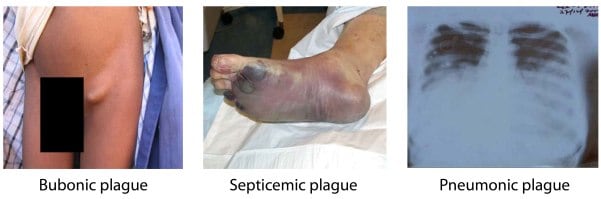
Plague signs


Bubonic plague is the most common presentation. and is named for the characteristic swelling of the lymph nodes (buboes) seen with the illness.  Septicemic plague is an infection of the bloodstream, and can lead to multiple organ failure and death


In some cases, however, Pneumonic Plague may develop. Here the infected person develops a severe pneumonia, with coughing and hemoptysis (expectoration of blood), and may spread the disease from human-to-human.


Luckily modern antibiotics are pretty good at treating plague. Without treatment, however, mortality rates run 40%-60%.  Untreated, pneumonic plague is almost always fatal.


While rare, the United States sees about 7 cases (range 1-17) of plague each year. The CDC has some advice on how to avoid this illness, by way of this 2-page PDF file.


image


While there is no vaccine available, with the advent of effective antibiotics, large scale outbreaks of plague are increasingly rare. 


In 1994 - the last big plague year -India reported more than 5,000 cases (see MMWR  Human Plague -- India, 1994), but since then the numbers reported each year have been considerably reduced.


I confess to having a strong interest in Plague, which stems from my working as a paramedic in Phoenix, Arizona where plague cases are occasionally found, and my reading – at the tender age of 11 – of James Leasor’s  The Plague and The Fire.


image


I’ve no doubt that this account of two incredible years in London’s history (1665-1666) - which began with the Great plague, and ended with the Fire of London – have unduly influenced my life, and interests, over the past 47 years.


Proving, I guess, that we should be careful what we read at an impressionable age.

»» Read More

A Pathogen That Still Plagues Mankind


# 6382


In 1975, after completing my paramedic training in Florida, I was offered an ALS (Advance Life Support) ambulance job in Phoenix, Arizona.


On my first day there, I was given an orientation, which included information about threats I hadn't dealt with in my home state of Florida: Scorpion stings, Gila Monster bites, and bubonic plague.


Albeit rarely, bubonic plague still occurs in the United States. This map, from the CDC, shows areas of the world where plague is endemic, mostly in rodents.


image


The last major urban outbreak of plague in the United States occurred in 1924-25 in Los Angeles.  Since then, only scattered cases have been reported, with about 10-15 cases each year.


Globally, the World Health Organization reports between 1,000 and 3,000 cases occur each year.


Today the Associated Press is reporting on an Oregon man who is hospitalized in critical condition with what appears to be septicemic plague.


Plague: Central Ore. man contracts rare disease

PRINEVILLE, Ore. (AP) — A central Oregon man in his 50s is in critical condition at a Bend hospital after a form of plague infected his blood, according to a Crook County health official.


The disease can spread through contact with a sick animal or a bite from an infected flea. The man, who has not been identified, had contact with a sick cat.

(Continue . . . )


Plague is caused by a gram negative bacteria called Yersinia pestis. There are three types of plague (all caused by the same pathogen); bubonic, septicemic & pneumonic.


From the CDC’s brochure Protect Yourself From Plague, we get the following definitions:

  • Bubonic plague is the most common form of the disease and typically occurs after the bite of an infected lea. The hallmark of bubonic plague is a swollen, painful lymph gland, called a “bubo,” usually in the groin, armpit, or neck. Other symptoms include fever, chills, headache, and extreme exhaustion. A person usually becomes ill with bubonic plague 2 to 7 days after being infected. If not treated early, the bacteria can spread from the bubo to other parts of the body.
  • Septicemic plague occurs when bacteria multiply within the bloodstream. This may occur if bubonic plague is left untreated, but it can also occur in patients without a bubo. Symptoms include high fever, exhaustion, light-headedness and abdominal pain. Septicemic plague can rapidly result in shock and organ failure.
  • Pneumonic plague occurs when the plague bacterium infects the lungs. This happens when bacteria spread through the bloodstream to the lungs or, less often, when bacteria are inhaled directly into the lungs. Symptoms include high fever, chills, cough, breathing difficulty, and bloody sputum. Pneumonic plague is almost always fatal if not treated rapidly.


Although most people are aware that plague is transmitted by the bites of infected fleas (who obtain the plague bacteria from rodents), it can also on rare occasions be transmitted from human-to-human (via droplet or saliva), and and can be contracted from contact with an infected animal, such as a mouse or squirrel. 


While it is uncommon, people can sometimes contract plague from their pets. Cats, which may have contact with infected rodents while roaming, can either bring back infected fleas, or become infected themselves.


The CDC offers the following advice on avoiding plague:

image


The good news is - that if diagnosed and treated early - plague responds well to several common antibiotics. 


My interest in plague began at the tender age of 11 when I read James Leasor’s  The Plague and The Fire.


image

I’ve no doubt that this account of two incredible years in London’s history (1665-1666) - which began with the Great plague, and ended with the Fire of London – have unduly influenced my life, and interests, over the past 45 years.


A cautionary note, I suppose, regarding what one ought to read at an impressionable age.


While Yersinia Pestis is assumed by most scientists to have been the cause of the Black Death of the Middle ages, there remains some controversy on that topic (see EID Journal: A Scholarly Debate).


Last year, Ed Yong, writing for Discover Magazine took a fresh look at the debate in The lost plague – London graveyards suggest that Black Death strain may be extinct.


While not a common disease in the United States, there have been some concerns that climate change could exacerbate the spread of Yersinia infected rodents, and increase the risks of infection (see Climate Change Eyed As Spreading Diseases).


For more on Plague, the CDC’s  DVBID (Division of Vector-Borne Diseases) maintains an extensive website on the pathgoen at:


http://www.cdc.gov/ncidod/dvbid/plague/

»» Read More

Uganda Outbreak Identified As Plague: Officials


UPDATED:  This story has been updated, and the diagnosis remains in doubt.   See OCHA: The Ugandan Outbreak By The Numbers

# 5123


After more than a month of speculation by local health officials and the media, we are seeing reports that officials have tentatively identified the outbreak of disease in the northern Ugandan district of Kitgum as pneumonic plague.


Previous blog entries on this outbreak include:

Updating Uganda’s Mystery Outbreak
Uganda: Unidentified Hemorrhagic Outbreak


A link to the Reuters report (h/t Shiloh on FluTrackers):


Pneumonic plague outbreak in Uganda: officials


Tue Dec 7, 2010 10:19am EST

KAMPALA (Reuters) - Pneumonic plague has broken out in northern Uganda, killing 38 people and putting dozens in hospital, a senior health official said Tuesday.

(Continue . . . )


Treyfish, posting on this FluTrackers thread, has another report from the Newvision website.


Mysterious Acholi disease is plague

By Conan Businge
and Chris Ocowun

PLAGUE, a disease that affects rodents but can be spread to humans and other animals by infected fleas, has hit the northern Ugandan district of Kitgum, the health ministry has confirmed.

(Continue . . .)


Although few people are aware of it, plague cases still occur and claim lives every year around the world. Even on rare occasions, in the United States.


In 1975, after completing my paramedic training in Florida, I was offered an ALS (Advance Life Support) ambulance job in Phoenix, Arizona.


On my first day there, I was given an orientation, which included information about threats I hadn't dealt with in my home state of Florida: Scorpion stings, Gila Monster bites, and bubonic plague.


This map, from the CDC, shows areas of the world where plague is endemic, mostly in rodents.


image


The last major urban outbreak of plague in the United States occurred in 1924-25 in Los Angeles.  Since then, only scattered cases have been reported, with about 10-15 cases each year.


Worldwide, on average, anywhere between 1,000 and 3,000 cases are reported each year.


Bubonic Plague (Yersinia Pestis) is a bacterial infection transmitted by fleas, carried by infected rats.   The infection generally sets up in the lymphatic system, resulting in the tell-tale buboes, or swollen lymph glands in the the groin, armpits, and neck.


In rare cases, however, Pneumonic Plague may develop.  Here the infected person develops a severe pneumonia, with coughing and hemoptysis (coughing up of blood), and may spread the disease from human-to-human.


Luckily modern antibiotics are pretty good at treating bubonic plague. Without treatment, however, mortality rates run 40%-60%.  Untreated, pneumonic plague is almost always fatal.


In 1994, the last big plague year, 5000 suspected cases of bubonic plague and pneumonic plague occurred in Surat, India, with 100 deaths. 

»» Read More

EID Journal: A Scholarly Debate


# 4902


As I’ve pointed out many times in the past, science isn’t absolute, nor is scientific progress linear.   Sometimes the things we think we `know’ turn out to be wrong.


Throughout history we’ve accounts of epidemics and plagues for which medical historians have tried to determine a cause.   Some, like the high mortality `English Sweats’ of the 1500s, remain a mystery to this day.


Since viable tissue samples from victims hundred of years ago are rarely available, and contemporary medical science was practically non-existent, the case for some of these determinations is largely circumstantial.


Roughly 660 years ago a disease swept through Europe killing – in just a matter of five years – between a third and a half of the population.   Some estimates put the toll at between 100 and 200 million deaths.


It was known as the `Black Death’, because of the characteristic dark bubboes (swelling of the lymph nodes) in the neck, armpit, and groin. 


Over the next 500 years, more than 100 smaller outbreaks occurred across Europe and Asia. 


For more than 100 years the cause of this horrific event has been widely accepted as coming from the bites of fleas carrying a bacteria called Yersinia pestis – which they acquired from infected rats. 


Rats that arrived in Europe from the recently opened trade routes from the Orient, where Y. Pestis is endemic in small rodents (the bobak marmot).


This tidy, and widely accepted theory came from the research of scientists who visited Hong Kong in 1994 1894 to investigate an outbreak of plague.  Among them was Alexandre Yersin, from whose name we get Yersina, or Y. pestis.


Over the next ten years, a theory on how the disease was vectored (rats to fleas to human) was developed.


In 1893, before this research began, historian F. A. Gasquet linked the Black Death of the 1300s to the modern outbreaks of plague. Fifteen years later, he was able to adopt the intervening research on Y. Pestis to complete his theory, which is widely accepted today.


Widely . . . but not universally accepted, that is. 


For more than 40 years, contrarian voices have suggested that Y. Pestis – while the cause of modern plague – may not have been behind the Black Death of 660 years ago.


Additionally, new research strongly suggests that body lice might be another vector for Y. Pestis as well.  


All of which brings us to a fascinating debate going on in the pages of the CDC’s EID Journal this month, in a series of letters under:


Body Lice, Yersinia pestis Orientalis, and Black Death

Welford M, Bossak B. Body lice, Yersinia pestis Orientalis, and Black Death [letter]. Emerg Infect Dis [serial on the Internet]. 2010 Oct [date cited]. http://www.cdc.gov/EID/content/16/10/1649.htm
DOI: 10.3201/eid1610.100683

McLean RG, Fall MW. Body lice, Yersinia pestis Orientalis, and Black Death [letter]. Emerg Infect Dis [serial on the Internet]. 2010 Oct [date cited]. http://www.cdc.gov/EID/content/16/10/1649.htm
DOI: 10.3201/eid1610.100822

Drancourt M, Raoult D. Body lice, Yersinia pestis Orientalis, and Black Death [letter]. Emerg Infect Dis [serial on the Internet]. 2010 Oct [date cited]. http://www.cdc.gov/EID/content/16/10/1649.htm
DOI: 10.3201/eid1610.100946


These are short, easy to follow letters debating this medical mystery and raise a lot of questions – some of which have public health implications today.  


Although the debate isn’t settled here, if you like your science just a a tad on the messy side, you’ll want to read them.


Bubonic plague still occurs around the world, of course, although rarely in the United States.  


This map, from the CDC, shows areas of the world where plague is endemic, mostly in rodents.


image


The last major urban outbreak of plague in the United States occurred in 1924-25 in Los Angeles.  Since then, only scattered cases have been reported, with about 10-15 cases each year.


Worldwide, on average, anywhere between 1,000 and 3,000 cases are reported each year.


Today, modern antibiotics are very effective against the plague, and so outbreaks are usually quickly contained.


My interest in Plague stems from working as a paramedic in Phoenix, Arizona where plague cases are occasionally found, and my reading – at the tender age of 11 – of James Leasor’s  The Plague and The Fire.


image


I’ve no doubt that this account of two incredible years in London’s history (1665-1666) - which began with the Great plague, and ended with the Fire of London – have unduly influenced my life, and interests, over the past 45 years.


Proving, I guess, that we should be careful what we read at an impressionable age.

»» Read More